


Dialogue Miner OG Jeremy: Optimistic about gold, silver, and tungsten; focusing on mineral investments using a licensing model
Author: Jianwei Zhizhuo Miscellaneous Talk
Tonight I listened to a blog post that was very interesting, especially the alternative mineral investment models. The essence of investing in minerals—when they truly make big money—is during the production phase, when metal prices rise on top of the initial investment. From a cyclical perspective, early-stage projects before going public are unlikely to attract funds (risks include cycle timing, liquidity, exit timing).
However, under another model, financial instruments are used to separate mineral cycle risks. Many places are exploring this, including the royalty model of mineral investment discussed in this article, which is currently more common overseas.
The host of this discussion, Rob Tyson, is the founder and director of Mining International and Mining International Executive, a leading global mining recruitment and headhunting firm.
The guest, Jeremy Gray, is a highly active mining executive and entrepreneur, currently serving as CEO of multiple companies including Pilar Gold, Pure Tungsten, Tuscano Gold, and Gold Road. He is also the founder of Chancery Royalty.
Jeremy’s business spans various commodities, jurisdictions, and business models, with a current focus on gold, critical minerals like tungsten, and alternative financing structures.
In this conversation, they discuss how Jeremy thinks about building and operating multiple companies simultaneously, why gold and tungsten are important now, the advantages of the royalty model over traditional mining, and his outlook on the next phase of the mining cycle.
Key Points:
1. Views on Gold Price and Market
Jeremy predicts gold will reach $5,000 in the short term, rise to $5,500 before the Chinese New Year (February 17), and possibly hit $7,000 by year-end.
He believes current gold price increases are driven by multiple factors:
-
Chinese demand: actual consumption may be ten times higher than official data.
-
Indian demand: remains strong.
-
Emerging players: such as Tether and central banks increasing gold holdings.
-
Physical gold shortages: for example, the Turkish government is purchasing gold at a premium of 357% over spot prices; Dubai refiners are starting to offer premiums instead of discounts.
He advises not to sell gold easily, believing it is still in the early stages of an upward trend.
2. Views on Silver Market
Silver prices are expected to reach $18–20 per ounce by year-end.
The market has been in a supply shortage for 5–6 years, with large short positions—equivalent to 4–5 years of global production.
Chancery Royalty intentionally includes silver in its portfolio to diversify.
3. Importance of Tungsten and Pure Tungsten’s Positioning
Tungsten faces tight supply because no new mines have come into production in 40 years, and China has shifted from an exporter to a net importer.
Prices have risen from $320 per 10 kg (about $10,000/ton) 18 months ago to $1,050 per 10 kg (about $100,000/ton), far above copper (~$14,000/ton).
Pure Tungsten has a tungsten mine near Almonty’s operations in Korea, which is about to start production, and collaborates with high-grade tungsten projects in Tajikistan.
4. What is the Royalty Model?
The royalty model is lower risk and less stressful compared to traditional mining operations.
Features of Chancery Royalty:
-
Fast transactions: e.g., their deal with Kefi in Ethiopia took only 6 weeks from contact to signing.
-
Low cost: no due diligence fees charged to miners (traditional firms may charge $300,000–$400,000).
-
Retail investor support: relies on retail funds (1,400–1,500 investors), believing retail investors are more reliable than large funds.
The goal is to surpass mid-tier royalty companies like Versamet or Elemental in the medium term.
The “royalty business” is a very important financial and investment model in mining, often called “mining royalties” or “mining rights/royalty business” in Chinese. It involves a royalty company paying an upfront sum to a mining project in exchange for a share of future production.
Core operation modes of royalty investment:
1) Early-stage investment:
Royalty companies (like Jeremy’s Chancery Royalty) provide a one-time, non-repayable cash advance to the miner.
2) Future revenue sharing:
In return, the royalty company gains a long-term right:
-
Royalties: a small percentage (e.g., 1–3%) of the total future sales revenue of the mine. As long as the mine is producing and selling, payments are made proportionally.
-
Metal streams: rights to purchase a specific amount of future production (e.g., gold or silver) at a cost well below market price (e.g., $400 per ounce), then sell at market prices (e.g., $2,300 per ounce) for profit.
Why is this model attractive?
1. For royalty companies (investors):
Light operational burden & high leverage:
Unlike mine operators, they don’t bear operational risks like cost overruns, safety incidents, or resource depletion. They only make financial investments. When commodity prices rise, profits from royalties and streams multiply. No need to participate in daily operations.
Portfolio diversification:
With one investment, they can hold stakes in multiple mines across different regions and minerals, spreading risk. That’s why Jeremy aims to build “the fastest-growing royalty group” in the industry.
2. For miners (mining companies):
Non-dilutive financing:
Unlike issuing new equity, royalties do not dilute existing shareholders.
No debt burden:
The upfront payment is non-repayable; it improves the balance sheet. Payments are only due after successful production.
Fast access to capital:
Jeremy emphasizes his rapid model. Traditional royalty processes are slow and costly; his firm’s royalty deals, like with Kefi, take only 6 weeks from meeting to funding, which is critical in a high gold-price environment.
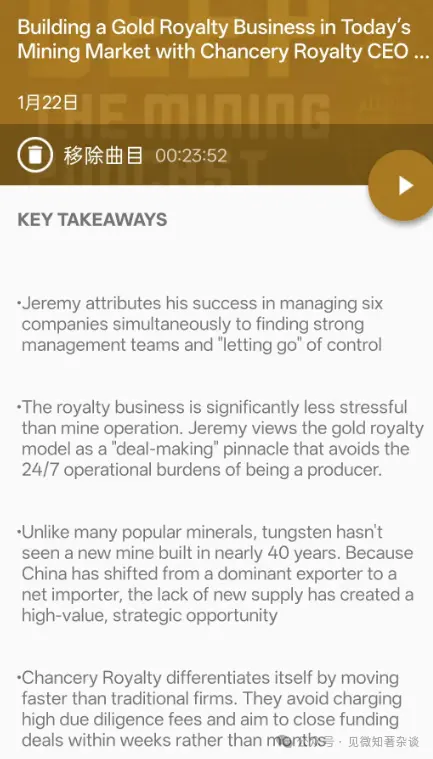
Below is the interview content
Rob Tyson: Could you briefly introduce your career and what you are currently busy with?
Jeremy Gray: Simply put, we own six companies, including four gold mining companies: Pilar Gold, Livergold, Tokano Gold, and Gold Road.
We also have a large tungsten company, Pure Tungsten. We are about to start production near Almonty’s mine in Korea. We believe we will be the next Almonty Industries.
However, I have stepped down from most operational CEO roles to focus 100% on Chancery Royalty. We basically plan to build the fastest-growing gold and silver royalty group in the industry.
Rob Tyson: As I mentioned, your companies involve multiple commodities and now also the royalty sector. How do you manage operating multiple companies and platforms? What guiding principles do you follow across different assets and stages?
Jeremy Gray: I think the key is delegation and letting go—don’t try to control everything. Find strong management teams and empower them.
My main role is to finance them, initiate gold or Korean tungsten projects, then let them operate independently, rather than micromanage.
This model has been running for 7 years with good results. When gold is at $4,400 instead of $1,600, everything moves much faster. When the market is strong and performance is good, just let professionals run the business because Rob, I am not an operator.
I tell you, I listened to your excellent interview with Martin (the guy from Centerman). That’s a real operator. He’s the kind of person we want to hire and include in our portfolio.
But I am just a promoter—I like to do deals, and royalties are the ultimate form of deal-making.
Rob Tyson: Yes. You just mentioned gold prices. In our last episode, you mentioned $5,000 as a target. It’s not quite there yet, but I think it will be soon.
What are your thoughts? Would you like to make a prediction? Why do you think gold prices haven’t reached that level yet?
Jeremy Gray: I believe the target is very close, maybe within 2 to 8 weeks. We expect to hit $5,500 before Chinese New Year (February 17), and ultimately reach $7,000 before Christmas.
I’m increasingly thinking this way, reminiscent of when I bought my first house in Richmond near Melbourne. My brother and I paid $240,000 for it, and three years later, sold it for $650,000, feeling like heroes.
It was a beautiful Victorian-style old house, one of my favorite properties in Melbourne. Now it might be worth $4 million. I think the same attitude should apply to gold: don’t rush to sell.
When everyone says “Oh, 2025 will be a good year, and there won’t be another,”… ah, some gold funds, like Schroder’s Jim Luke fund, have risen 200%, and people say “Jim won’t do that again.”
I bet he will—maybe not 200%, but at least 100%. So I believe we are in the early stages of a very big bull run, and don’t be scared by these high prices—they won’t fall in the short term.
Rob Tyson: Yes, the overseas markets are the same. Continuing on gold, it’s been volatile over the years. How is the current gold environment different? Why should investors pay renewed attention?
Jeremy Gray: Basically, China triggered this rally. Every time I meet Chinese people, I want to hug them, tearfully because they really saved our group. We had a very tough 24 years.
Then the market broke through $2,100, and, you know, the rest is history. But I believe Chinese consumption is at least ten times the official figures. Indian demand remains strong, but now there are players like Tether and central banks buying.
I even heard yesterday that the Turkish government is paying a premium of 3.57% over spot to acquire physical gold. That’s another clear sign: we keep getting calls from Dubai refiners: “Hey, can we be your buyers?”
In the past, they would ask for 4–5% discounts to buy your gold because they “exploited” Africans at 10% discounts. Now they offer premiums of 0.5–1%.
So the market is now all about physical gold replacing paper markets. I think we’ll be surprised.
Rob Tyson: Certainly. Continuing with precious metals, gold is obviously your main commodity. What about silver? What are your views? The silver market has seen many developments, such as China recently requiring a license to export silver.
What’s your take? How does the silver market compare to gold?
Jeremy Gray: So, silver might reach $18–20 by year-end. Supply has been short for 5–6 years. Huge short positions—if you believe in conspiracy theories, current shorting is equivalent to 4–5 years of global mine output.
Gold’s short position might be about 2 years’ worth. So, hmm, I think big banks and investment banks are losing sleep over their short positions.
Yes, silver will definitely go higher. That’s why in Chancery Royalty, we secured a silver by-product purchase right from the lovely Gold Road mine in Arizona, aiming to add some extra appeal to our portfolio.
Rob Tyson: You’re involved in operating, developing, and growing gold projects. How do you view risks and value creation differently between operating assets and development projects? What misconceptions do investors often have about this trade-off?
Jeremy Gray: Good question, Rob. You know, our business model for 7 years has been buying large second-hand gold mines and then scrambling for funding to get them running, buying at 1–2 cents on the dollar.
We’ve never engaged in early-stage development. Pure Tungsten is similar; we merged with Korea’s excellent CEO Tiger Kim’s TBI, which owns fully built mines and processing plants.
So we usually avoid early-stage projects, although they are doing well with the market now.
Rob Tyson: Clearly, tungsten isn’t as popular as precious metals, lithium, or copper, but it’s strategically critical. For those less familiar, what makes tungsten so important? Why do you think Pure Tungsten is well-positioned in today’s geopolitical and supply chain environment?
Jeremy Gray: Tungsten’s beauty is that no new mines have been built in 40 years, and many have closed. China used to dominate, but now they are a large net importer.
Prices have risen from $320 per 10 kg (about $10,000/ton) 18 months ago to over $1,050 per 10 kg (about $100,000/ton). That’s very significant. Copper sells for around $14,000 per ton.
It’s a high-value product. When you’re in a 40-year bear market, that’s actually good because no new supply is coming online. When demand suddenly explodes, everyone is caught off guard.
I believe this market could double again. We announced our merger with Tiger and GBI when the market was still weak, 8 months ago. You have to do these deals when the market is down; otherwise, you get squeezed out by slick promoters in Perth and Vancouver.
So tungsten will be a very exciting commodity. I think Sanjong Mine will be as good as Almonty’s Sandong Mine. We also have a beautiful joint venture in Tajikistan, with Tiger securing Mekahora Mine, which I believe is one of the highest-grade tungsten deposits in the world.
It supplied a third of Soviet tungsten during WWII, with large tailings and resources that can be mined for another 50 years. Pure Tungsten is a pretty exciting small company. We plan to take it public—I’m looking at listing on the NYSE, currently exploring SPAC options. I believe it has the potential to become a $1 billion market cap company. Almonty is now valued at CAD 3 billion, so hats off to Lewis Black—he’s done a fantastic job.
Rob Tyson: Let’s talk about what excites you most right now. Clearly, you recently launched Chancery Royalty. What attracted you to the royalty model? What advantages does it offer over traditional ownership, in terms of risk and capital allocation?
Jeremy Gray: Well, Rob, before entering the gold sector, I came from the royalty space. We were the largest investor in a Papua New Guinea company called K92.
We provided the late Tookie (rest in peace) and Ian Stalker with a 0.5% royalty interest and an 8,000-ounce metal stream agreement, holding 25% of K92 at $0.20 per share.
Now, that stock is at $24, with a market cap of $5 billion. We’ve always been in royalties. Around 2019, we shifted from royalties to buying gold mines.
It wasn’t a very exciting journey because royalty business is much less stressful. Royalty companies never become miners, but miners can easily switch to royalties—like going from a doctor on call 24/7 to a royalty company with lots of free time.
Many spend their time in expensive clubs, while we are not members. Since launching our current platform 5 weeks ago, we’re stunned by the market response.
We already have four royalty projects—three producing, and one large project with Kefi in Ethiopia, which will start production in about 18–19 months.
We’re looking for more royalty projects to grow bigger than Versamet or Elemental, the favorites in the mid-tier royalty space.
We’re very excited about this business. It’s a huge revelation for our team. Since Christmas, we haven’t taken a day off. Ed and the team were working on Christmas Day, just because our funding round attracted massive investor interest. It’s incredible—I’ve never seen anything like it.
Rob Tyson: Glad to hear that. What are your goals for this business? How do you see it developing over the next 4, 5, 7 years?
Jeremy Gray: We see ourselves basically as the Costco of the royalty industry, not the Harrods Food Hall (that’s for others). For example:
Our fourth deal is Kefi, which I believe is the most exciting undeveloped gold deposit in Africa, located in Ethiopia, one of Africa’s greatest countries.
We met Harry about five weeks ago—no, less than a month ago. We will fund him within two weeks, so from meeting to funding takes only 6 weeks. We signed a binding agreement just 3 days after meeting.
We don’t charge high due diligence fees; in fact, we don’t charge anything. Most royalty companies ask for $300,000–$400,000 just to review your project. Then they hire the most expensive lawyers in Vancouver or London, charging another $200,000.
We cover all those costs ourselves because we have an internal team and we understand mines—honestly, at $4,500 gold, very few mines pass due diligence.
The old royalty model, taking 6 months for due diligence and asking stupid questions, is outdated. You must realize the market won’t go back. We’re heading toward $7,000.
If you want to add royalties to your portfolio, you need to act fast, and we are the fastest on the street. We have ample capital channels and can raise funds quickly.
We already have three projects generating cash flow—one in Arizona (Gold Road), which is cash-flow positive; Pilar starts next month; Livergold in Finland begins in April or May.
So yes, our model is somewhat different from the exclusive club-style approach of the past 10 years.
Rob Tyson: You’ve experienced multiple market cycles. How do you think today’s capital markets differ from previous cycles? What must mining companies do differently to earn investors’ trust, capital, and patience?
Jeremy Gray: You know, Rob, you went through a very dark, scary period from 2012 to 2024, when gold miners performed terribly, and financing was nearly impossible. Many mines went bankrupt, projects delayed indefinitely.
Reputation of developers and producers plummeted because they couldn’t find funding—not their fault, but because the market was absent.
Then, when the market suddenly hit $4,500, everything started moving fast. Going public, calling Canaccord or Haywoods, and doing equity financings with full warrants became very easy.
We come from private equity, financing 100% through retail channels—by the way, we now have about 1,400–1,500 investors, and after the Chancery funding, nearly 2,000.
This shows how big our retail private funding scale is. Getting a retail investor to write a check in private placement is about ten times harder than issuing on the public market with full warrants.
So I think the market is very hot, financing is easy, and many non-top-tier projects will also get funding. But that’s the reality of a super-hot market.
Of course, the past 12 months have been much better. I believe our financing capacity will continue for some time.
Rob Tyson: Looking ahead over the next few years, what are you most optimistic about regarding your different commodities—gold, critical minerals, and alternative mining models? What should investors and industry leaders be more cautious about?
Jeremy Gray: I believe gold and silver will remain the top trading choices. Currently, people are chasing some under-the-radar commodities like nickel and zinc, or any targets that look good on charts and are at the bottom.
Tungsten will have another stellar year, but I prefer to stay focused on gold and silver because I think they are structurally in a very good position and will continue for quite some time.
Just like in the Australian property market—if you sold 10 or 20 years ago, it might seem foolish now. I think the same applies to gold: this isn’t a flash-in-the-pan.
Yes, we are sticking firmly to precious metals now. We almost bought a nickel mine in Brazil, but then the market surged, and suddenly they had other bids. So we decided to focus on gold, silver, and royalties, plus tungsten.
Rob Tyson: Finally, please share what truly excites you. Clearly, your current focus is on royalties, but in summary, what would you like to share with our audience?
Jeremy Gray: Thank you very much, Rob. Listen, we are just super relieved that the market has finally turned. All four of our gold mines are either in production or about to start. That wasn’t the case 18 months ago. It was a very tough period, and I want to thank all our amazing supporters who stuck with us.
I am very excited about all four gold companies—Pilar Gold, Livergold, Tokano Gold, and Gold Road. Also extremely excited about Pure Tungsten and Korea’s Sanjong Mining. We’ll be in Korea soon; the mine opening ceremony is scheduled for early April.
But at least the royalty business remains my main focus. I don’t have to wake up every morning and approve payroll, deal with onsite issues, equipment failures, and all the hassles of mining. We are actively seeking new deals and are very excited about growing bigger than Versamet and Elemental, the mid-tier royalty leaders.
Anyone in the audience can contact me directly—Max, Eric, Ed, and I are always available. Support from retail investors makes all this possible.
Because I tell you, if you rely too much on a big fund or a major investor, they often let you down at the last minute. Retail investors, when mom and dad say they want to do something, they will follow through.
That’s the big difference. When we say we’re going to do a royalty deal, we do it. I call those royalty companies because I think many of their management see themselves as royalty royalty—like royalty members of the royal family, related to Kate, Harry, and William.
But we are not. We are ordinary people, gold miners, and we are very excited to turn Chancery into a company worth over a billion dollars.
Rob Tyson: As Jeremy hinted, precious metals are clearly in a bull market, with gold set to go higher. But at the same time, tungsten markets are less discussed, yet Jeremy has a great project there, along with royalty streams and his newly launched ventures.