


Russia's Return to the Dollar: A Non-Existing Dilemma
The rumors of discussions on Russia’s return to the dollar system sparked speculation about the strength of the financial alternatives deployed to bypass sanctions. While the central bank denies being involved in such talks, the Kremlin clarified that Russia never left the dollar: it was excluded.
Russia Denies Taking Part in Discussions About Using the Dollar, Highlights Ongoing Exclusion
The dollar is in the spotlight after reports that Russia might be considering returning to using the U.S. currency for trade transactions surged this week.
Bloomberg disclosed having reviewed an internal memo that highlighted the possibility of a partnership with the U.S. in several key fields, including energy and critical materials, that also encompassed the return to the U.S.-led settlement system.
The implementation of such proposals would include the withdrawal of some or all sanctions against the Russian Federation, and the opening of traditional channels to complete energy-derived settlements.
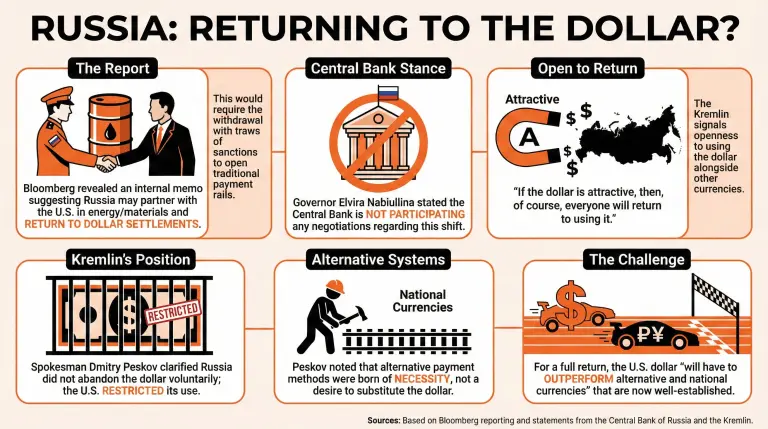
Nonetheless, if these talks are really taking place, the Central Bank of Russia seems to be unincluded. Elvira Nabiullina, Governor of the Central Bank of Russia, recently stated that the institution was not taking part in any of these negotiations.
“As regards the potential development of relations with the United States, we as the Central Bank, are not participating in it so far in any case,” Nabiullina stressed.
Nonetheless, the Kremlin has given other signals, showing a more open stance on such changes. Dmitry Peskov, a spokesman for the organization, pointed out that returning to the dollar would not be a policy opposed to Russia’s rising use of national currencies for trade settlements.
During a briefing, he clarified that Russia did not abandon the dollar: it was the U.S. that excluded Russia from using it.
“It was the issuing country, the United States, that restricted a number of countries’ right to use the dollar. And these countries, naturally, are using alternative payment methods, alternative forms,” Peskov explained.
“If the dollar is attractive, then, of course, everyone will return to using it, including alongside other currencies,” he added.
While many analysts argue that Russia’s adoption of the dollar could be considered a setback for the national currency system, Peskov said that these alternatives were born out of the necessity of transacting outside the dollar, not out of a desire to replace it.
Even so, Peskov concluded that the U.S. dollar “will have to outperform alternative and national currencies,” which use systems that are now well established and can be resilient to the dollar in their current form.
FAQ
- What recent reports suggest a shift in Russia’s currency strategy?
Reports indicate that Russia may consider returning to using the U.S. dollar for trade transactions, signaling a potential partnership with the U.S. in key sectors. - What changes would be necessary for Russia to re-enter the U.S.-led settlement system?
Any return to the dollar would likely involve lifting some sanctions against Russia, allowing traditional energy-derived settlement channels to reopen. - What is the Central Bank of Russia’s position in these discussions?
Governor Elvira Nabiullina stated that the Central Bank is not involved in negotiations related to improving relations with the U.S. or returning to dollar transactions. - How has the Kremlin responded to these developments?
Kremlin spokesman Dmitry Peskov emphasized that using the dollar wouldn’t oppose Russia’s use of national currencies, and suggested that the dollar remains an option if it proves attractive to trade partners.