


The Evolution of Altcoin Cycles: Yesterday's wind can't fly today's kite
If we compare the cryptocurrency industry to a set of teeth, then the process of listing tokens (listing) over the years is like an “industry orthodontics” journey. From the chaotic state in 2017 to the industrialized pipeline in 2025, each token distribution method fundamentally corrects the industry’s structural deformities and challenges the distribution of power.
In this process, project teams pursue top-tier liquidity, evolving from early “volume battles” to today’s high-cost “bride price model”; exchanges, to survive and attract traffic and fees, have shifted from a simple listing logic to a pricing logic.
How do exchanges, project teams, VCs, and traders destroy, love, slander, and achieve each other?
For you, a thousand times over.
Introduction
Teeth are a very “magical” organ in the human body. Why do I say that? Because teeth are the only organs in the adult human body that allow us to perform deep customization, movement, and modification through physical and biological means.
This “plasticity” enables us to counteract misalignments caused by genetics and wear and discomfort brought by aging.
We usually think bones are hard and fixed; teeth embedded in the alveolar bone should be immovable. But orthodontics (braces) exploits the fact that bones are a “dynamic, active tissue.” When braces apply a steady light force to teeth, the alveolar bone on the compressed side senses pressure, and the body sends “osteoclasts” to resorb the bone, making way for the tooth; after the tooth moves, on the side of the gap, “osteoblasts” are sent to fill in new bone.
Teeth “destroy” bone on one side and “rebuild” it on the other, achieving slow movement within the skeleton.
This is something no other hard organ in the human body can do. After all, unless you are exceptionally gifted, you cannot apply pressure to shorten your thigh bone or change the position of your ribs, but teeth can.
The rules and policies of token listing are similarly like this.
Part One: Listing = The Fight and Transfer of Asset Pricing Power
This article divides the path of token listing into four stages: baby teeth — growing teeth — deformity — orthodontics. The core running through these four stages of evolution is: who holds the pricing power of assets.
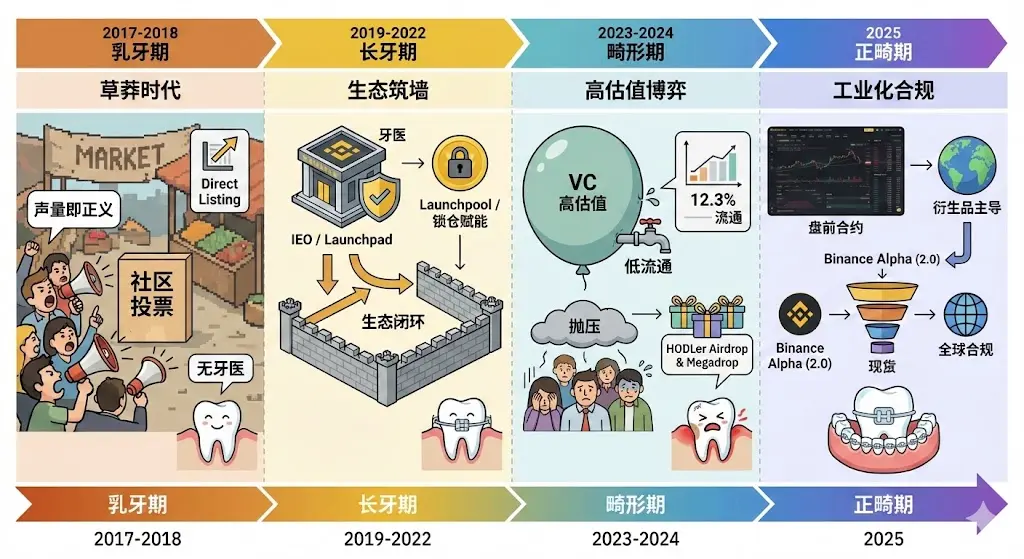
Stage One (Community Pricing)
Pricing power is in the hands of “callers” and grassroots communities. Traffic is king; whoever has a louder voice is right. The result is bad money drives out good, and the market is filled with noise.
Stage Two (Exchange Pricing)
Exchanges regain pricing power through IEO/Launchpad, acting as “gatekeepers” and “investment banks.” The reputation of the exchange becomes the core support for asset prices.
Stage Three (VC Pricing Collapse)
VCs hold excessively high pricing power in the primary market, making the secondary market unprofitable. Exchanges are forced to intervene, attempting to “rob the rich to help the poor” through coercive measures (airdrops), but this is only a palliative, not a cure.
Stage Four (Market-based/Derivative Pricing)
Funds in on-platform trading are not in spot markets, so pricing power shifts to more mature financial mechanisms. Through “contract trading” and pre-market trading, the market, after full betting, forms a fair price, no longer relying on single narratives or VC valuation reports.
Part Two: The Background, Logic, and Evolution of Token Listing
Stage One: 2017-2018 “Baby Teeth” — The Era of Volume as Justice
Core Path: Direct Listing, Community Voting
This period’s industry was in a “no-dentist” state. Listing logic was heavily influenced by founders and community sovereignty; as long as a project could rally fans, it could get a listing.
Background
This was the “Genesis” phase of crypto. The industry was still in the pure exchange platform era. Users mainly cared about trading convenience, speed, and low costs. Most mainstream exchanges at the time were slow and unstable; new platforms built their reputation on “extreme simplicity,” without complex learning systems or social features, designed entirely for experienced professional traders.
Reasons
Customer acquisition anxiety: Early-stage platforms needed to attract traffic from competitors at low cost and high efficiency. “Community voting” was not just about choosing tokens but also about vying for community belonging.
Regulatory vacuum: Global regulation had not yet intervened, giving exchanges high decision-making freedom. The logic was simple: the more fans a platform had, the more liquidity it guaranteed.
Gameplay: Represented by Binance’s “monthly community voting for listing,” users paid a small amount of tokens (e.g., 0.1 BNB) to vote. Winning projects (like Zilliqa, Pundi X) almost got top traffic for free, but manipulation of votes caused market dislocation, ultimately leading to abandonment.
Stage Two: 2019-2022 “Long Teeth” — Ecosystem Building and Premium Issuance
Core Path: IEO (Initial Exchange Offering), Launchpad, Launchpool, Direct Listing
The industry began wearing “ecosystem” braces. Exchanges were no longer just intermediaries but became “dentists” with deep due diligence capabilities.
Background
After the ICO bubble burst in 2017, fraud and technical vulnerabilities damaged industry credibility. The market needed a safer, backed fundraising method. Meanwhile, the DeFi Summer (2020) popularized “liquidity mining” as a consensus.
Reasons
Credibility repair: Exchanges introduced “bank-level” due diligence via Launchpad, acting as industry dentists, screening projects with legitimate teams and technology, upgrading ICO to a more secure IEO.
Ecosystem loop: To strengthen user stickiness, platforms used Launchpool to empower their own ecosystem tokens (like BNB), allowing users to “hold” rather than “snatch” new tokens, reducing participation risk.
2019-2020 (IPO frenzy): Launchpad (e.g., Bittorrent) adopted a pricing issuance model. Projects had to pass technical audits and accept exchange “pricing suggestions” to ensure a certain “wealth effect” upon listing.
2021-2022 (Lock-up empowerment): Launchpool became mainstream, empowering platform tokens, marking a shift from “buying new tokens” to “mining new tokens.” Users locked platform tokens to receive new tokens, forcibly linking project benefits with the platform ecosystem.
Stage Three: 2023-2024 “Deformation Period” — Overvaluation, Low Circulation, and Mechanism Upgrades
Core Path: HODLer Airdrops, Launchpool
Background
Venture capital (VC) flooded back into the market, spawning many projects valued in hundreds of millions of dollars but with extremely low circulating supply (median only 12.3%). This structure left retail investors with almost no profit space, only continuous unlocking pressure. Meanwhile, hefty fines and regulatory crackdowns shifted focus from “wild growth” to “global compliance and stability.”
Reasons
Pricing power conflict: VC-driven projects peak at launch, stripping away market price discovery. To protect the ecosystem, exchanges must intervene forcibly, redistributing gains back to the community.
Regulatory pressure: From May 2024, rules favor small and high-distribution projects, requiring project teams to reduce float, aiming to curb VC manipulation.
Corrective measures: Launching HODLer Airdrops and Megadrops (distributing tokens via Web3 tasks) to forcibly disperse “bride price” directly to retail investors.
This is the most painful “periodontitis” stage in industry orthodontics. VC’s over-inflated projects, with median token circulation dropping to 12.3%, and Binance’s industry report estimates that in 2024, about 155 billion USD of potential sell pressure exists in new projects over the next 12-24 months.
Due to VC manipulation, retail investors buy at high prices, and token listings peak early, causing market confidence to plummet and severely damage the market. Poor secondary market performance shrinks spot trading volume.
To maintain platform token attractiveness, attract flows, and support trading, platforms began large-scale promotion of HODLer Airdrops (airdrops to long-term holders) and Megadrops (distribution tied to Web3 tasks). Listing policies increasingly favor small and medium projects with high distribution ratios.
From late 2024, exchange derivatives mechanisms underwent major upgrades, supporting more small tokens and new perpetual contracts, allowing risk hedging and early pricing via derivatives before spot liquidity matures. Traffic and revenue increasingly shifted toward perpetual trading.
Stage Four: 2025 “Orthodontics” — Multi-layered, Industrialized Compliance Matrix
Core Path: Binance Alpha Airdrop, Pre-Market Trading, Web3 Wallet Integration
Background
2025 is dubbed the “Year of Cryptocurrency Industrialization.” Total market cap surpasses 40 trillion USD, with Bitcoin becoming a macro asset. Perpetual contracts dominate the derivatives market, accounting for over 75% of global crypto derivatives volume.
Reasons
Pricing power shifts: The market is no longer driven by narratives and call signals but by ETF flows, corporate earnings reports, and protocol revenues.
Efficiency optimization: Futures First allows pre-listing derivative-based pricing before new tokens go live in spot markets. Data from 2025 shows this process shortens the conversion cycle to 14 days—the fastest route into mainstream adoption.
Pre-market contracts: The most significant mechanism change in 2025. “Pre-market” trading was introduced, allowing users to trade perpetual contracts with up to 5x leverage based on external price feeds before tokens are officially listed in spot markets.
Deep liquidity for small tokens: Because derivatives and pre-market trading attract massive traffic, many small and medium projects (like ESP, AZTEC, KITE) quickly establish derivative liquidity, becoming the fastest to enter mainstream visibility, with an average cycle of about 14 days from listing to official token issuance.
Binance Alpha (2.0): As a “pre-listing token selection pool,” projects must first prove their liquidity and resilience in this sandbox before upgrading from derivatives to spot trading. It replaces manual due diligence with market-driven selection.
Part Three: From “Grassroots” to “Industrialized Orthodontics” — The Power Shift
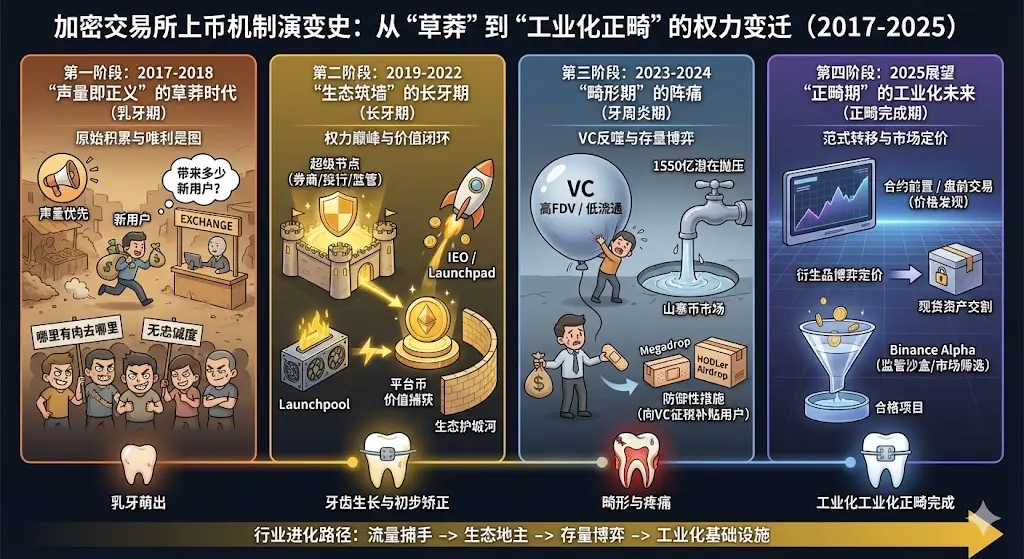
Stage One: “Volume is Justice” in the Wild West Era (2017-2018)
This was the “primitive accumulation” period for exchanges. They had almost no ability to assess project quality, nor did they need to. Their only question was: “How many new users can this coin bring me?”
This model cultivated the first batch of “profit-driven” crypto users, who had no loyalty to platforms or projects, chasing whatever had the most hype, laying the groundwork for future liquidity mining tragedies.
Stage Two: “Ecosystem Building” in the Long Teeth Period (2019-2022)
Exchanges reached the peak of power, becoming top predators in the industry. They were no longer just trading venues but became super nodes akin to brokerages, investment banks, and regulators. IEOs became the best tool for monetizing their brand premium.
The shift from “buying new coins” to “mining new coins” (Launchpool) was highly clever. It forcibly transferred external project benefits to platform token holders, completing the value capture loop for platform tokens. This was the most critical step in building a “moat” for exchanges.
Stage Three: “Deformation Pain” (2023-2024)
This was a backlash against the over-expansion of VC in the previous bull run. High FDV, low circulation tokens are essentially VC’s systemic harvest using informational advantages and capital dominance over retail investors.
The “potential sell pressure” of about 155 billion USD in new projects in 2024 explains why altcoins are dead silent while Bitcoin hits new highs. The market lacks new capital and is drained by unlocking old projects.
This reflects the helplessness of exchanges: knowing it’s a trap but still launching new projects to stay competitive. Megadrop and HODLer Airdrops seem innovative but are actually defensive measures—taxing VC and redistributing to retail investors to sustain ecosystem activity. A painful “stock game.”
Stage Four: “Industrialized Orthodontics” Future (2025 Outlook)
By this stage, the industry finally realizes that relying solely on spot markets, simple IEOs, airdrops, and KOL rounds cannot meet the growing capital and community demands.
Derivatives replace spot as the main price discovery mechanism, with pre-market trading.
This is a paradigm shift: previously, assets existed first, then derivatives; now, derivatives lead the pricing, with spot delivery following. This accelerates price discovery significantly. The true value of a project is no longer revealed only at the moment of listing but is pre-formed during pre-market derivatives battles.
Binance Alpha’s emergence also provides a pre-listing window for “industrialized listing.” It is essentially a “draft sandbox” or “decentralized curated market,” requiring projects to demonstrate liquidity and resilience in real, tough markets before “going official.” It replaces manual due diligence with market-driven selection.
Part Four: The Evolution of Listing Fees — From Listing Fees → Buying Path Money → “Shareholder” Fees
This section does not target any specific exchange but discusses based on publicly available information.
The evolution of listing fees across these four stages essentially reflects the transfer of industry power: from initially paying “buying path money” to the platform, to now “spending a fortune for traffic.” Viewing this “bride price” evolution reveals how the industry has been gradually transformed.
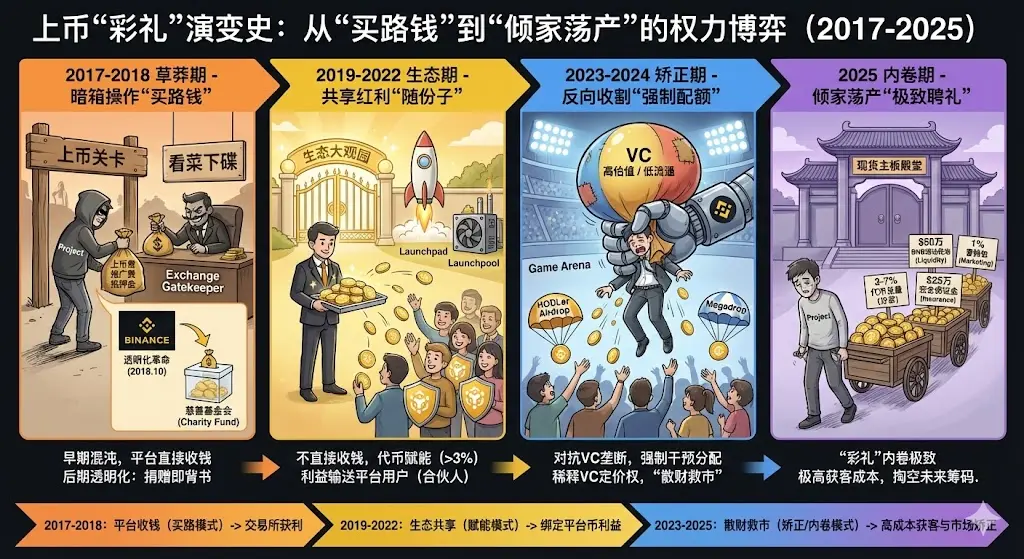
Here are the four stages of listing fee models:
Stage One (2017-2018): From “Buying Path Money” to “Gifting”
In the early chaotic period, rumors of huge listing fees circulated widely. Exchanges were in a “pick-and-choose” mode, with numerous charges: listing fees, activity fees, promotion fees, deposits, etc.
In October 2018, Binance launched a transparency revolution, announcing that all listing fees would be 100% donated to charity. Listing fees shifted from “direct income for the platform” to “brand reputation endorsement.”
Stage Two (2019-2022): “Ecosystem Dividend” Benefit Exchange
During this period, direct fee collection was abandoned. Instead, “ecosystem empowerment” became the norm: project teams needed to allocate tokens to platform users (mainly platform token holders).
For example, Binance used Launchpad for priced issuance or Launchpool for liquidity mining.
Although there was no explicit “listing fee,” projects had to allocate a certain percentage of tokens (usually over 2-3%) as distribution chips. This money no longer went into the exchange’s pocket but into partners supporting the platform ecosystem.
Stage Three (2023-2024): Counterattack on VC Monopoly with “Mandatory Quotas”
With the proliferation of “high valuation, low circulation” tokens, exchanges began to intervene in profit distribution. Binance, for instance, was rumored to charge “x% token listing fees,” sparking industry debate. The official response clarified that tokens were not handed over to the exchange but used for airdrops and community rewards.
They promoted HODLer airdrops, Launchpool, Megadrop, etc., forcing projects to distribute tokens massively at listing to dilute VC’s pricing power.
Stage Four (2025~): “Costly Bride Price” of Value Inversion
By 2025, the “bride price” for mainboard listings has become extremely inflated:
- Distribution ratio increased: averaging 3% to 7% of total tokens (from Alpha to spot).
- Margin requirements: projects typically need to deposit about $250,000 as a security deposit (refundable after 1-2 years) and prepare at least $500,000 in BNB for liquidity pools.
- Marketing budget: about 1% of supply allocated for platform marketing.
From 2017 to 2025, listing fees have undergone three major leaps:
- 2017-2018: Platform charges (buying path).
- 2019-2022: Ecosystem sharing (empowerment).
- 2023-2025: Distributing wealth to stabilize the market (correction).
Today, “listing fees” have fully evolved into a customer acquisition cost. Projects pay tokens exceeding their entire fundraising amount to secure top exchange liquidity. Although this “bride price” guarantees initial user gains, it also nearly exhausts future growth potential at the “wedding day.”
Part Five: Industry Participants — What Should They Say?
This article is not only a review of history but also an evolution report on the survival philosophies of exchanges and project teams.
It shows how Binance-like exchanges have adjusted their positioning across different cycles: from “traffic grabbers” to “ecosystem landlords,” and after the “VC harvest” crisis, ultimately evolving into “industrialized financial infrastructure.”
Future listings will no longer be simple “bell-ringing ceremonies” but complex, multi-layered financial engineering. For project teams, the era of just writing whitepapers and raising VC is over; for retail investors, blindly chasing new listings for quick riches is a thing of the past. The future demands more professional trading skills and understanding of derivatives.
What? You say exchange listing rules are tough?
Teeth are also very tough, aren’t they?
😂
Orthodontics takes time.
For you, a thousand times over.
Postscript
The cover is “The Kite Runner.” Highly recommend everyone read the original (or watch the movie).
After watching the movie and then reading this article, your feelings might change—what does it mean to destroy and achieve each other? What is: being a good person again?