How much time does PayPal have left as AI reshapes the shopping journey?
Stripe and PayPal are shifting from payment tools to AI business infrastructure, competing to become the default engine for AI transactions.
Original headline: AI: PayPal’s $200M Wake-Up Call in AI Commerce
Original author: LUKE SPILL, FintechBlueprint
Translation: Peggy, BlockBeats
Editor’s note: As AI agents begin to replace humans in product discovery, decision-making, and ordering, the traditional e-commerce funnel is rapidly shrinking. Payments are no longer the endpoint of transactions but part of embedded infrastructure. This article uses PayPal’s acquisition of Cymbio as a starting point to explore the new competitive landscape emerging with Agentic Commerce: Google and Shopify are trying to control routing layers with UCP; OpenAI and Stripe are vying for the agent execution layer through ACP; while PayPal is working to shift from a “payment button” to a key node in “business workflows.”
For fintech companies like PayPal and Stripe, whether they can embed underlying AI commercial protocols will determine if they can stay at the table; for banks and the crypto industry, the window of opportunity is also short.
Below is the original text:
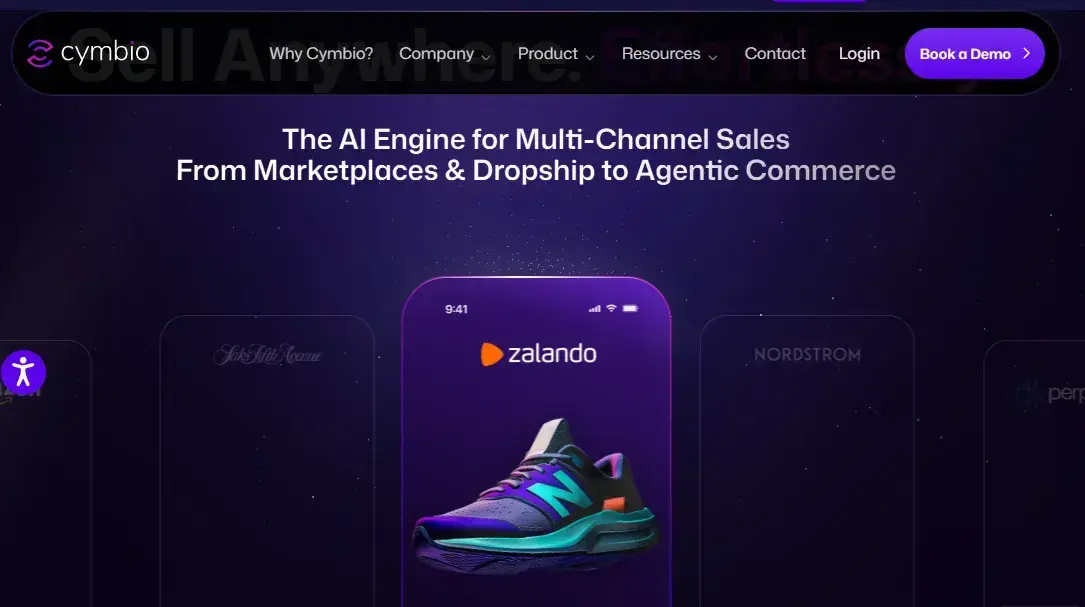
Last week, PayPal acquired Cymbio, a platform that helps merchants complete sales across multiple AI interfaces, including channels like Microsoft Copilot and Perplexity. Market sources estimate the deal was worth between $150 million and $200 million. It is widely seen as a strategic move by PayPal to remain competitive in the field of Agentic Commerce.
Therefore, as AI agents continue to compress and reconstruct the traditional e-commerce funnel, PayPal is shifting from a typical Web2 payment tool toward upstream, more core business functions such as product discovery, catalog distribution, and order orchestration. This shift almost perfectly confirms our January analysis of exponential growth, power-law effects, and increasing returns in Agentic Commerce.
Meanwhile, foundational infrastructure in the industry is rapidly taking shape:
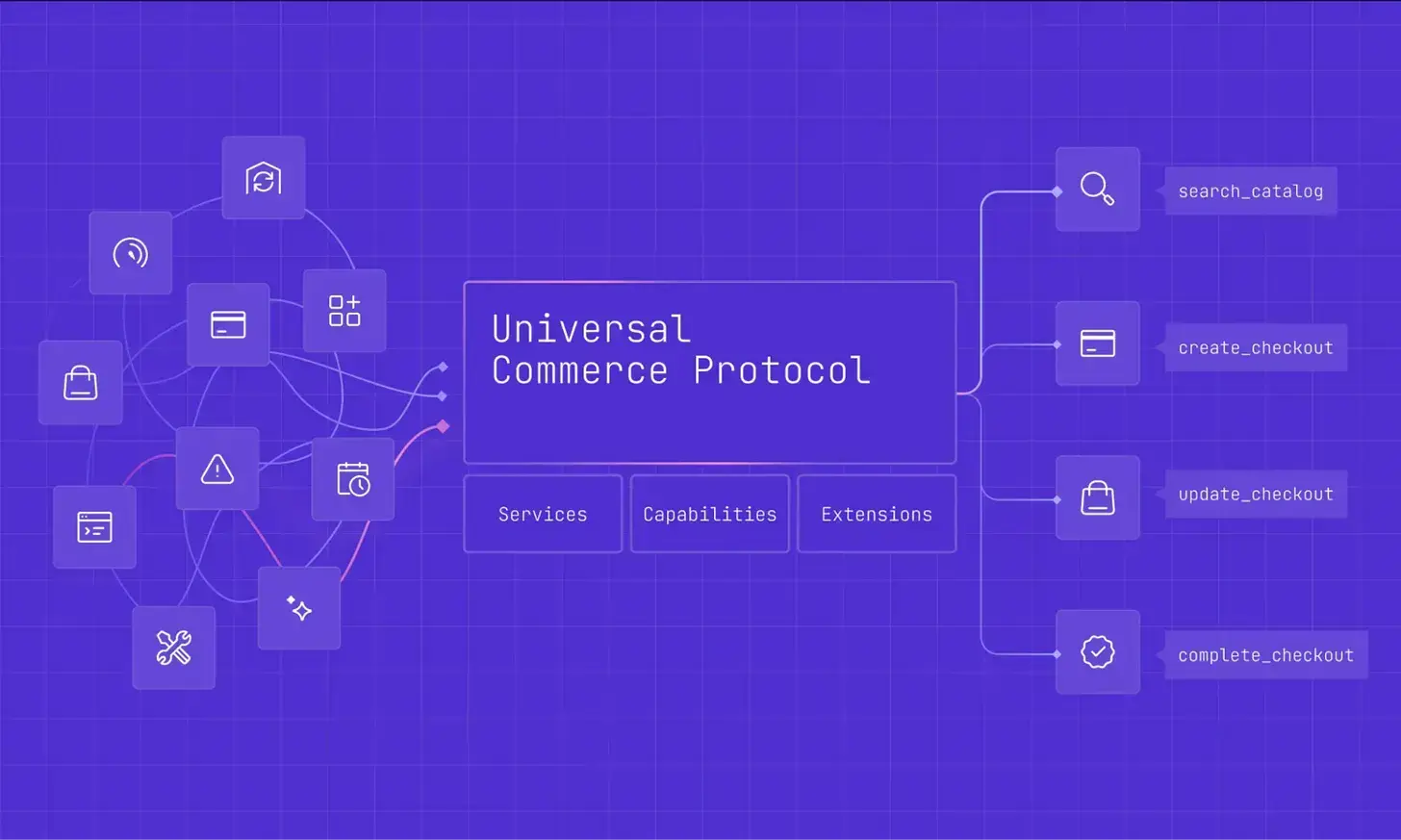
Google and Shopify are pushing the Universal Commerce Protocol (UCP);
OpenAI and Stripe are jointly advancing the Agentic Commerce Protocol (ACP);
Microsoft is embedding settlement capabilities directly into Copilot.
Shopping infrastructure centered around “machines” rather than “human users” is being rewritten at unprecedented speed. Agentic Commerce is delivering exponential growth in real-world terms. Predictions from various parties are both astonishing and increasingly aligned:
McKinsey forecasts: By the end of this decade, Agentic Commerce could generate $1 trillion in revenue in the US retail market, accounting for about one-third of all online retail sales.
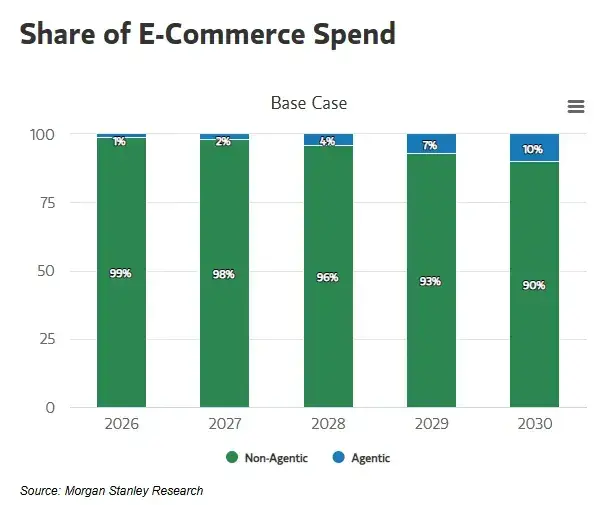
Morgan Stanley predicts: By 2030, Agentic Commerce will drive US e-commerce spending to between $190 billion and $385 billion, representing a market penetration of 10%–20%.
Bain estimates: By 2030, the market size of Agentic Commerce will reach $300 billion to $500 billion, about 15%–25% of total online retail.
Existing data indicates we are at a tipping point in exponential growth: as of November 2025, 23% of US consumers have used AI to complete a purchase at least once.
Cymbio could become PayPal’s “middle layer” in AI commerce
For PayPal, Cymbio’s potential positioning is as an intermediate infrastructure layer within the AI commerce ecosystem. Its core value propositions include:
Synchronizing product catalogs across different markets and channels
Real-time inventory management
Routing orders to merchants’ existing OMS (Order Management System) and fulfillment systems
Allowing merchants to remain the legal entities of record (Merchant of Record)
The Store Sync product enables merchants’ catalogs to be directly discoverable by AI agents like Microsoft Copilot and Perplexity, with plans to integrate next with ChatGPT and Google Gemini.
The premise for AI agents to complete transactions is that product data, prices, inventory, and fulfillment info must be machine-readable and highly reliable.
From “Checkout” to “Agentic Commerce Workflow”
PayPal processes over $1.7 trillion annually, with more than 142 million active accounts. In traditional models, PayPal’s core leverage point is at the moment of payment.
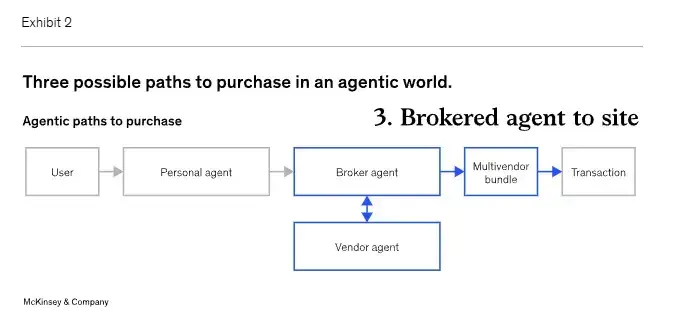
In an Agentic Commerce system, AI can handle product discovery, compare options, and even place orders directly, while PayPal manages identity verification and payment authorization.
After integrating Cymbio, PayPal covers the entire chain:
Discovery: Products are recommended and presented within AI agents
Decisioning: Options are refined through conversational interactions
Checkout: PayPal handles identity verification and payment
Fulfillment: Orders are directly injected into merchant systems for execution
Protocol competition: Service vs. Standard
When PayPal promotes Agentic Commerce as “products and services,” Google and Shopify are building a cross-functional, standardized Agentic Commerce protocol system.
Key points:
Google is embedding UCP (Universal Commerce Protocol) directly into Search and Gemini
Shopify ensures its millions of merchants only need to integrate once to reach multiple AI agents
This means the underlying infrastructure of AI commerce is evolving from “single-point capabilities” to a “protocol network.”
UCP aims to control the “routing layer” of AI commerce, not to own or operate the commerce itself.
It’s more of a defensive layout: by making this layer a “free” public protocol and leveraging strong network effects, it prevents any single player from monopolizing the core control of AI commerce.
Therefore, PayPal is not directly competing with UCP but actively embedding into this ecosystem.
Google has explicitly stated that UCP-based checkout capabilities will support multiple payment providers, including PayPal and Google Pay.
In other words, UCP aims to be a “neutral highway,” while PayPal hopes to be an indispensable toll booth and payment node on that highway.
OpenAI and Stripe are major competitors in this space.
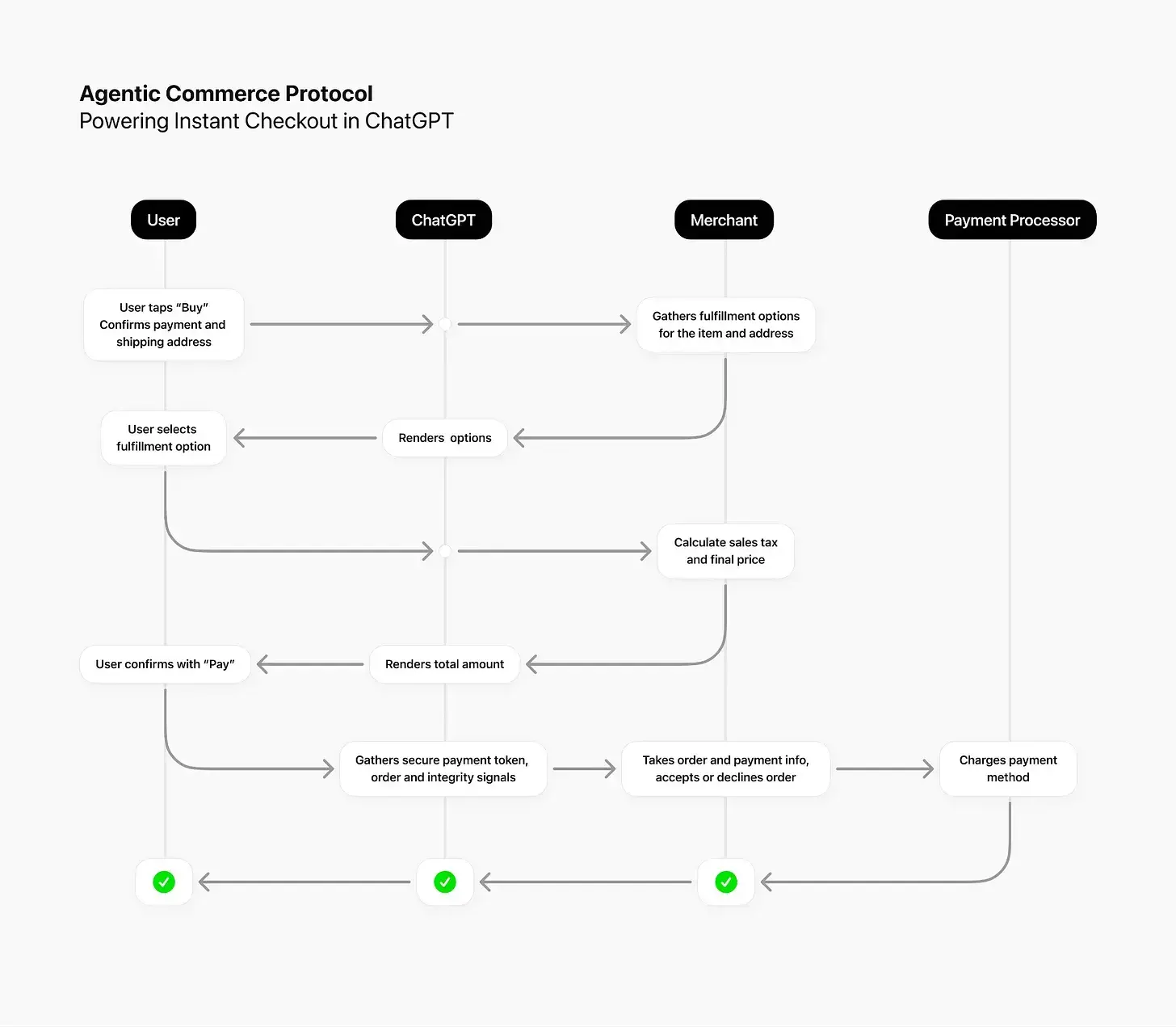
As early as September, Stripe and OpenAI announced the launch of Instant Checkout within ChatGPT, supported by the Agentic Commerce Protocol (ACP).
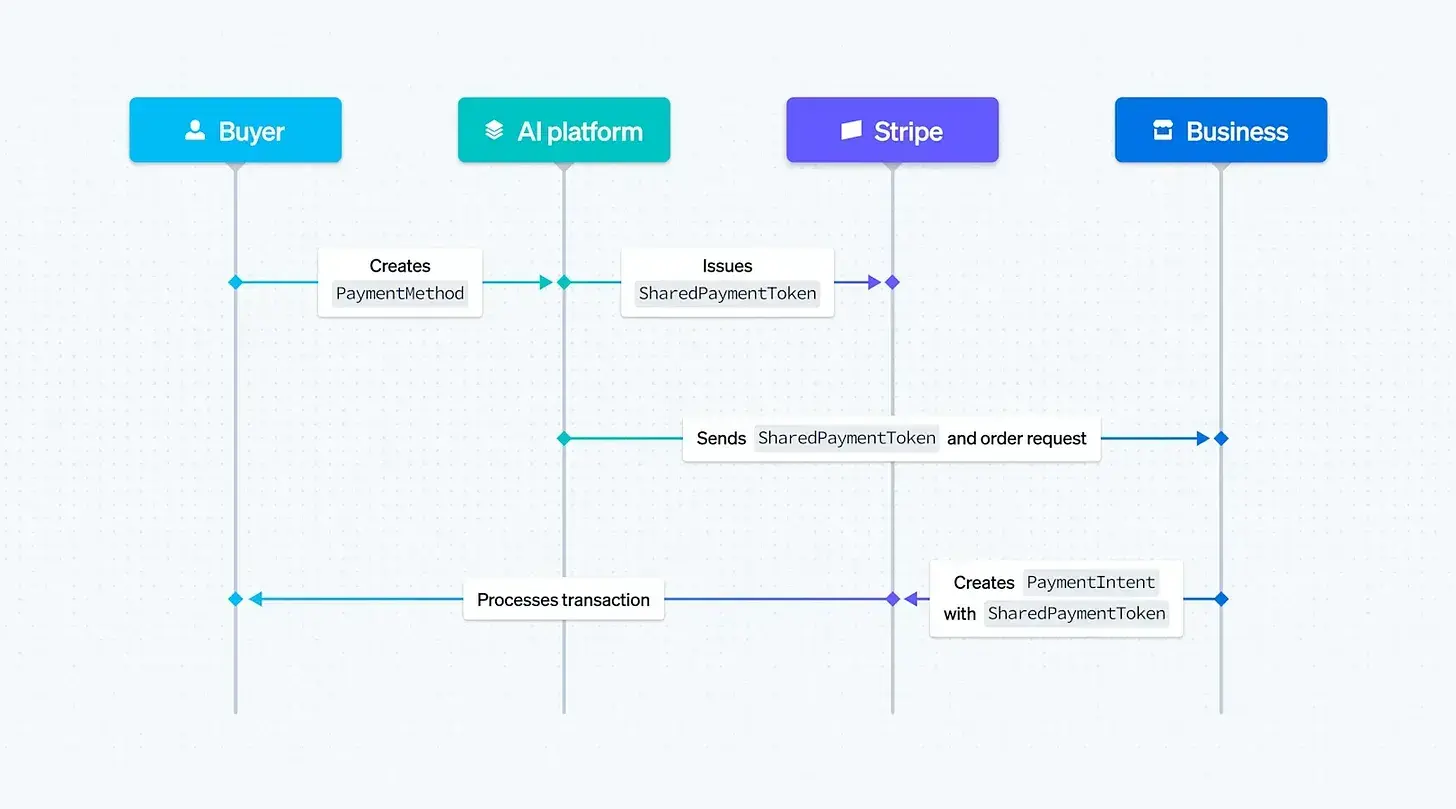
ACP allows AI agents to initiate purchase requests via structured APIs and Stripe to issue shared payment tokens, enabling payment confirmation under agent authorization. This allows AI, once authorized, to complete the entire transaction process from ordering to payment on behalf of the user.
Stripe subsequently launched the Agentic Commerce Suite in December 2025, enabling merchants to:
Publish product catalogs accessible directly by AI agents
Choose which AI agents to sell through
Handle payments, risk management, and dispute resolution via Stripe
Feed order events back into existing business systems
In 2024, Stripe processed over $1 trillion in payments, serving millions of businesses worldwide. Its strategic goal is clear: to become the “default wallet” and “action layer” for AI agents—similar to how it became the default payment API for internet companies in the past.
Against this backdrop, PayPal and Stripe are clearly in direct competition:
They are fighting not just over payments, but over the critical control points when AI agents actually “execute” transactions.
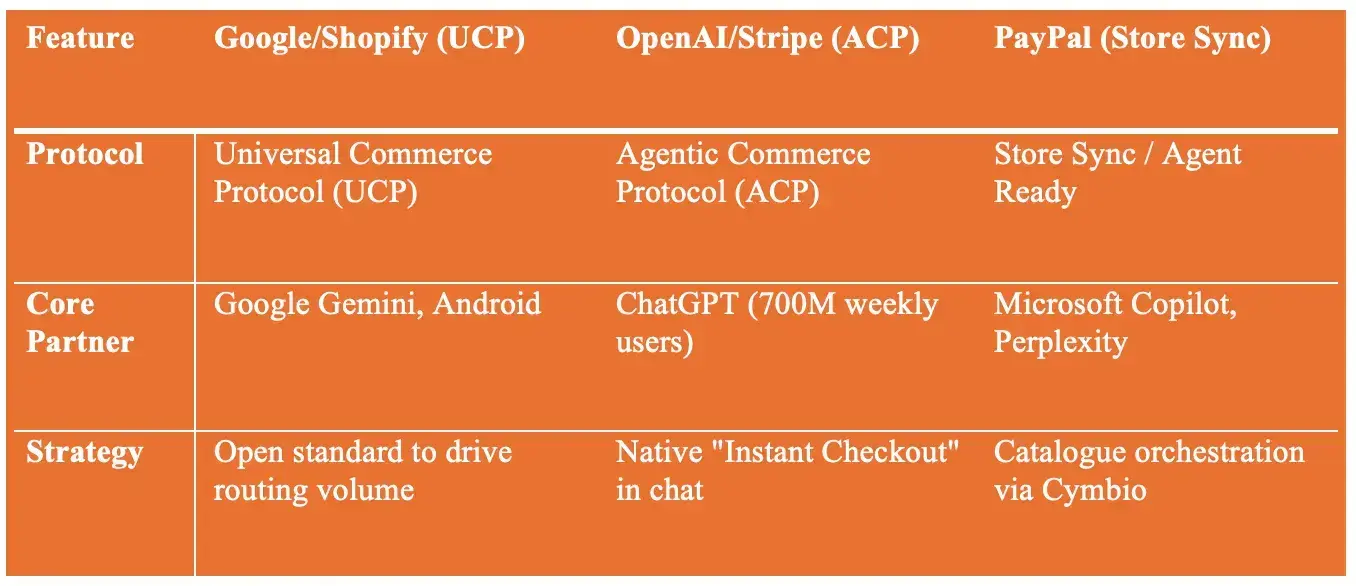
Comparing the three systems (Comparing the three systems together)
(This section would typically compare UCP / ACP / PayPal + Cymbio side by side: who controls routing, protocols, payments, and fulfillment—plus the sources of their network effects.)
If you like, I can help you turn the next paragraph into a comparison table or a high-level “big picture” summary that clearly explains the division of roles and strategic game among the three.
Key Takeaways
Three points stand out:
Business actions will become conversational and agent-executable
Purchases will no longer be a step-by-step click process but understood and authorized through AI dialogue.
Merchants will “integrate once, distribute everywhere”
Merchants won’t need to adapt separately for each platform; a single integration will enable their products to reach users via multiple AI agents and channels.
Payments will become embedded infrastructure, no longer the transaction endpoint
Payments will no longer be “the last step button” but a foundational capability embedded deeply into discovery, decision, and fulfillment processes.
Preemptive responses from payment networks
By the way, Mastercard announced in January 2026 that it is researching “AI business rules,” essentially trying to get ahead in defining governance frameworks for this transition.
Payment networks clearly realize that before AI agents can handle large-scale transactions, the rules and standards will determine future positioning.
As we pointed out in our January analysis: banks, fintechs, and crypto firms must “sit at the table,” not be left out afterward.
If financial institutions fail to embed themselves early into these platforms, their financial functions may ultimately be internalized by Big Tech.
Different camps and their choices
For banks:
Traditional banks lack the infrastructure to directly compete with Google, OpenAI, or Microsoft at the Agentic Commerce layer. But they still control three key resources: payment clearing channels, customer credit relationships, and compliance/regulatory expertise.
These assets mean banks won’t disappear but need repositioning.
For fintechs:
PayPal, Stripe, Adyen, and others realized early that merely doing payments is no longer enough for long-term dominance.
They are proactively moving upstream into: commerce orchestration, merchant services, and foundational infrastructure for the AI era.
For crypto:
So far, the Agentic Commerce protocols published are almost entirely traditional financial pathways: credit cards, Google Pay, PayPal, Stripe, etc.
Cryptocurrency and stablecoins are largely absent from UCP, ACP, and Store Sync, except for some sporadic experiments involving Stripe or Coinbase.
Is this a major strategic oversight or a deliberate exclusion? That remains to be seen.
For crypto companies, the opportunity is clear: if they can build native AI agent-compatible payment rails (instant settlement, programmable currencies, global reach) and embed into protocols before they are fully standardized, they could leapfrog traditional finance; otherwise, they risk being permanently excluded.
Conclusion
Fundamentally, PayPal is working to catch up with Stripe and adapt to rapidly changing consumer behaviors.
As more daily decisions are made on AI platforms, these platforms will increasingly become the “default virtual storefronts” for brands.
Whoever can embed the infrastructure behind these storefronts will stay at the table.
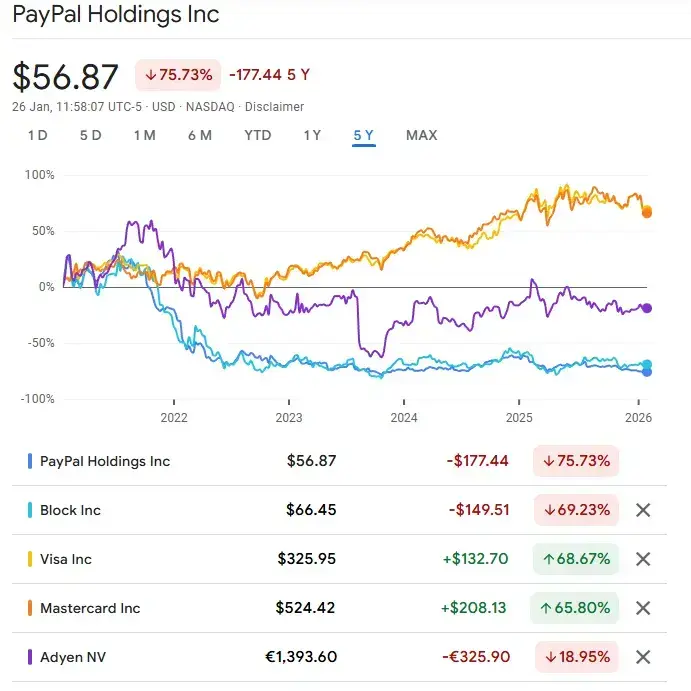
PayPal’s stock has been depressed for some time, down about 37% from its 52-week high. Investors are increasingly questioning whether the company still has long-term structural relevance, and the rise of Crypto + AI narratives has only intensified these concerns.
Against this backdrop, the diversification into Agentic Commerce is not an aggressive move but a necessary cost to maintain relevance. For PayPal, it’s not just an upgrade—it’s an entry fee: only by making this shift can it hope to remain a core part of the next-generation business infrastructure.