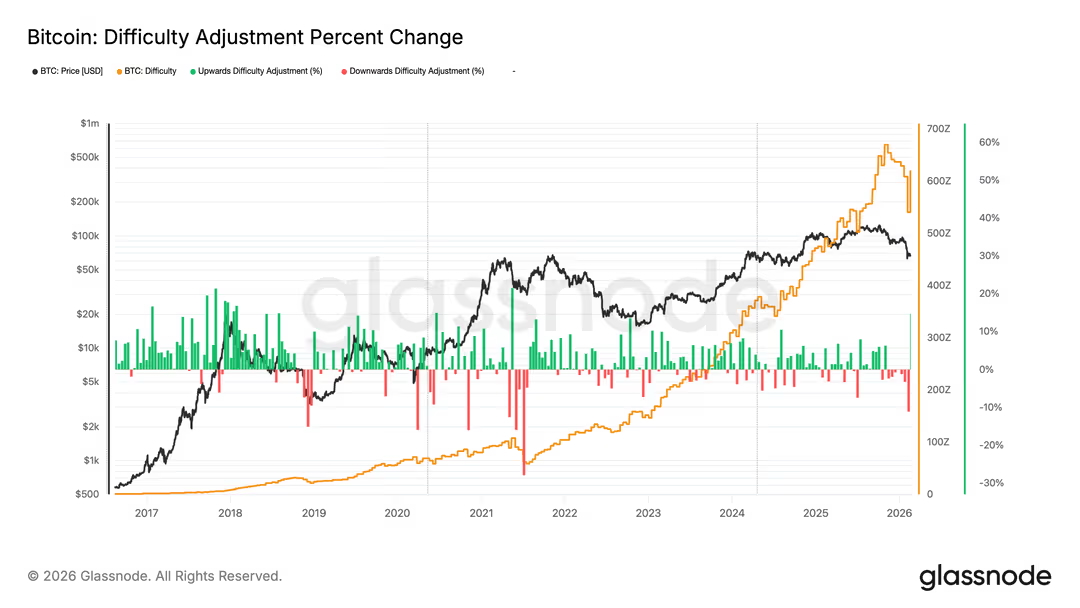
Largest increase since 2022! Bitcoin mining difficulty surges 15% to 144.4 T
Despite Bitcoin’s recent price underperformance, mining competition has not decreased but instead increased. The latest data shows that Bitcoin mining difficulty has surged significantly to 144.4 T, with a single adjustment of up to 15%, the largest single increase since 2021.
The last time such a dramatic adjustment in mining difficulty occurred was during China’s comprehensive crackdown on Bitcoin mining in 2021, which triggered a massive migration of hash power. After the network gradually stabilized, the difficulty once experienced an upward correction of as much as 22%.
Bitcoin’s blockchain adjusts difficulty every 2,016 blocks (approximately two weeks) based on the total hash rate to ensure that blocks are produced roughly every 10 minutes, regardless of how many miners are mining.
Mining difficulty essentially reflects the level of competition among miners; the higher the difficulty, the more intense the competition. If hash rate increases over the past two weeks, the difficulty will also rise, making Bitcoin mining more challenging. Conversely, if hash rate declines, the difficulty level will decrease, making it easier for miners to solve blocks.
The last adjustment in Bitcoin mining difficulty was a 12% reduction, mainly due to a sudden drop in hash rate. This was caused by extreme winter storms in the United States, forcing several large mining companies to temporarily scale back operations, resulting in the most severe setback for mining activity since late 2021.
Data shows that in October last year, when Bitcoin’s price soared to a record high of about $126,500, the total network hash rate also peaked at 1.1 ZH/s. However, as the coin price fell back to around $60,000 in February this year, the hash rate also dropped to 826 EH/s.
Recently, with the price rebounding to about $67,000, the total network hash rate has quickly recovered and has now risen back to the 1 ZH/s level, setting the stage for this surge in mining difficulty.