Prominent crypto attorney and U.S. Senate candidate John Deaton has escalated his opposition to any pardon for former FTX CEO Sam Bankman-Fried, rejecting recent attempts to portray the exchange as solvent before bankruptcy.
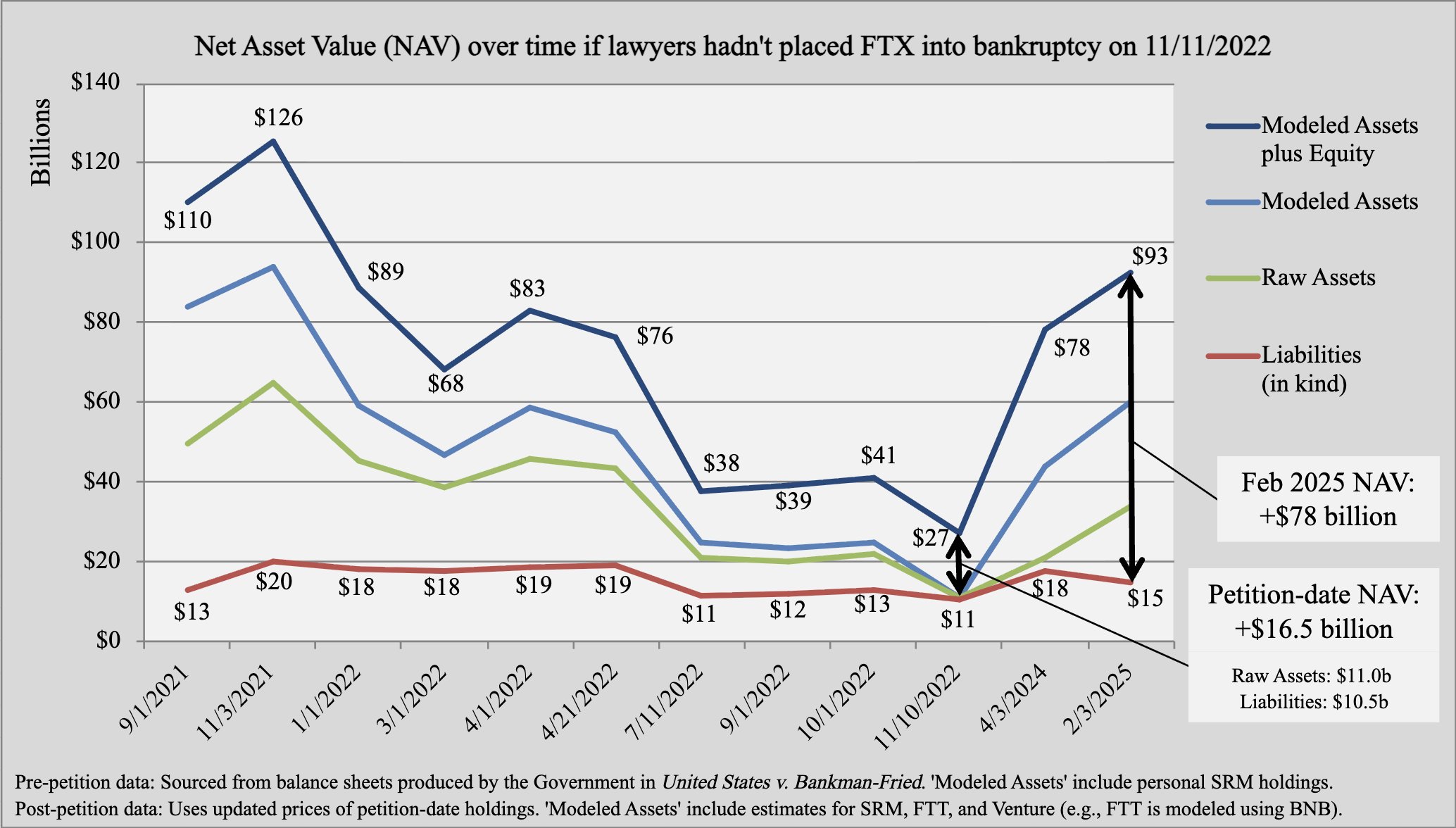
As SBF circulates modeled charts projecting a potential $78 billion net asset value by 2025, Deaton argues the legal verdict and creditor losses outweigh theoretical recoveries.
John Deaton rejects SBF’s $78B solvency claims and pardon plea
Deaton’s comments follow Bankman-Fried’s attempts at a digital comeback In a recent “10 Myths About Me & FTX” post on X, SBF disputed insolvency claims and shared a chart modelling FTX’s net asset value over time.
HOT Stories
Morning Crypto Report: XRP on the Edge vs Bitcoin as February Ends, Vitalik Buterin Donates More ETH for Charity, Shiba Inu (SHIB) May Challenge PayPal USD in March
XRP Records Largest On-Chain Realized Loss Spike Since 2022
The graphic there suggested that had bankruptcy not been initiated in November 2022, net asset value could have climbed to $78 billion by February 2025, compared with a petition-date NAV of $16.5 billion. The projections rely in part on modeled valuations of holdings, including tokens such as SRM and FTT.
 Source: Sam Bankman-FriedDeaton, widely known for his advocacy for the XRP community during the SEC v. Ripple escalation, is not buying the statistical revisionism. For him, the former billionaire was a “crook, thief, and liar,” and his previous operations were essentially a family-coordinated effort to siphon retail savings into political influence and global marketing.
Beyond the “Sam Bankman Fraud” moniker, Deaton’s critique extends to the “two-tiered justice system,” questioning why SBF’s parents, both Stanford professors, have not faced similar criminal repercussions for their alleged roles in the FTX ecosystem.
While SBF’s team shares charts, legal experts remain skeptical, noting that “modeled assets” often rely on illiquid tokens that lack real-world market depth.
As the 2026 political cycle heats up, Deaton’s categorical opposition may signal that the crypto industry’s “pro-law” faction is ready to fight any narrative that minimizes the gravity of the FTX fraud, regardless of current market valuations or theoretical recoveries.
Disclaimer: The information on this page may come from third parties and does not represent the views or opinions of Gate. The content displayed on this page is for reference only and does not constitute any financial, investment, or legal advice. Gate does not guarantee the accuracy or completeness of the information and shall not be liable for any losses arising from the use of this information. Virtual asset investments carry high risks and are subject to significant price volatility. You may lose all of your invested principal. Please fully understand the relevant risks and make prudent decisions based on your own financial situation and risk tolerance. For details, please refer to
Disclaimer.
Related Articles
U.S. Court Rules: Uniswap is Not Responsible for Scam Tokens; Open-Source Smart Contracts Are Neutral Tools
A New York federal judge dismissed the class-action lawsuit against Uniswap, ruling that open-source smart contract developers are not responsible for third-party scam tokens. This sets a legal precedent for the DeFi industry. The judge emphasized that Uniswap is a neutral tool, and developers must clearly distinguish themselves from illegal activities. The ruling provides legal protection for open-source software and encourages users to conduct their own risk assessments.
動區BlockTempo12m ago
Uniswap Token Scam Collective Lawsuit Wins, Open Source Developers' Indemnity Established
The Southern District Court of New York dismissed the class-action lawsuit against Uniswap Labs, ruling that the plaintiffs failed to adequately allege that the defendants were aware of the fraud or violated consumer protection laws. The court emphasized that open-source developers should not be held responsible for third-party misuse. This ruling provides legal protection for DeFi developers and clarifies the boundaries of liability for scams.
MarketWhisper22m ago
Cryptocurrency scams target dating apps, $327,000 USDT seized
Boston authorities in the United States have filed charges in a cryptocurrency dating scam case, where the victim was defrauded of $327,829.72 in Tether (USDT) by the scammer "Linda Brown" through a dating app. The case fits the "pig butchering" scam pattern, where the scammer first builds emotional trust before inducing investment. USDT, due to its stability and anonymity, has become the main tool for scam funds, highlighting the severity of current crypto scams and the enforcement challenges.
MarketWhisper28m ago
CFTC appoints former federal prosecutor David Miller to lead enforcement, strengthening cryptocurrency regulation
CFTC Chairman Michael Selig announced the appointment of David Miller as Head of Enforcement. Miller has extensive experience in digital asset cases. At the time of the appointment, the CFTC is preparing to strengthen regulation of the cryptocurrency industry, and Miller will focus on combating fraud and manipulation.
GateNews1h ago
U.S. prosecutors seek to seize $327,000 USDT in connection with "Pig Butchering" crypto scam case
Massachusetts federal prosecutors have filed a lawsuit seeking to recover 327,829.72 USDT involved in a cryptocurrency scam through a dating app. The suspect used the fake identity "Linda Brown" to lure victims into investing, and the victims discovered they had been scammed after withdrawal attempts failed. The case highlights the increasing vigilance of U.S. regulators against romance-related crypto scams.
GateNews2h ago
US Prosecutors Seek $327K Crypto Forfeiture Over Romance Scam
U.S. prosecutors are seeking to forfeit nearly $328K linked to a crypto romance scam where a Massachusetts resident was deceived into investing in a fake cryptocurrency opportunity. The funds were traced through various wallets before being converted into Tether (USDT).
Decrypt4h ago


