


Bitcoin "Exchange Whale Ratio" soars to 0.64, the highest since 2015. Is this a warning sign of selling pressure or a turning point?
According to the latest data from CryptoQuant, the Bitcoin Exchange Whale Ratio reached 0.64 on February 20, 2026, the highest level since 2015. This indicator tracks the proportion of inflows from the top ten large deposits relative to total exchange reserves, indicating that large holders now account for 64% of total inflows.
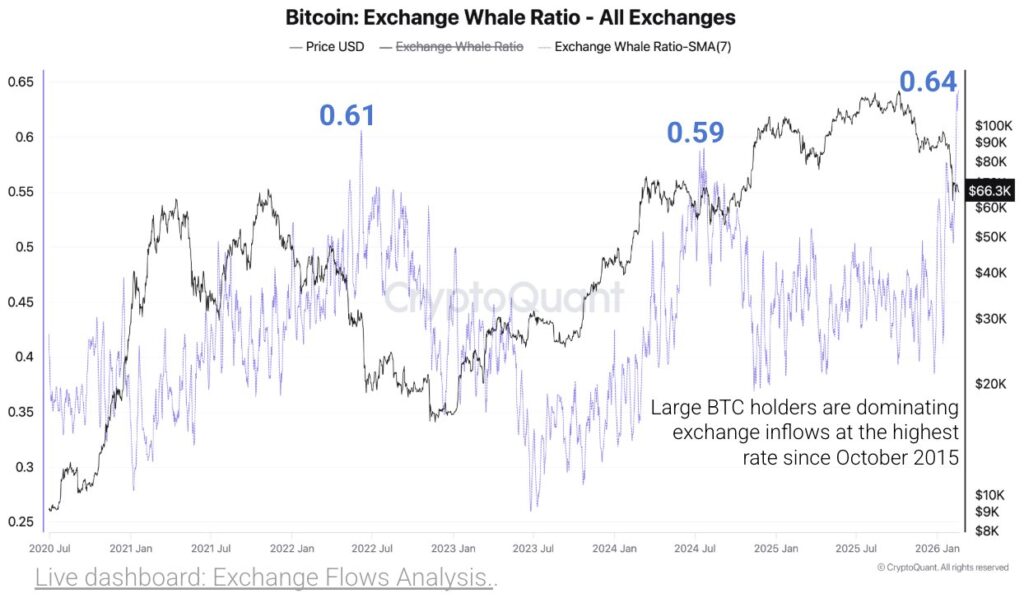
Image source: CryptoQuant/X
Excessive Concentration Could Trigger Sharp Price Corrections
This surge reflects increased activity among “whales,” who are depositing large amounts of Bitcoin into platforms like Binance. Especially during the correction period from Bitcoin’s October 2025 peak of $126,080 down 47% to around $67,200, this concentration could intensify selling pressure amid tightening liquidity. Analysts warn that such concentration may lead to significant price corrections, particularly as Bitcoin attempts to recover from recent declines, with whales potentially taking advantage of limited buyer liquidity to realize profits.
This indicator tracks the proportion of top inflows relative to total exchange deposits, which has recently risen sharply, notably on Binance: from 0.4 between February 2 and 15 to 0.62. The 30-day average whale inflow on Binance reached $8.3 billion, the highest since 2024. Some inflows originate from early Bitcoin holders, with approximately 10,000 BTC transferred to platforms (possibly related to “BTC OG Insider Whales” or Garrett Jin). Since January 2026, Binance’s total inflow has been about 363,000 BTC.
Historically, such high ratios often precede market declines, as whales reposition amid uncertainty, contrasting with retail accumulation seen earlier in 2025. The retail-to-whale ratio has fallen to 1.45, the lowest since mid-2024, indicating a shift toward large players. Despite ETF demand driving exchange reserves downward (daily inflows from 60,000 BTC on February 6 to recent levels of 23,000 BTC), the reversal by whales signals potential oversupply warning signs.
Market context adds urgency: recent patterns resemble the volatility of 2025, when whale sell-offs conflicted with institutional buying. During the peak sell-off in 2025, whales distributed holdings, though exact data on 115,000 BTC is unavailable, the overall distribution trend was clear; ETF net inflows totaled about $53 billion (peaking near $63 billion at year-end). Recent ETF outflows (–$111 million on February 18 and –$113.9 million on the 17th) have intensified pressure. As Q4 seasonal strength wanes, long-term holders are also distributing, increasing Bitcoin’s volatility risk in a low-liquidity market. Macroeconomic factors, such as the Fed injecting $18.5 billion in overnight repos (the fourth-largest since COVID) and Trump considering limited strikes on Iran, also heighten uncertainty. The Fear & Greed Index has hit extreme fear (11), and searches for “Bitcoin is dead” have peaked.
Although bullish ETF momentum has kept Bitcoin dominance above 55%, the 0.64 ratio highlights a shift from accumulation to selling, differing from the whale preference for accumulation in mid-2025. Traders should monitor whether this ratio falls below recent highs, which in the past has signaled easing pressure and potential rebounds. Currently, the high level suggests caution in the short term to guard against downside risks. Additionally, signs of potential reversal include positive ETF net flows, accelerated on-chain accumulation, or macro liquidity improvements.
Could Bitcoin Finally Signal a Positive Turn?
Furthermore, CryptoQuant analyst Darkfost posted on the 21st stating, “Bitcoin demand has rebounded after three months of weakness, finally showing some positive signs!” He noted that since the beginning of the year, the dynamics suppressing Bitcoin demand have begun to shift. He pointed out that after Bitcoin’s monthly apparent demand fell to a low of –154,000 BTC on December 18 last year, demand has gradually improved and recently returned to positive territory, around +1,200 BTC.
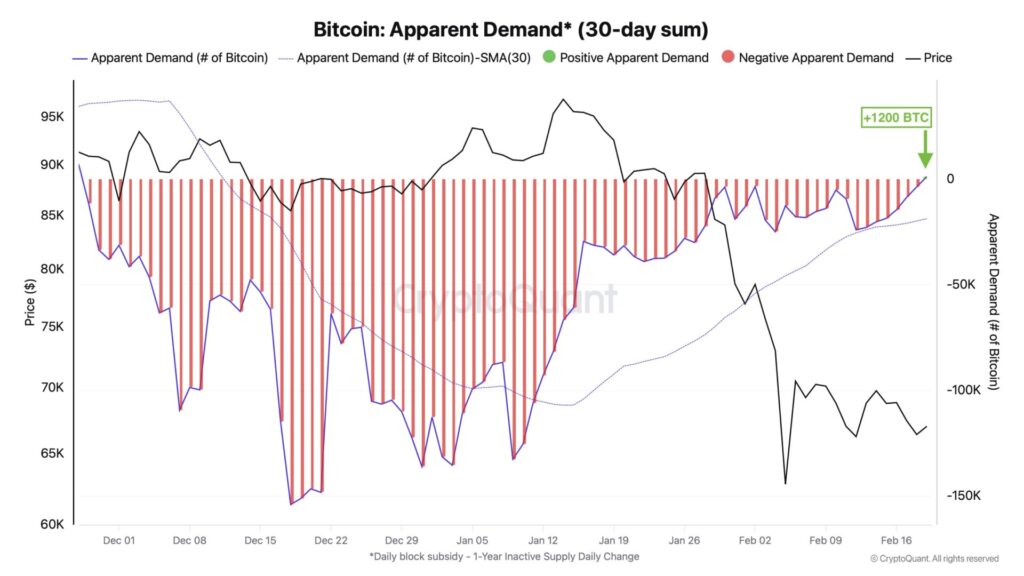
Image source: CryptoQuant – @Darkfost_Coc/X
This reversal ends nearly three months of consecutive negative demand, which was a primary factor behind Bitcoin’s prolonged price stagnation.
Related Articles
The US restores accelerated depreciation policy, allowing Bitcoin miners to achieve 100% first-year tax deduction
Anthony Pompliano's Bitcoin Treasury ProCap Buys Back Stock Amid 85% Price Plunge