


Tether Offshore Renminbi Stablecoin Enters History! CNHT Issuance and Redemption Removed Within 1 Year

Tether announces the termination of the offshore Chinese yuan stablecoin $CNH₮, phased out in two stages, and reorganizes its product line amid declining $USDT supply and the rise of $USDC.
Offshore Chinese Yuan Stablecoin Enters History, Tether Implements Two-Stage Exit Strategy
The world’s largest stablecoin issuer, Tether, officially announced last Saturday (2/21) that it will cease all support for its offshore Chinese yuan stablecoin, $CNH₮. This decision marks the start of the token’s phased exit process. Tether stated that this move is part of an internal review and strategic adjustment aimed at ensuring its product offerings meet long-term market demands. The exit process will be carried out in two stages:
- The first stage took effect immediately upon announcement, with Tether halting all minting and issuance of new $CNH₮ tokens. Currently, there is no new supply entering the market, and existing circulating tokens will enter a one-year transition period.
- The second stage is scheduled for February 2027, at which point Tether will fully end redemption support for $CNH₮. Before the final deadline, existing holders can still redeem tokens according to Tether’s terms of service.
The company emphasizes that reminders will be sent before termination, and users are advised to complete asset conversions promptly to avoid technical or liquidity issues before the deadline.
Low Demand and High Operating Costs Lead to Strategic Shift Toward Core Assets
Regarding the motivation behind terminating $CNH₮, Tether admits that the token’s market demand has been persistently low, and community adoption has not met expectations. Originally, $CNH₮ was designed to track the offshore Chinese yuan value for international investors, providing liquidity options outside mainland China. However, compared to USD stablecoins, $CNH₮ has very low activity, and its trading volume cannot sustain ongoing operational costs.
Tether evaluates that maintaining the technical support and human resources required for $CNH₮ is no longer commercially viable. The company has decided to streamline its product line, reallocating operational resources from low-demand products to projects with greater market impact and long-term growth potential. Tether’s management principles emphasize that products must be highly sustainable and genuinely meet community needs. By discontinuing $CNH₮ issuance, Tether aims to focus more on enhancing liquidity for its core stablecoins and developing more forward-looking financial tools for users worldwide.
Stablecoin Market Reshuffle, $USDT and $USDC Competition Intensifies
Alongside the delisting of $CNH₮, the stablecoin market is experiencing significant shifts. According to Artemis Analytics data, Tether’s flagship stablecoin, $USDT, saw a noticeable decline in supply in February 2026. As of February 22, the total supply of $USDT dropped below 184 billion, down from approximately 187 billion at the beginning of January, a decrease of 3 billion. If this trend continues, February could record the largest monthly decline since the FTX collapse at the end of 2022.
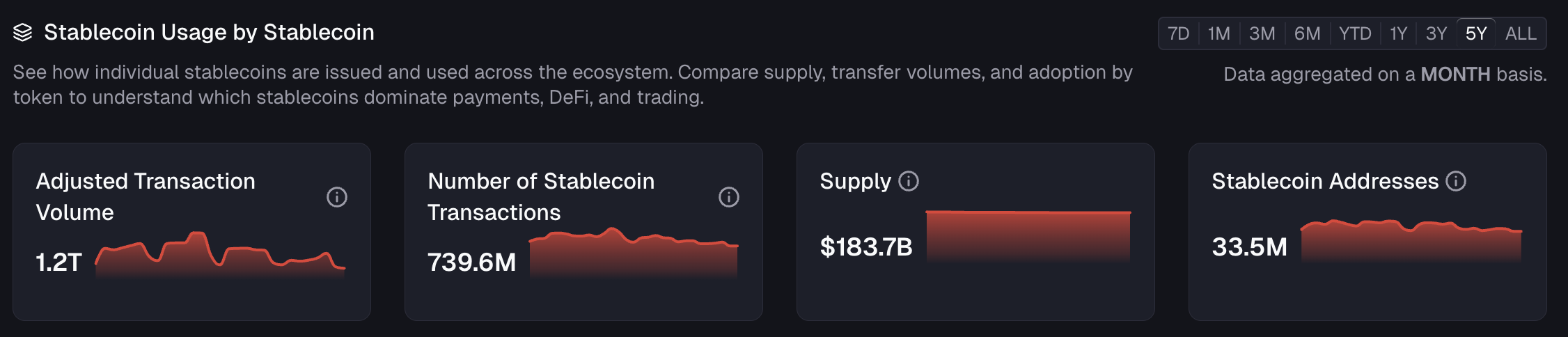
Image source: Artemis Analytics $USDT Data Overview
Meanwhile, Circle’s $USDC has shown strong growth. Its supply increased to 76.4 billion in February, with a monthly growth rate of nearly 5%. Despite fluctuations in individual stablecoin supplies, overall trading activity remains frequent.
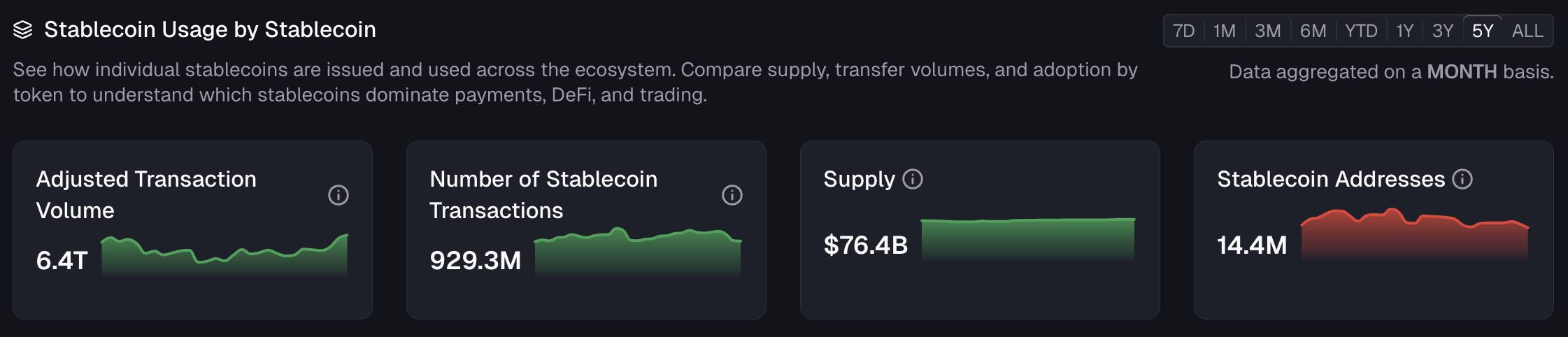
Image source: Artemis Analytics $USDC Data Overview
Looking back to 2025, global stablecoin transfer volumes grew by 72%, reaching 33 trillion USD. Among them, $USDC accounted for 18.3 trillion USD in transactions, while $USDT handled 13.3 trillion USD. These figures indicate that although $USDT holds a market cap advantage, it is engaged in fierce competition with $USDC for transfer applications, prompting Tether to manage its token portfolio more cautiously.
Strong Financial Reserves and Organizational Expansion, Actively Building Tokenization Infrastructure
Throughout its strategic adjustments, Tether has maintained a robust financial system. According to the latest Q4 2025 report, as of September 30, 2025, Tether’s reserve assets totaled $181.2 billion, with total liabilities of $174.4 billion. This means its reserve assets exceed liabilities by approximately $6.8 billion, demonstrating a high level of asset coverage.
This solid reserve base enables Tether to expand into more diverse blockchain applications. Currently, Tether is working to connect traditional assets with blockchain technology; for example, Elemental Royalty has allowed shareholders to receive dividends in Tether Gold (XAU₮), combining gold investment with digital tokens.
Additionally, platforms like Rumble have integrated $USDT and gold tokens into wallets. To support these developments, Tether is expanding its global footprint, with headquarters in El Salvador and offices in Switzerland. The company team has grown to 300 employees and plans to hire an additional 150 engineers over the next 18 months, shifting from a stablecoin issuer to a technology-driven digital asset infrastructure provider.
Related Articles
U.S. Seizes $61 Million USDT, "Pig Butchering" Scam Money Laundering Chain Crumbles
Tether supports Oobit in launching wallet transfer functionality for any bank account worldwide
Tether announces the official discontinuation of support for the offshore RMB stablecoin CNHT, offering a one-year redemption window.
USDT circulating market cap decreased by $1.5 billion in February, marking the largest decline since 2022