


Sell Cardano (ADA) for Bitcoin? Here’s Why the Switch Could Make Sense Now

Crypto feels heavy again.
After months of distribution and fading rallies, the market resembles prior bear cycles. Bitcoin is down roughly 30% over the past 12 months. Cardano (ADA) is down closer to 60% over the same stretch. Liquidity is weak. ETF flows have cooled. Retail enthusiasm has faded.
This environment looks more like 2018 or 2022 than 2021.
So the question becomes uncomfortable but practical: does it make sense to rotate from ADA into Bitcoin at this stage of the cycle?
Let’s look at history.
- Bitcoin Leads, Altcoins Follow
- Cardano’s Recent Underperformance
- Bear Market Risk: ADA vs BTC
- So… Does the Switch Make Sense?
Bitcoin Leads, Altcoins Follow
In previous cycles, Bitcoin moved first.
After the brutal 2018 bear market, Bitcoin bottomed near $3,200 in December 2018. By mid-2019, BTC had already rallied above $13,000 — a 4x move — while most altcoins lagged significantly behind. Many never recovered meaningfully until much later.
The same pattern repeated after the 2022 crash. Bitcoin bottomed around $15,500 in late 2022. By early 2023 and into 2024, BTC reclaimed $30,000, then pushed toward new highs. The early stage of that move was Bitcoin-dominant. Altcoin dominance remained muted for months.
Capital flows into Bitcoin first during recovery phases. It is the most liquid, the most trusted, and the primary institutional on-ramp. Only after BTC stabilizes and gains confidence does capital rotate into higher-risk altcoins.
If a new bull phase begins in late 2026 or 2027, odds favor Bitcoin leading again.
To be clear – that does not guarantee it. But historically, it has been the pattern.
Cardano’s Recent Underperformance
Cardano’s last cycle was painful for long-term holders.
During the 2020–2021 bull run, ADA pumped aggressively, peaking above $3. But in the 2023–2025 recovery phase, it struggled to regain momentum compared to major competitors.
Ethereum pushed to new cycle highs. Solana broke past previous all-time highs and became one of the strongest performers of the cycle. XRP also hit new all-time high in the summer of 2025.
ADA, by contrast, never reclaimed its former highs. It failed to generate sustained upside momentum when liquidity returned to the market.
For holders who stayed through 2024 and into 2025 and 2026, that relative weakness has been frustrating.
When an asset fails to outperform during favorable conditions, investors start asking hard questions about opportunity cost.
Read also: Big XRP and ADA Market Caps Just Found a Tax-Free Liquidity Shortcut on Base
Bear Market Risk: ADA vs BTC
Another factor is downside protection.
If the bear market extends through 2026, risk assets may face additional pressure. Historically, Bitcoin falls less than mid-cap altcoins during deep corrections.
The data supports this dynamic. Over the past 12 months, ADA is down around 60%. Bitcoin is down roughly 30%. In downturns, capital tends to consolidate into the most liquid and established asset.
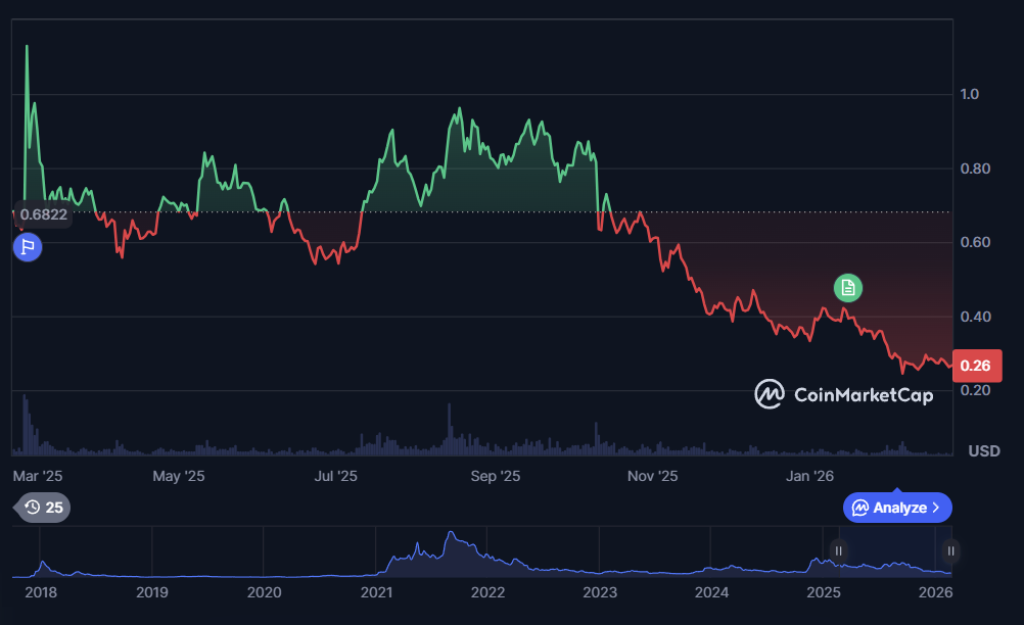
Source: CoinMarketCap/ADA’s 1-year price action
Bitcoin has stronger institutional support, deeper liquidity, and broader global recognition. That often cushions drawdowns relative to altcoins.
If macro conditions worsen, ADA could decline faster than BTC. The volatility gap cuts both ways: it creates upside potential in bull phases, but it magnifies pain in bear phases.
So… Does the Switch Make Sense?
This is not a blanket call to sell ADA. Cardano still has a loyal community, ongoing development, and long-term ambitions.
But from a cycle-rotation perspective, shifting some capital into Bitcoin during late bear phases has historical backing.
If a new bull market begins, Bitcoin likely moves first. If the bear deepens, Bitcoin may hold value better.
That is the trade-off.
ADA offers higher theoretical upside. Bitcoin offers stronger relative safety and first-mover momentum when cycles turn.
The smarter move may not be all-in on one side. It may be about understanding cycle dynamics, relative strength, and risk tolerance.
In bear markets, capital preservation matters. In early bull markets, leadership is important as well. Historically, Bitcoin has delivered both.
Related Articles
DDC purchases an additional 50 Bitcoins, bringing the total holdings to 2,118 Bitcoins.
South Korean police arrest two suspects involved in the theft of 22 Bitcoin evidence
Analysis: Multiple Bitcoin mining company stocks defy the trend and strengthen, with short covering and electricity advantages being key drivers