


Who is Jane Street?
Written by: CoolFish
A company with 3,000 employees earns more than Citibank and Bank of America. It doesn’t advertise, has no CEO, and doesn’t sign non-compete agreements. Its name rarely appears in the news—until it finds itself in the defendant’s seat.
On February 24, Terraform’s liquidators sued Todd Snyder, accusing high-frequency trading giant Jane Street of insider trading, illegal profits, and accelerating the collapse of Do Kwon’s crypto empire.
Although Jane Street denied the allegations, claiming they are unfounded, market attention has already begun to shift toward this firm. At the same time, a Jane Street intern recruitment post surfaced on Twitter.
The screenshot shows the company is hiring quantitative trading interns, with a four-month contract and a base salary of $300,000. The key point is they don’t require a finance background or programming experience—only one question: can you solve puzzles?
The first glance at the salary and requirements was truly shocking. Who exactly is this company? Is a quant intern’s salary really that high? How does it make so much money? What role does it play in the global financial markets?
These questions deserve serious answers.
Because when you peel back layers of low profile and truly understand this company, you realize one thing: Jane Street’s existence is itself an extreme experiment in information, speed, and rule boundaries.
Its name rarely appears in the news—until it appears in the defendant’s seat.
A Windowless Room and Four Gamblers
1999, New York.
Three traders from Susquehanna International Group (SIG), plus a programmer who left IBM, rented a windowless small office and started a business most people looked down upon: ADR arbitrage.
ADR, American Depositary Receipt, is a certificate representing foreign company stocks traded in the U.S. market. Its price should theoretically align with the underlying shares listed in the home country, but time zone differences, exchange rate fluctuations, and information delays create tiny gaps. The four founders of Jane Street—Tim Reynolds, Robert Granieri, Michael Jenkins, and Marc Gerstein—focused on these gaps, using algorithms and speed to profit.
This business was straightforward: no grand narrative, no industry disruption ambitions—only an extreme sensitivity to numbers and a pathological pursuit of execution.
Research firm Alphacution suggests the company was initially registered under the name “Henry Capital,” and renamed Jane Street in August 2000. Publicly, they were almost obsessively low-profile.
This obsession seems to be part of the company’s DNA from the start.
Of the four founders, three came from the same company and left to start their own. Susquehanna even sued Jane Street for “stealing proprietary information to poach core talent”—though the lawsuit was ultimately dropped. This sensitivity may have profoundly influenced Jane Street’s later approach to secrecy: no media interviews, no industry conference speeches, no unnecessary exposure.
They quietly worked in that windowless room, solving puzzles.
ETF: The Bet That Changed Everything
In the early 2000s, Jane Street made a decision that would prove transformative: to focus mainly on ETFs, which at the time were still niche products.
ETFs (Exchange-Traded Funds) were relatively marginal in the early 2000s—low liquidity, few participants, and large institutions found it inconvenient to trade in and out, so they largely avoided it. But this “neglect” made it an ideal hunting ground for Jane Street.
Market makers are central to this game. They quote both bid and ask prices, ready to trade with any counterparty, earning from the bid-ask spread. It sounds simple, but doing it requires millisecond-level precise pricing, managing large inventory risks, and maintaining continuous operation across global markets.
Jane Street achieved this with algorithms—fast and accurate.
What followed is one of the classic “choosing the right track” stories in history.
Over the next two decades, ETFs exploded—from a few trillion dollars to over ten trillion. Institutions, retail investors, and pension funds flooded in. Jane Street had become one of the most indispensable infrastructures in this market.
3,000 People Outselling Citibank and Bank of America
Here’s a set of numbers that vividly illustrate Jane Street’s profitability:
In 2024, Jane Street’s net trading revenue: $20.5 billion.
In the same year, Citigroup’s trading division net income: $19.8 billion. Bank of America’s trading division: $18.8 billion.
Jane Street beat them, with a $700 million margin over Citibank, and $1.7 billion over Bank of America.
According to online data, Citibank has about 220,000 employees worldwide. Bank of America has about 210,000. Jane Street has over 3,000 employees.
This is an almost perverse level of efficiency.
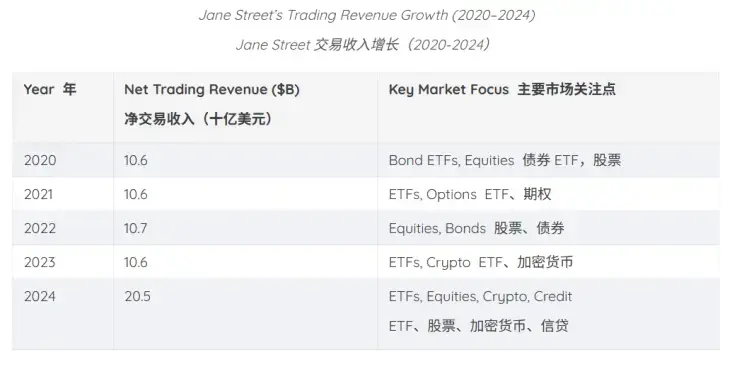
Source: MSTIMES
And by 2025, the data becomes even more astonishing. According to Bloomberg and others, Jane Street’s Q2 net trading revenue in 2025 reached $10.1 billion, surpassing all major Wall Street banks. Total revenue for the first three quarters of 2025 hit $24 billion—exceeding the entire 2024 annual total…
Putting these figures into industry context: Citadel Securities’ 2024 trading revenue was about $9.7 billion, Virtu Financial about $2.9 billion, Flow Traders about $500 million. Jane Street’s lead is at least double.
Beyond scale, market share data helps reveal how deeply this company has penetrated:
In 2024, Jane Street held 24% of the US-listed ETF primary market, 41% of bond ETF trading volume, and 17% of European ETF secondary market trading. Its average monthly stock trading volume reached $2 trillion, accounting for about 8% of all options traded by Options Clearing Corporation, and over 10% of North American stock trading.
In other words: you, your fund, your pension—every ETF trade you make—there’s a significant chance Jane Street is on the other side, and you might not even know it.
OCaml, Puzzles, and the Real War Machine
Jane Street’s headquarters is at 250 Vesey Street, Manhattan’s financial district. Inside, there’s a real WWII Enigma machine—used by Nazi Germany to encrypt communications.
It’s not just decoration; it’s a declaration.
The company loves encryption, puzzles, and building its world with languages only a few can understand.

Jane Street’s core trading system is programmed in OCaml.
OCaml is a functional programming language known for its strong type system and logical rigor, but it’s almost unheard of in finance. As of 2023, Jane Street’s OCaml codebase exceeds 25 million lines—half the size of the Large Hadron Collider’s codebase, according to the Financial Times.
This choice seems odd, but it’s rooted in engineering logic: in financial trading systems, a single bug can cause hundreds of millions in losses. OCaml’s type system forces errors to be caught at compile time, reducing runtime crashes more effectively than C++.
The side effect: engineers who work at Jane Street often find it hard to be hired elsewhere because of their OCaml expertise. Headhunters say: “People stay at Jane Street because they love it, but also because no one else can use OCaml to poach them.”
This creates an unexpected moat: a talent lock-in through technology.
It’s worth noting that Jane Street has no CEO.
No hierarchical bureaucracy, no management layers, no titles like “Vice President” or “Managing Director”—familiar terms in finance.
The Financial Times describes it as “an extremely profitable anarchist commune.”
The company is run by 30-40 senior employees making decisions collectively, through a management and risk committee. These 40 own about $24 billion worth of equity, operate trading desks and business units, but they are not called “president” or “CEO”—they are simply owners.
All employee compensation is tied to the company’s overall profits, not individual trading performance. No one risks beyond limits for personal bonuses, because losses are shared, and gains are shared.
In 2024, Jane Street paid about $1.4 million in total compensation per employee for roughly 3,000 staff.
That intern recruitment screenshot isn’t marketing hype—it reflects Jane Street’s self-awareness: they’re not looking for finance experts, but “people who love solving interesting problems.”
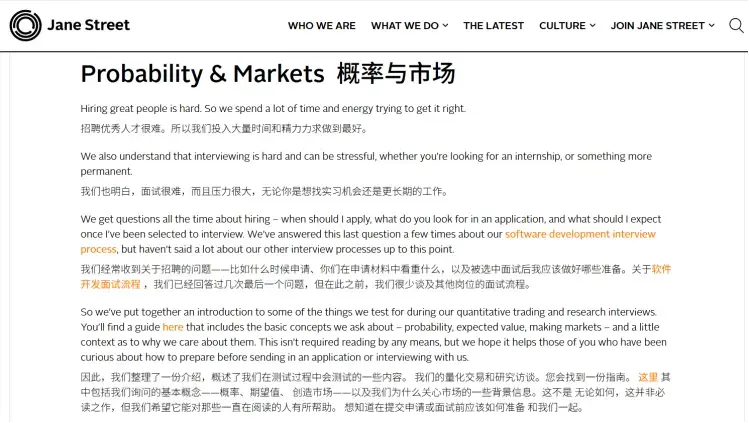
“The interview process is notoriously difficult.” Candidates must solve probability puzzles, game theory problems, and expected value calculations under pressure—testing core logic, not industry knowledge. According to the company, only a “tiny fraction” of applicants are invited to interview.
The company does not use non-compete agreements—rare in finance, where such clauses are almost standard. Jane Street believes its competitive advantage isn’t a particular algorithm but its entire system’s culture and density of capability—something hard to replicate.
A senior quant at a hedge fund notes: “Jane Street is a trader’s world, while Citadel Securities is more for quants and developers. ‘Jane Street is trader-oriented, Citadel is more systematic,’ he explains. ‘Traders are more social, which explains the relaxed, poker-playing culture at Jane Street.’”
Michael Lewis, author of the SBF biography Going Infinite, recalls that when SBF was at Jane Street, the trading floor had a “sound system”: different alert tones for different trading states—Homer Simpson’s “D’oh!”, Mario’s 1-Up sound, even the famous “You must construct additional pylons” from Starcraft.
Noise was everywhere. Some even thought their traders were playing video games because of the chaos.
This relaxed, deliberately quirky atmosphere is a cultural marker they maintain while operating at full throttle.
SBF and the 2016 Election Night: From Profit to Loss
In 2014, a young MIT graduate joined Jane Street, earning $300,000 in his first year.
His name was Sam Bankman-Fried, known as SBF.
He later founded FTX, then destroyed it, and was sentenced to 25 years. But during his three years at Jane Street, he left a night that became one of the company’s most dramatic chapters.
In his first interview, SBF was not asked “what did you do over the summer,” but faced a series of game-like tests—really gambling games. He had to quickly solve math or probability problems, like “What’s the probability of rolling at least one three with two six-sided dice?” or “What’s the probability of rolling two threes with two dice?” These questions were easy for SBF, and he thrived.
As the questions grew more complex and the pace quickened, his performance improved. He “immediately realized that the key to the game was making quick judgments about expected value in bizarre scenarios and acting on them.” He understood that “they were testing his judgment and execution under chaos—not just the answers.”
This game mode was meant to evaluate future traders’ potential. But the real payoff was applying these skills in real trading.
And that came two years later.
During the 2016 U.S. presidential election, Jane Street traders believed that if Trump won, global stocks would plummet. Lewis reveals that to gain an edge, Jane Street tasked SBF with designing a system to predict election results.
Their goal: know the outcome before CNN, and trade faster than anyone else.
SBF assigned different traders to analyze voting data from each state. The system worked astonishingly well—Jane Street predicted results in key states minutes or hours earlier than CNN.
On election night, the system sent a signal shortly before dawn: Florida’s vote data heavily favored Trump, with his probability jumping from 5% to 60%.
“We even had time to panic, think there was a mistake, confirm there wasn’t, and then say: ‘To hell with it, sell.’”—SBF told biographer Michael Lewis later.
According to Lewis, Jane Street shorted the S&P 500 index, with positions totaling billions of dollars, betting on a market crash if Trump won.
By the time SBF went to sleep, the position had a $300 million unrealized profit. It was the company’s biggest single profit ever.
Three hours later, he returned to the trading desk to find the world had changed.
Markets digested Trump’s victory and started to rise.
U.S. markets didn’t fall—they rose—because many saw Trump as pro-business.
Jane Street’s short position was squeezed in this rally.
“That trade, which was Jane Street’s biggest profit, turned into the biggest loss—$300 million—overnight.”—SBF
From +$300 million to -$300 million, a $600 million swing in one night.
Jane Street didn’t punish SBF. They chose another way to evaluate: his prediction system was accurate; the mistake was in market reaction judgment, which isn’t purely mathematical. It’s said he was even praised internally for the precision of his prediction machine.
With excellent trading performance, SBF was paid $300,000 in his first year, $600,000 in the second, and a $1 million bonus in the third. It’s estimated that if he kept this up, his annual salary in ten years could reach $75 million.
But he left to build Alameda Research and FTX—then again made history in a different way.
The Outgoing List of Jane Street
After FTX’s collapse, it was shocking to find that many key figures involved in the incident had Jane Street backgrounds:
SBF himself (Jane Street trader, 2014–2017). Caroline Ellison (CEO of Alameda, SBF’s ex-girlfriend, former Jane Street trader). Gabe Bankman-Fried (SBF’s brother, briefly a Jane Street trader). Lily Zhang and Duncan Rheingans-Yoo (former colleagues of SBF, later founded Modulo Capital with about $400 million from Alameda, headquartered in SBF’s Bahamas residence).
The density of this circle is hard to ignore.
Jane Street cultivated some of the most influential people in the crypto world of this era—however you define “influential.”
Partly because his brother had just left and started poaching talent from Jane Street to his own competing firm. Insiders say the brothers once almost didn’t speak for a long time.
A $1 Billion Secret
This story begins with a lawsuit, which unexpectedly ignited an even bigger crisis.
In February 2024, two Jane Street traders—Douglas Schadewald and Daniel Spottiswood—suddenly resigned and joined hedge fund giant Millennium Management.
Jane Street immediately sued them and Millennium in April, accusing them of stealing a “highly valuable” proprietary trading strategy.
What was the core of this strategy? A detail in court revealed: it was a short-term index options strategy targeting the Indian market—bringing Jane Street over $1 billion in profit in 2023 alone.
Specifically, after the traders took this strategy to Millennium, Jane Street’s profits in India plummeted 50% in March 2024, while Millennium’s India operations expanded rapidly.
In December 2024, the case settled under confidentiality, with undisclosed terms.
But the “$1 billion India options strategy” disclosed in the lawsuit drew the attention of India’s SEBI. Many retail investors in India suffered heavy losses in options trading—why could a foreign firm earn such huge profits?
On July 3, 2025, SEBI issued a 105-page interim order, announcing its investigation findings.
SEBI’s description painted a picture:
Every expiry of Bank Nifty options, Jane Street’s algorithms would buy large amounts of Bank Nifty stocks and futures after market open (9:15–11:46), sometimes accounting for over 20% of total market volume, including key stocks like Kotak Bank, SBI, Axis Bank. Meanwhile, Jane Street built large short positions in options—selling calls, buying puts.
In the afternoon (11:49 until close), Jane Street would reverse: selling off the stocks and futures bought in the morning, exerting downward pressure on the index. The closing prices would fall, and the short options positions would profit massively.
On a key day under SEBI’s scrutiny, Jane Street lost about $7.5 million on spot and futures but gained about $89 million on options—net profit of $81.5 million.
From January 2023 to March 2025, SEBI estimates Jane Street’s total trading profits in India reached 365.02 billion rupees (~$4 billion). It earned 432.89 billion rupees (~$5 billion) from index and stock options, but lost 72.08 billion rupees (~$800 million) in stock futures.
“This outrageous behavior blatantly disregards NSE’s explicit warnings issued in February 2025, clearly showing that Jane Street is not a well-intentioned market participant like most foreign institutions, and cannot be trusted.”—SEBI
SEBI also added a disturbing background: it had previously found that 93% of retail options traders in India lost money, with annual losses exceeding 1 trillion rupees, while professional trading firms—represented by Jane Street—profited handsomely.
On July 4, 2025, SEBI suspended all trading permissions for Jane Street in India, froze bank accounts, and prohibited unauthorized deductions.
On July 14, Jane Street deposited about 4.84 billion rupees (~$560 million) into escrow to resume trading. On July 21, SEBI allowed it to reopen, under the condition of ongoing investigation.
Jane Street denied all allegations in internal memos, calling SEBI’s charges “a desperate lawsuit and transparent extortion.” They argued that the losses of Terra and Luna investors stemmed from “billions of dollars of fraud” by Do Kwon and Terraform’s management, and vowed to fight back.
They are not wrong. Do Kwon pleaded guilty and was sentenced to 15 years; Terraform paid a $4.47 billion fine.
But “being guilty of Do Kwon” and “being innocent of others” are two separate issues.
A building with structural flaws is a fact. When it collapses, someone has already moved the most valuable items out—another legal issue altogether.
What Is This Company Anyway?
Jane Street’s story is hard to sum up in one word.
It’s “one of Wall Street’s most profitable firms,” as $20.5 billion net income in 2024 proves.
It’s “an elite talent filter,” with extremely low admission rates, a rare OCaml skill set, and top-tier salaries pointing to that.
It’s “a deep player in rule gray areas,” with SEBI’s 105-page ruling, Terraform’s lawsuit, Millennium’s secret settlement—all pointing to that.
It may be all of these at once.
In financial markets, asymmetric information always exists. Jane Street’s uniqueness lies in leveraging this asymmetry at a systemic level.
“At Jane Street, a trader isn’t truly excellent unless they can explain why they’re excellent.”—Michael Lewis, Going Infinite
What is the true market price at any moment? Where are the mispricings? How to discover and trade faster than everyone else? These questions—Jane Street seems to be constantly solving puzzles.
Mathematical puzzles in interviews can be riddles; Terra’s collapse can be a riddle; why Bitcoin “crashed at 10 o’clock” after being sued is also a riddle.
Jane Street describes itself as “a collection of puzzle solvers.”
But when market eyes turn to Jane Street itself, it becomes a puzzle too.
Related reading: the $40 billion collapse, the daily 10 o’clock “knife”—all point to the same name: Jane Street.