


Pi Network Price Faces Technical Resistance in March 2026 as GCV Narrative Divides Community

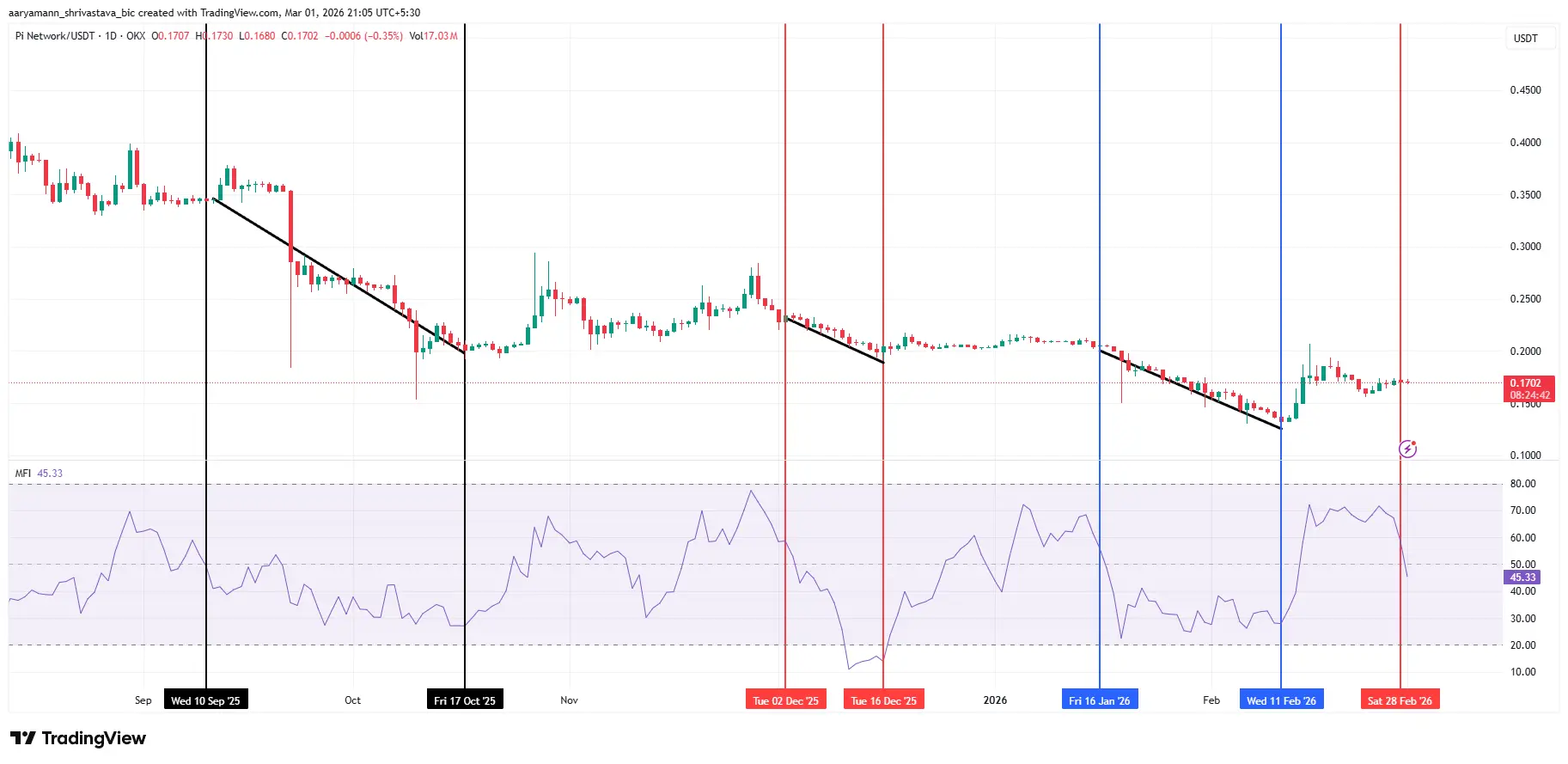
Pi Coin is trading at approximately $0.1701 as of March 2, 2026, attempting to recover from a new all-time low earlier this year while facing significant technical resistance and persistent capital outflows. The asset’s Money Flow Index has fallen below the neutral 50 level, and the Chaikin Money Flow indicator has remained negative for nearly three consecutive weeks, signaling sustained selling pressure.
Concurrently, the Pi community remains divided over the “Global Consensus Value” narrative proposing a $314,159 valuation per token, a figure derived from the mathematical constant π that lacks official endorsement from the Pi Core Team or validation from exchange-based price discovery.
Technical Indicators Signal Continued Weakness for Pi Coin
Pi Coin’s price action in early March 2026 reflects broader technical challenges following a volatile February. The asset is holding above an ascending trendline support at $0.1597, with immediate resistance established at $0.1752. However, momentum indicators suggest that sustained upside may prove difficult in the coming weeks.
 (Source: TradingView)
The Money Flow Index has slipped below the neutral 50 threshold, indicating that capital outflows are outpacing inflows. Historical patterns show that when MFI crosses below this level for Pi, prices tend to continue declining until buying momentum returns. Current readings suggest sellers remain active, and unless the indicator rebounds above 50, downside risks may outweigh short-term recovery attempts.
The Chaikin Money Flow indicator reinforces this cautious outlook, having remained below the zero line for nearly three consecutive weeks. This persistent negative reading signals ongoing net outflows from Pi Coin, reflecting fading investor confidence and reduced participation from new buyers. Without fresh capital entering the ecosystem, upward price movements may lack sustainability, limiting breakout potential and increasing vulnerability to corrections.
Pi Coin is tracking a 16% loss for the first quarter of 2026 following mixed results in January and February. If selling pressure intensifies, the asset may decline toward the $0.1597 support level. A breakdown below that threshold would likely expose $0.1502, with continued weakness potentially pushing the price closer to the all-time low of $0.1300.
The bearish thesis would be invalidated only if buyers regain control. A decisive breakout above $0.1752 would be the first signal of strength, and flipping $0.2002 into support would confirm renewed bullish momentum. Sustained inflows and improved sentiment would be required to support such a move.
March Historical Volatility Weighs on Investor Sentiment
March has historically been a volatile month for Pi Coin. In March 2024, the token declined by 66.5%, marking its weakest monthly performance on record. That steep drop followed its initial launch phase, when early participants moved quickly to secure profits.
While those specific launch-related dynamics do not fully apply today, the memory of extreme volatility continues to shape investor caution entering March 2026. The combination of historical precedent and current technical weakness creates a challenging environment for sustained price appreciation.
GCV Narrative Gains Traction Despite Lack of Market Validation
A parallel development within the Pi community involves the widespread discussion of a “Global Consensus Value” suggesting that 1 Pi should equal $314,159. This figure references the mathematical constant π (3.14159) multiplied by 100,000, giving the target symbolic meaning rather than economic grounding.
The GCV concept originated from Pi barter communities and social media campaigns, not from the Core Team itself. Supporters actively promote the concept across social platforms, framing it as a unified valuation model based on community agreement rather than market forces.
The Pi Core Team has never officially acknowledged the GCV as legitimate, emphasizing instead that Pi’s true value will be determined by free-market forces once the Open Mainnet achieves full functionality. No official exchange listings or verified trading markets support the $314,159 figure, making the claim purely speculative at this stage.
Critics highlight several fundamental issues with the GCV narrative. If each Pi were worth $314,159, the network would be valued at over $31 trillion, exceeding annual global economic output and far surpassing Bitcoin’s entire market capitalization. With a supply of approximately 100 billion coins, Pi is not scarce like Bitcoin, making such valuations mathematically implausible under current conditions.
Currently, Pi trades on limited exchange venues at market-set prices that vary by platform, with figures reflecting speculative interest in the absence of broader market access.
Ecosystem Development Progresses Amid Price Uncertainty
Pi Network marked the one-year anniversary of its Open Network launch in February 2026, releasing key metrics that highlight ecosystem growth despite price weakness. Approximately 16.2 million users have completed migration to the mainnet, with 17.7 million having passed Know Your Customer verification.
The network currently maintains over 421,000 active nodes supporting decentralization and network stability. More than 300 ecosystem applications have launched on the mainnet, and the Pi Maps platform lists approximately 148,000 merchants accepting Pi as payment.
The project’s leadership has reiterated the “utility-first” development path, emphasizing that Pi differs from initial coin offering-driven or short-term speculation projects by building around mobile mining, identity verification, and local business applications. The stated goal is to drive practical daily payments and use cases rather than price speculation.
The 2026 development roadmap includes three strategic priorities: ecosystem tokens running parallel to Pi with automated market maker functionality, expansion of KYC infrastructure as a service for other Web3 projects, and artificial intelligence integration to optimize platform operations and developer productivity.
Despite these developments, community sentiment remains mixed. Some supporters endorse the utility-first strategy as beneficial for long-term adoption, while others express frustration with KYC approval timelines, migration progress, and the pace of decentralized functionality rollout.
Market Outlook and Key Levels
Pi Coin’s near-term trajectory depends on several factors. Technical indicators suggest that March may bring continued corrective pressure unless buying demand improves meaningfully. The $0.1597 support level represents a critical threshold, with a breakdown potentially accelerating losses toward the all-time low.
On the fundamental side, expanded exchange access, deeper liquidity, and demonstrable real-world use cases will play decisive roles in price formation. The network’s ability to convert its sizable user base into stable daily applications and payment demand will determine whether its mobile-first, KYC-driven approach generates sustainable value.
The GCV narrative, while generating community excitement and engagement, currently lacks market validation. Sustainable value ultimately depends on demand, liquidity, and real utility rather than symbolic consensus. Until open trading, functional applications, and regulatory clarity materialize, such valuations remain aspirational rather than grounded in economic reality.
FAQ: Pi Network Price and GCV
What is the Global Consensus Value (GCV) in Pi Network?
GCV is a community-suggested valuation proposing that 1 Pi Coin should equal $314,159, a figure derived from the mathematical constant π. The concept originated from barter communities and social media campaigns, not from the Pi Core Team, and has never been officially endorsed or validated by exchange-based price discovery.
Why is Pi Coin facing resistance in March 2026?
Technical indicators including the Money Flow Index and Chaikin Money Flow show persistent capital outflows and selling pressure. March has historically been volatile for Pi, with a 66.5% decline in March 2024. The asset is currently trading near $0.1701 with support at $0.1597 and resistance at $0.1752.
What are the key ecosystem metrics for Pi Network?
As of February 2026, approximately 16.2 million users have migrated to mainnet, 17.7 million have completed KYC verification, and over 421,000 active nodes support the network. More than 300 applications have launched on mainnet, with about 148,000 merchants accepting Pi through the Pi Maps platform.
Related Articles
Pi Network Rolls Out Phase 2 Protocol Upgrades With Mandatory Node Deadline
Pi Network Completes March Upgrade With 421K Active Nodes
Pi Network’s SECRET March Explosion – You’re NOT Ready
Pi Network Urges Mainnet Node Operators to Upgrade Before Key Deadline
Pi Network March technical deterioration, is the historical curse repeating?
Pi Network Celebrates One Year of Open Network: A Look at the 2026 Key Metrics