


Relying on cryptocurrencies for emergency hedging? Within minutes of the U.S. and Israel airstrikes, Iran exchange outflow surged by 700%
After the U.S. airstrike on Tehran, Nobitex experienced a 700% surge in capital outflows, with cryptocurrencies becoming a tool for Iran’s capital flight and risk hedging.
Geopolitical turmoil sparks panic, with millions fleeing through cryptocurrencies
Last Saturday, U.S. and Israeli forces launched a joint airstrike on Tehran, Iran’s capital, and confirmed the killing of Iran’s Supreme Leader Ayatollah Ali Khamenei, triggering intense market volatility.
According to the latest data from blockchain analysis firm Elliptic, within minutes of the initial strike, capital outflows from Iran’s largest cryptocurrency exchange Nobitex surged by an astonishing 700%. Experts view this movement as an emergency risk-avoidance measure, reflecting that investors inside Iran, amid extreme political instability, are attempting to achieve “capital flight” through digital assets to bypass traditional banking regulations and potential asset freezes.
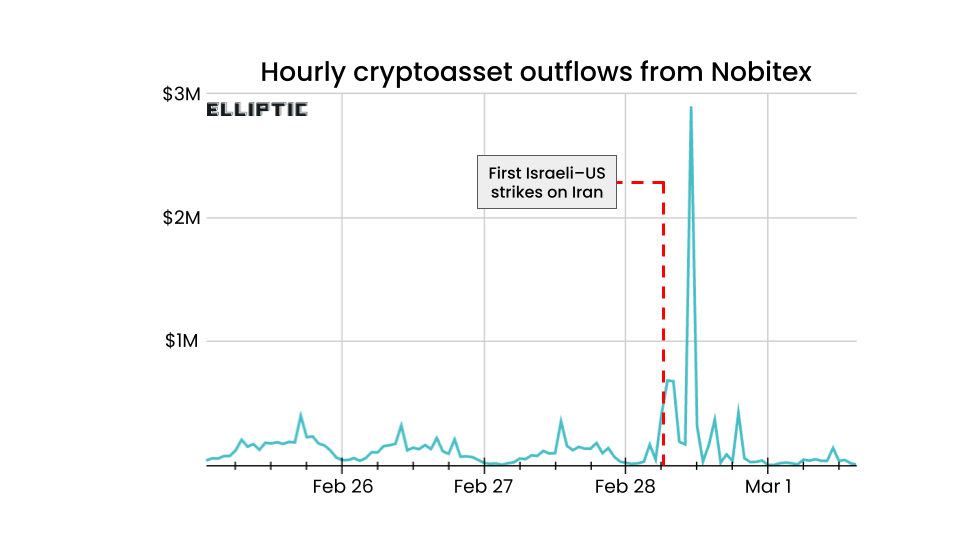
Image source: Elliptic. Within minutes of the initial strike, capital outflows from Iran’s largest crypto exchange Nobitex skyrocketed by 700%.
Elliptic’s report states that Nobitex’s withdrawal volume immediately spiked after the attack, with outflows in a single hour approaching $3 million. Preliminary on-chain tracking shows most of these funds were transferred to overseas exchanges with a history of receiving Iranian funds.
Elliptic co-founder and Chief Scientist Dr. Tom Robinson analyzed that this phenomenon indicates investors are leveraging blockchain’s decentralization to bypass traditional banking systems for asset transfers.
Especially as the Iranian Rial continues to depreciate, Nobitex, as the core of the country’s digital asset ecosystem, provides users with a channel to convert fiat into cryptocurrencies and withdraw to external wallets. In the extreme circumstances of war, this has become the last line of defense for locals to preserve their assets.
Network blackouts and data disruptions restrict digital asset flows amid physical infrastructure challenges
Although the initial capital outflow was massive, this trend did not continue to expand. Blockchain forensic platform TRM Labs observed that after Saturday’s airstrikes, Nobitex’s outflows sharply declined. This is not due to easing panic but because the Iranian government has implemented extremely strict internet controls.
Data shows that shortly after the conflict erupted, Iran’s nationwide internet connectivity plummeted by about 99%, nearly entering a complete blackout. TRM Labs offers a different interpretation from Elliptic, suggesting that current data cannot confirm ongoing capital flight, but instead indicates that under strict government internet censorship, Iran’s crypto ecosystem is experiencing a broad contraction in trading volume and liquidity.
Even in environments with network disconnection, on-chain data still shows some funds continuing to flow out, implying that certain users or institutions may have special connectivity channels allowing continued management of their crypto assets when websites are inaccessible. This data flow game reveals the dual role of cryptocurrencies in global geopolitical conflicts: they serve as safe havens for people escaping financial turmoil, yet their operation is heavily constrained by physical communication infrastructure and government enforcement.
Elliptic also notes that while cryptocurrencies can bypass banking restrictions, the transparency of blockchain is a double-edged sword; law enforcement and compliance agencies can track the movement of these funds more quickly and accurately than traditional finance, which is crucial for monitoring and regulating circumvention.
Bank system collapse and sanctions pressure drive the expansion of Iran’s crypto economy
Iranian investors’ reliance on cryptocurrencies is growing daily, rooted in the country’s fragile financial system and long-standing international sanctions. In October 2025, Iran’s largest private bank, Ayandeh Bank, declared bankruptcy with losses of $5.1 billion and debts of $3 billion, affecting over 42 million customers. Subsequently, the Central Bank of Iran issued warnings that eight other local banks face dissolution if reforms are not implemented. Under the dual blow of losing trust in traditional banks and the Rial’s sharp decline, cryptocurrencies have shifted from speculative tools to essential means for Iranians to store value and transfer funds.
Nobitex plays a pivotal role in this ecosystem, handling about 87% of crypto transactions within Iran. In 2025, the platform processed a total of $7.2 billion in transactions and had over 11 million users. Notably, Elliptic previously linked this exchange to financial activities associated with the Islamic Revolutionary Guard Corps (IRGC), and in January 2026, detected that Iran’s central bank allegedly used the platform to support its weakening national currency.
With multiple U.S. sanctions targeting Iranian proxies, cryptocurrencies are widely viewed as key tools for sanctions evasion and acquiring hard currency. However, Nobitex itself faced cybersecurity challenges, including a $81 million hack in June 2025 that temporarily damaged market confidence in the platform.
Global markets shake and quickly rebound, with Bitcoin showing war sensitivity
The sudden escalation of Middle East tensions caused sharp fluctuations in the global crypto markets following the airstrike news. Bitcoin ($BTC) plummeted sharply after the attack, briefly falling below $64,000, then rebounded around $65,000. Ethereum ($ETH) and other major tokens also declined, with drops reaching about 3.8%. Yet, the recovery was equally rapid; as investors digested war risks, Bitcoin swiftly rebounded to near $68,000, demonstrating strong resilience with “zero panic” sentiment.
This market behavior highlights the high sensitivity of crypto assets under extreme geopolitical stress. Investors are also watching oil supply stability, especially concerns over a potential Strait of Hormuz blockade. If oil prices surge due to conflict, global inflation expectations could shift the Federal Reserve’s monetary policy, impacting risk assets like cryptocurrencies.
Currently, markets generally believe that although initial airstrikes triggered localized liquidity crises and capital outflows, the role of cryptocurrencies as a global safe haven is strengthening—especially in regions like Iran with compromised financial sovereignty—making digital assets an indispensable “shadow economy” pillar.
Related Articles
DeFi Total Value Locked Reaches $90B with Ethereum Maintaining 58.8% Dominance
Vitalik Buterin Warns Ethereum Upgrade Could Shift Centralization Risk
Big Brother Maqi deposited $250,000 to add to his ETH position this morning, and now the account has only $73,000 remaining.
As the market declines, Magi Ethereum long positions are partially liquidated again.
The swing whale "pension-usdt.eth" has completed its position at an average price of $67,522. Currently, the BTC long position size has reached $66.5 million.