


Visa leads 72% of cryptocurrency cards, with spending skyrocketing by 525% in one year

According to data from Dune Analytics, the total net transaction volume of crypto cards issued via Visa in 2025 increased by 525%, with spending rising from $14.6 million in January to $91.3 million at the end of December. In the overall crypto card market, Visa holds approximately 72% of the market share, with a transaction volume of $717.9 million.
Visa vs Mastercard: Analyzing the Crypto Card Market Landscape
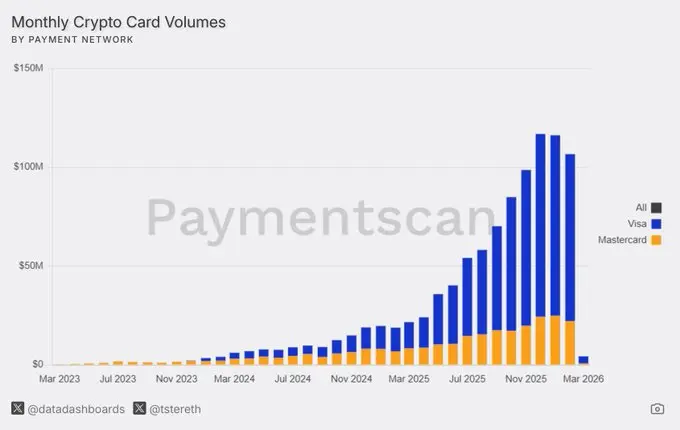 (Source: Paymentscan)
To date, the gap between Visa and Mastercard in the crypto card market is not only significant but also continues to widen. This trend is clearly reflected across three key metrics: transaction volume, where Visa reached $717.9 million and Mastercard $275.1 million; number of transactions, with Visa at 7.208 million and Mastercard at 4.476 million; and active users, with Visa at 145,585 and Mastercard at 119,278.
Currently, six blockchain projects are partnered with Visa to issue crypto cards: payment platforms GnosisPay and Cypher, as well as decentralized finance projects EtherFi, Avici Money, Exa App, and Moonwell.
Six Major Crypto Cards: 2025 Spending Overview
- EtherFi (Visa Credit Card): $55.4 million annual spending, ranked first among the six cards
- Cypher (Visa): $20.5 million annual spending, ranked second
- GnosisPay, Avici Money, Exa App, Moonwell: Smaller but steadily growing spending amounts
- Overall Spending Growth: December spending reached $91.3 million, more than six times January’s $14.6 million
- Monthly Transaction Volume: Visa has consecutively surpassed 1 million transactions in the past two months, aiming for a monthly goal of $100 million
From Experiment to Routine: Visa’s Strategic Deployment of Stablecoin Infrastructure
Behind these figures is Visa’s ongoing strategic effort to deepen integration with the crypto ecosystem. By mid-December 2025, Visa established a dedicated stablecoin advisory team to assist banks, merchants, and fintech companies in deploying and managing stablecoin-based products. Currently, Visa supports stablecoins on four blockchains and continues to strengthen partnerships and infrastructure development.
Polygon researcher Alex Obchakevich noted on X that these data highlight the rapid adoption of cryptocurrencies and stablecoins by users, as well as their strategic role within Visa’s broader payment ecosystem. He emphasized that “the growing transaction volume indicates that cryptocurrencies are moving from experimental phases to mainstream financial use.”
In the broader stablecoin market context, this trend is equally evident. Data from payment platform Bridge shows that total stablecoin transactions have exceeded $2.5 trillion; Chainalysis reports that USDT’s monthly transaction volume peaked at $1.14 trillion in January 2025. The surge in crypto card spending suggests that connecting digital assets with familiar payment channels may be one of the clearest paths to mainstream adoption.
Frequently Asked Questions
Q: Why does Visa hold a 72% share in the crypto card market?
Visa has partnered with six blockchain projects—including EtherFi, GnosisPay, Cypher, and others—to issue crypto cards, and continues expanding its stablecoin infrastructure to support settlement across four blockchains, making its transaction volume more than twice that of Mastercard.
Q: Why is EtherFi ranked first among Visa’s crypto cards?
EtherFi’s Visa credit card allows users to make everyday purchases directly with DeFi holdings. In 2025, it achieved $55.4 million in spending, approximately $34.9 million more than the second-place Cypher. Its unique model of combining DeFi yields with daily spending is a key reason for its leading position.
Q: What does the rapid growth of crypto cards mean for the overall market?
The 525% surge in crypto card spending in 2025 indicates a shift in user behavior—from purely speculative holding to practical daily use. Coupled with initiatives like Visa’s stablecoin advisory team, the mainstream adoption of crypto payments may accelerate faster than market expectations.