Stablecoin Leader Tether Spent a Decade Securing a New USAT Stablecoin Endorsed by Deloitte, Not the $183.6 Billion USDT
(Background: USDT Supply Shrinks Again, Signaling Bottom in 2022! CryptoQuant Analyst: Bitcoin Selling Pressure Exhausted, Possible Reversal)
(Additional context: Tether Invests $150 Million to Acquire Gold.com Stake, Integrates XAUT to Accelerate Gold Token Strategy)
Table of Contents
Toggle
- Receiving Reserve Proof from Deloitte
- Two Accounts: Differences Between USDT and USAT
- The Revolving Door Back to the U.S.
- The Elephant in the Room of $183.6 Billion
- The Most Expensive Trust
- Advantages and Disadvantages of USAT
Over the past decade, whenever someone asked why Tether didn’t get the Big Four accounting firms to audit its USDT reserves, the answer was always the same: “They refuse to take it.”
In 2017, Tether announced hiring Friedman LLP for an audit. Months later, the relationship fell apart. Tether claimed Friedman’s audit procedures were “too cumbersome.” Friedman did not publicly respond.
In 2019, New York Attorney General sued Tether and its affiliated exchange Bitfinex, accusing Bitfinex of misappropriating Tether’s dollar reserves to cover an $850 million shortfall. In 2021, they settled, with Tether paying a $18.5 million fine but denying any wrongdoing.
That same year, the CFTC released troubling data: from June 2016 to February 2019, Tether claimed “each USDT is backed by equivalent USD reserves,” but in a 26-month sampling, only 27.6% of days met full reserve requirements. The CFTC fined Tether $41 million.
Two fines totaling nearly $60 million—was it worth it or too costly?
Receiving Reserve Proof from Deloitte
Today, March 2, 2026, Tether finally received a report from a Big Four firm. Deloitte signed the first reserve proof for USAT stablecoin, confirming $17.6 million in reserves backing 17.5 million USAT tokens in circulation, with a reserve ratio of 100.57%.
This is a historic moment. But the audit target isn’t Tether’s $183.6 billion USDT in circulation. It’s the new stablecoin USAT, launched just five weeks ago.
Two Accounts: Differences Between USDT and USAT
USDT is Tether’s flagship, launched in 2014 in the British Virgin Islands (BVI). It has long operated as an offshore entity, with no fixed headquarters or US financial license. Its reserves include USD, US Treasury bonds, Bitcoin, and gold. It’s a key base currency in crypto, with a circulation over $100 billion more than USDC.
USAT is a completely different product. Launched on January 27, 2026, issued by the US-regulated Anchorage Digital Bank, its reserves are limited to cash and US Treasuries, under the supervision of the OCC, fully compliant with the GENIUS Act stablecoin law passed in July 2025.
In plain terms: USDT is a child raised on a Caribbean island, mysterious but capable. USAT is the same family’s legitimate heir born in the US, with full documentation and a clean pedigree.
While this is a milestone, Deloitte’s audit covers only a newborn with a $17.6 million scale, not the $183.6 billion USDT. The scope and significance are in different universes.
The Revolving Door Back to the U.S.
USAT’s CEO is Bo Hines (29), a Yale graduate with a J.D. from Wake Forest Law. Before taking over Tether USA, he held a more prominent role: Executive Director of the White House Digital Asset Advisory Committee.
From January to August 2025, Hines served in the Trump administration as a bridge between the crypto industry and federal agencies, coordinating regulators and Congress to promote crypto-friendly policies. One of the bills he helped push was the GENIUS Act, defining the legal status of USAT.
In August 2025, Hines left the White House. Three weeks later, he became CEO of Tether USA.
In Washington, this phenomenon is called the “revolving door”: the rule-makers turn into the biggest beneficiaries.

Bo Hines
Thus, Tether transformed from an offshore company registered in BVI, fined by two US regulators, into a US-based financial institution led by a former White House official, supervised by the OCC, and endorsed by Deloitte.
The Elephant in the Room of $183.6 Billion
No matter how polished USAT’s packaging, how prestigious Hines’ title, or how official Deloitte’s letter, one big question remains: what about USDT?
As of March 2026, USDT’s circulation is about $183.6 billion. Tether’s quarterly attestation reports, issued by Italy’s BDO, show reserves including US Treasuries, repurchase agreements, Bitcoin, gold, secured loans, and “other investments.” In 2025, Tether’s net profit exceeded $10 billion, surpassing most Wall Street banks.
The numbers are staggering. But there’s a crucial difference between attestation and audit.
Attestation is a snapshot: an accountant walks in on a given day, reviews the books, confirms the numbers are correct for that day, and leaves. It doesn’t answer “what happened yesterday” or “what will happen tomorrow.” It also doesn’t answer “how was the $13 billion profit made” or “are the Bitcoin and gold reserves sufficient to support a stablecoin.”
An audit is a health check: an accountant examines transaction records, internal controls, risk management processes, related-party transactions over a period. It answers: “Does this company’s overall financial condition fairly reflect its economic substance?”
Tether provides USDT with only the former. For USAT, it’s also just the former: proof of reserves. But because Deloitte issues it, market perception is entirely different.
The Most Expensive Trust
In 2025, Circle’s USDC market cap grew 72% to $75.1 billion, while USDT’s growth slowed to 36%. In January and February 2026, Tether burned 6.5 billion USDT, reducing its market cap from $186.8 billion to $183.6 billion.
USDC’s on-chain usage has outpaced USDT for two consecutive years, driven by clearer US regulatory frameworks. Compliance is no longer a cost but a ticket to market share.
Tether’s USAT responds to this trend. But with a current scale of only $17.6 million, compared to USDC’s $75.1 billion, the gap is four orders of magnitude. Tether bets that it can leverage its decade-long distribution network and brand recognition in emerging markets to grow USAT from $17.6 million to billions and hundreds of billions.
USAT’s Strengths and Weaknesses
USDT’s dominance in global crypto trading is built on ten years of liquidity depth and network effects. Users in emerging markets choose USDT not just because they trust Tether’s reserves, but because every exchange, OTC desk, and cross-border remittance node supports it.
USAT aims to inherit not USDT’s trust but its network. However, network effects and regulatory compliance often conflict. USDT’s global strength lies in its lack of regulation by any single country; once USAT is bound by US law, it loses the ability to operate in sanctioned countries, gray markets, and capital control zones—areas where USDT is most indispensable.
Tether has proven over ten years that in crypto, liquidity outweighs trust. Now, the question is whether this equation still holds under regulation.
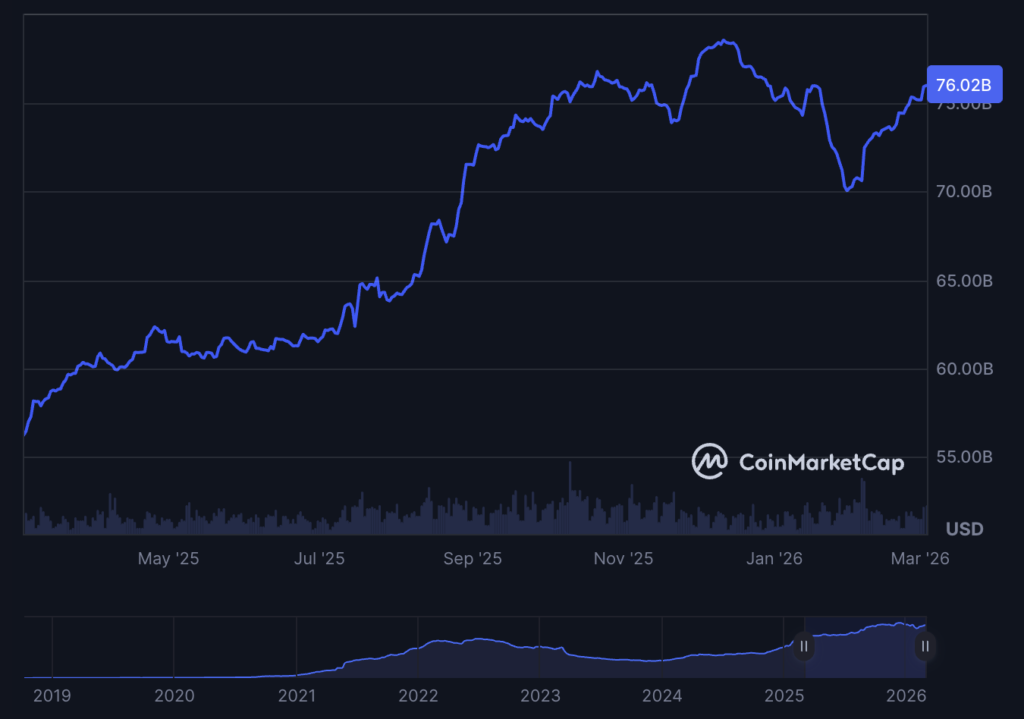
USDC Market Cap Changes
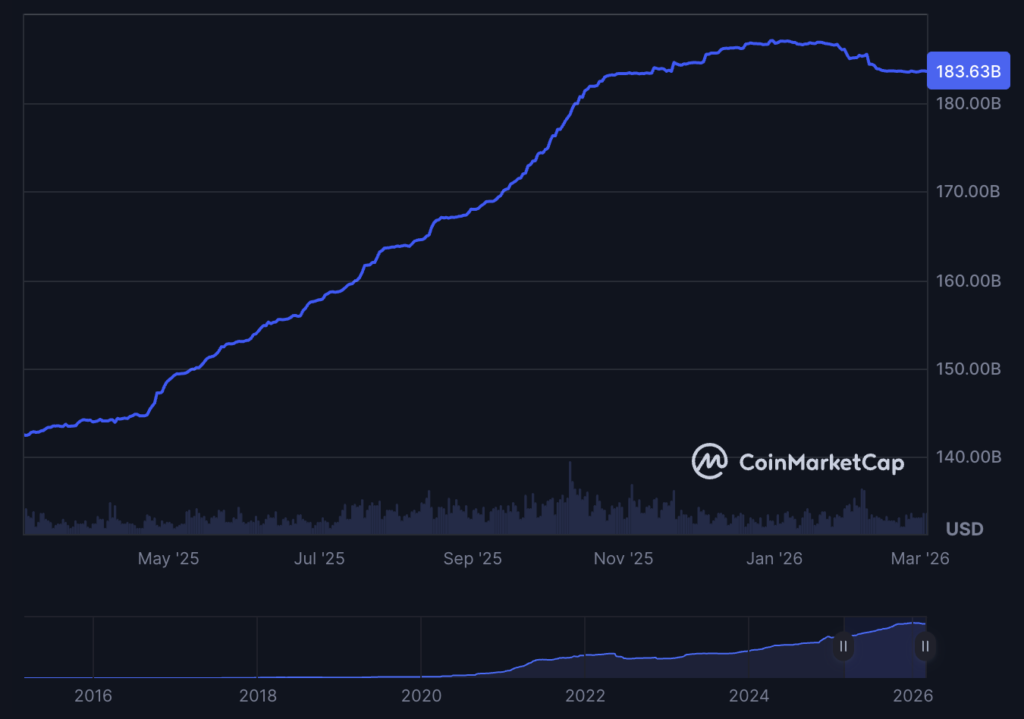
USDT Market Cap Changes
USDC’s on-chain activity has outpaced USDT for two years, driven by clearer US regulations. Compliance is no longer a cost but a market entry ticket.
Tether’s USAT responds to this trend. But with only $17.6 million in scale today versus USDC’s $75.1 billion, Tether’s gamble is that it can use its decade of market presence and brand recognition to grow USAT from millions to billions and beyond.
USAT’s Strengths and Weaknesses
USDT’s position in global crypto trading is rooted in a decade of liquidity and network effects. New users in emerging markets choose USDT not just because they believe in Tether’s reserves but because every exchange, OTC, and cross-border remittance supports it.
USAT’s challenge is inheriting USDT’s network, not its trust. But network effects and regulation often clash. USDT’s strength is its lack of regulation; USAT, once bound by US law, loses access to sanctioned and gray markets—areas where USDT is irreplaceable.
Tether has shown that in crypto, liquidity beats trust. The current challenge: does this still hold under regulation?