


Is a milestone approaching? Bitcoin's circulating supply is approaching 20 million coins, and it will take another 114 years to mine the last million coins.

Bitcoin’s circulating supply approaches 20 million coins, with over 95% already mined. The final 1 million coins will take a century to mine, drawing renewed attention to its scarcity.
The “King of Cryptocurrency,” Bitcoin, is preparing to reach a significant milestone: the 20 millionth Bitcoin is about to be issued. According to on-chain data platform Clark Moody Dashboard, approximately 19,996,979 Bitcoins have been mined and are in circulation, leaving only about 3,000 coins to reach 20 million. Based on the block production rate, it is estimated to happen in about 7 days.
At that point, over 95% of the total supply of 21 million Bitcoins will be in circulation, while the remaining 1 million will take more than a century to mine completely.
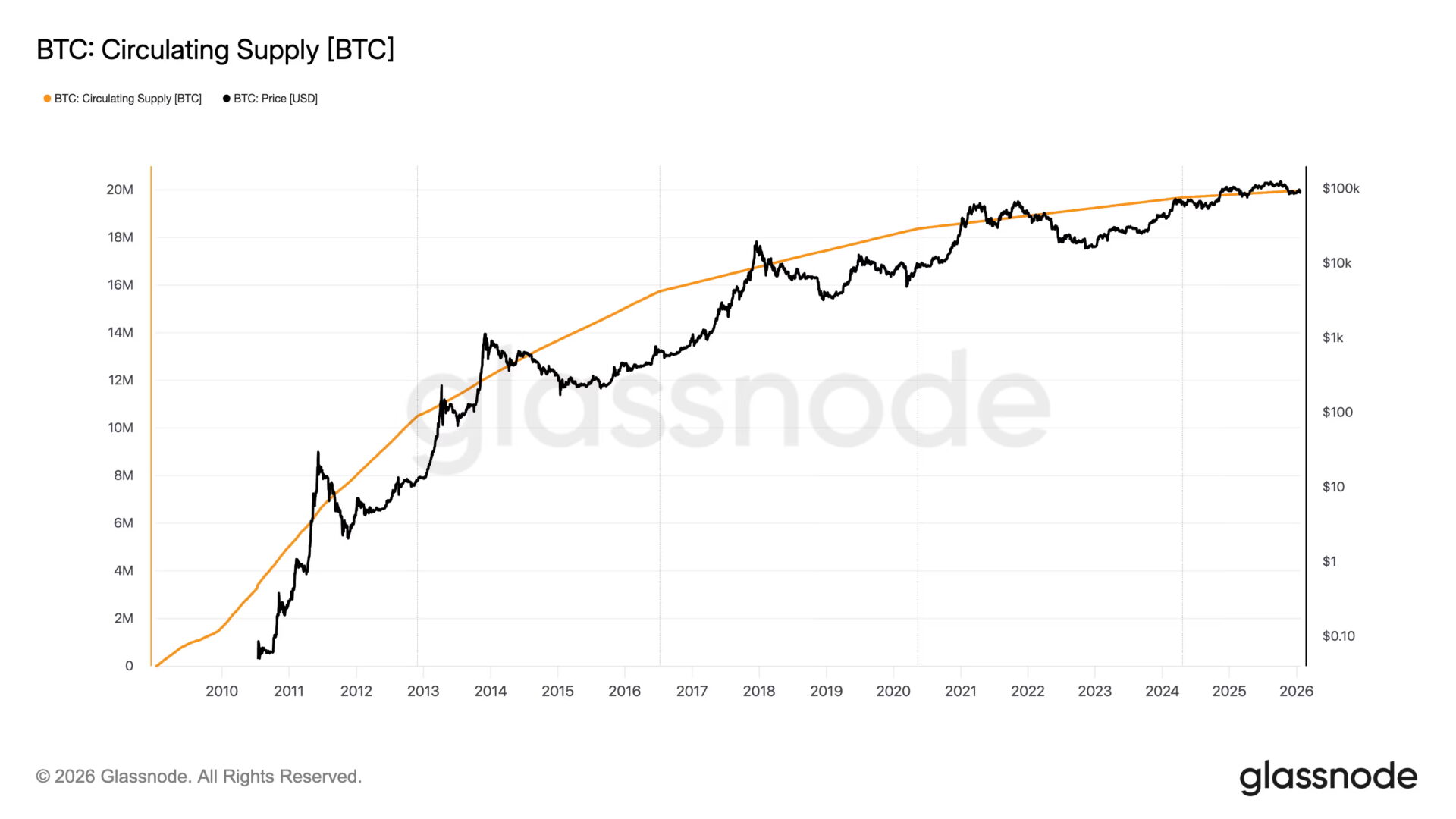
Image source: glassnode
When Bitcoin’s creator, Satoshi Nakamoto, designed the protocol, he set the maximum supply at 21 million coins in the original code, creating a form of currency with “absolute scarcity,” in stark contrast to fiat currencies issued by central banks, which can be increased at any time.
Although Nakamoto never publicly explained why he chose the number 21 million, this immutable cap has become an unshakable belief among Bitcoin enthusiasts. To them, any proposal to change the supply limit is a fundamental betrayal of Bitcoin’s value as a “hard currency.”
Bitcoin’s scarcity is often compared to gold and oil. However, in traditional commodity markets, if gold or oil prices surge, producers typically increase extraction or find new sources to boost supply and stabilize prices. Bitcoin is different; because its issuance curve is transparent and tamper-proof, no matter how wild the market prices become, the supply cannot be accelerated.
Bitcoin’s issuance rate decreases with each “halving event,” which occurs approximately every four years, halving the block rewards for miners and slowing new coin issuance. Currently, Bitcoin’s inflation rate has fallen below 1%, with about 450 new coins produced daily.
At this pace, 99% of the total supply will be mined by January 2035, and the last Bitcoin is expected to be mined around 2105. The remaining smaller fractions will continue to be released gradually until around 2140.
Once all Bitcoins are issued, miners will no longer rely on block rewards but will depend entirely on transaction fees for revenue. This means the long-term security and economic model of the Bitcoin network will ultimately depend on whether transaction demand can sustain miner income.
- This article is reprinted with permission from: “BlockCast”
- Original title: “Bitcoin Circulating Supply Approaching the 20 Million Milestone! The Last 1 Million Coins Will Take 114 Years to Mine”
- Original author: Block Sister MEL
Related Articles
Starknet, Base, Ink, Solana, and Injective Lead in BTCFi Capital Inflows As Bitcoin DeFi Accelera...
Data: 26,800 SOL transferred out from Wintermute, worth approximately $2.47 million
Data: 644.86 BTC transferred from an anonymous address, worth approximately 47.10 million USD
ETH drops 1.02% in 15 minutes: whale sell-offs and leverage liquidations drive short-term pressure
Data: 467.28 BTC transferred out from MARA, worth approximately 7,347,300 USD.
Data: 240 BTC transferred to Jump Crypto, valued at approximately $21.72 million