


Over 95% of Bitcoin's supply is about to be circulated; the remaining 1 million coins will take 114 years.
As of March 4th, the total number of Bitcoins mined has reached 19,996,979, just about 3,000 away from the 20 million milestone. At the current mining rate of approximately 450 coins per day, this will be achieved in about seven days. After that, within the fixed cap of 21 million, the remaining 1 million coins will take approximately 114 years to mine completely.
20 Million Milestone: The Complete Timeline of the Supply Curve
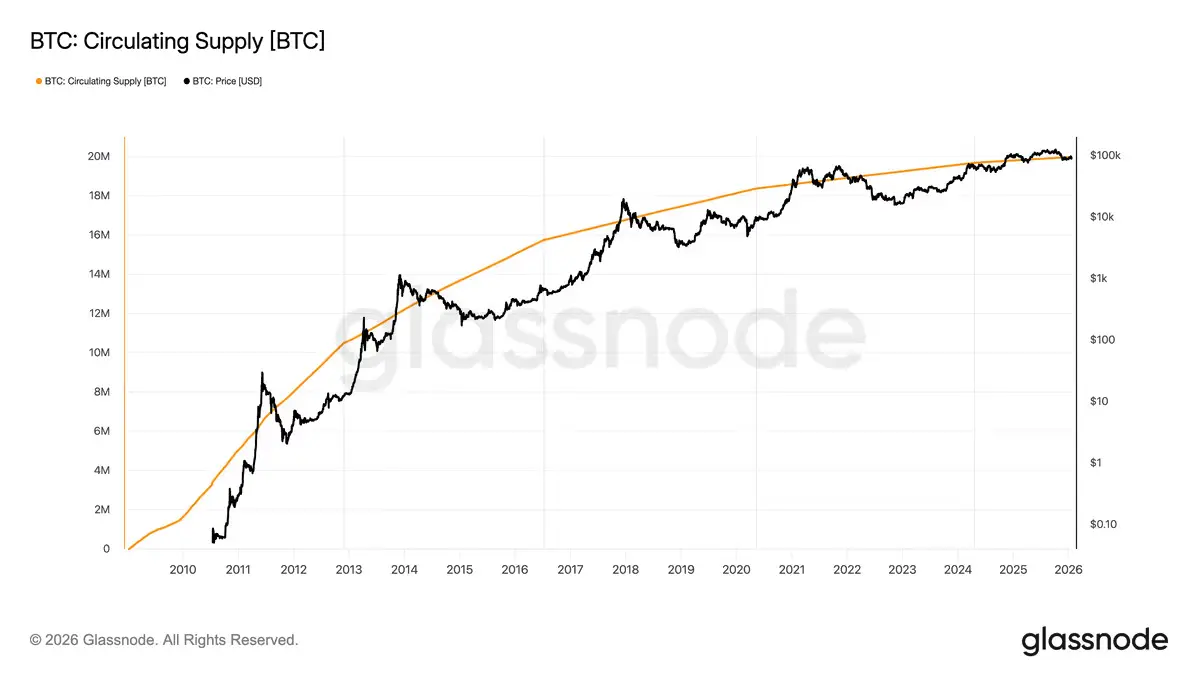
(Source: Glassnode)
Reaching this milestone means that over 95% of the total supply of 21 million Bitcoins will be in circulation. Satoshi Nakamoto embedded this cap directly into the Bitcoin protocol to create a currency with absolute scarcity, fundamentally contrasting with fiat currencies that central banks can infinitely issue.
The slowdown in Bitcoin’s supply rate is governed by the halving mechanism—roughly every four years, the reward for miners halves. Currently, Bitcoin’s annual inflation rate is below 1%, with about 450 new coins added daily. At this rate, 99% of the total supply is expected to be mined by January 2035, with the last full Bitcoin likely to be mined around 2105, and the final issuance of Satoshis extending until around 2140.
Unlike commodities like gold or oil, Bitcoin’s supply cannot be accelerated by rising prices. Its supply curve is a transparent, unchangeable protocol rule—any proposals to alter the 21 million cap are viewed by the Bitcoin community as a fundamental breach of its “hard money” properties.
Dual Significance: Strengthening Scarcity and Transitioning Miner Revenue
Key timeline for the 20 million milestone:
- March 2026 (this week): 19,996,979 coins mined, about 7 days remaining to reach 20 million
- After reaching 20 million: Over 95% of Bitcoin in circulation, only 1 million coins left to mine
- January 2035: Estimated 99% of Bitcoin supply mined
- Around 2105: The last full Bitcoin likely to be mined
- Around 2140: The final Bitcoin with Satoshis will appear; miner revenue will rely entirely on transaction fees
For miners, the 20 million milestone highlights a long-term structural trend: as block rewards continue to decrease, miner income will gradually shift from primarily block rewards to entirely relying on transaction fees. This transition will be complete around 2140, when the security of the Bitcoin network will depend solely on fee income—one of the core unresolved issues of Bitcoin’s long-term security model.
Frequently Asked Questions
Why is Bitcoin’s supply cap set at 21 million coins, not another number?
Satoshi Nakamoto never fully explained why the specific number 21 million was chosen, but this cap is hardcoded into the Bitcoin protocol, establishing its supply’s absolute predictability. Any proposals to change this cap are viewed by the Bitcoin community as a fundamental breach of its “hard money” properties and are practically unlikely to gain sufficient network consensus.
After 2140, with miners relying solely on fees, will Bitcoin’s network security be at risk?
This is one of the core issues widely discussed in Bitcoin’s long-term security model. Supporters believe that as adoption and transaction volume grow, fee income will be sufficient to incentivize miners; critics worry that if fees are insufficient to attract enough hashing power, network security could be threatened. This debate remains unresolved.
What is the fundamental difference between Bitcoin’s programmatic scarcity and gold’s scarcity?
Gold’s supply can respond to demand increases through more mining or discovery of new deposits, giving it some elasticity. Bitcoin’s supply cap is embedded in the protocol rules and cannot be adjusted in response to demand. Its supply curve is fully transparent and immutable. Supporters see this “programmatic scarcity” as a core differentiator of Bitcoin compared to gold.