


XRP Today News: Ripple Implements AI-Driven Secure Ledger, Upgrades Security After Vulnerability Exposure

Ripple engineers recently discovered a potential security vulnerability in the XRP Ledger’s batch transaction processing mechanism, raising concerns about network disruption risks. The team quickly intervened to prevent the vulnerability from expanding. To prevent similar incidents from happening again, RippleX engineering director J. Ayo Akinyele confirmed that the development team is fully integrating AI tools into the ledger development process.
XRP Ledger Vulnerability Incident: Security Risks in Batch Transaction Mechanism
The security incident originated when Ripple engineers identified a potential flaw in the XRP Ledger’s batch transaction processing mechanism. Under certain boundary conditions, triggering this flaw could cause network-level disruptions. The engineering team intervened promptly to prevent the vulnerability from causing significant impact on the mainnet environment.
The incident highlights a technical challenge: even mature blockchain systems that have been stable for a long time can expose unexpected security gaps under extreme conditions. Traditional manual code reviews have inherent limitations in covering large-scale boundary cases, which has directly motivated Ripple to adopt AI-assisted security defenses.
Ripple’s AI Security Enhancement Plan: Three Core Tools
RippleX engineering director J. Ayo Akinyele publicly confirmed that AI tools will become part of the standard XRP Ledger development process, covering the entire defense chain from code review to pre-deployment stress testing.
Core Functions of the AI Defense System
AI-assisted Code Review: Automatically flags high-risk logic segments during submission, reducing human oversight errors.
Automated Invariance Testing: Systematically verifies ledger consistency across various transaction combinations, preventing core rules from being broken by edge cases.
Agent-based Fuzzing: Currently planned as a core tool, it automatically simulates thousands of potential attack scenarios in testing environments, covering boundary conditions difficult to reach with traditional manual testing.
Akinyele emphasized that as the XRP ecosystem continues to expand, ledger security has become equally critical as functionality development. A robust security infrastructure is viewed as a key pillar of XRP’s long-term trustworthiness.
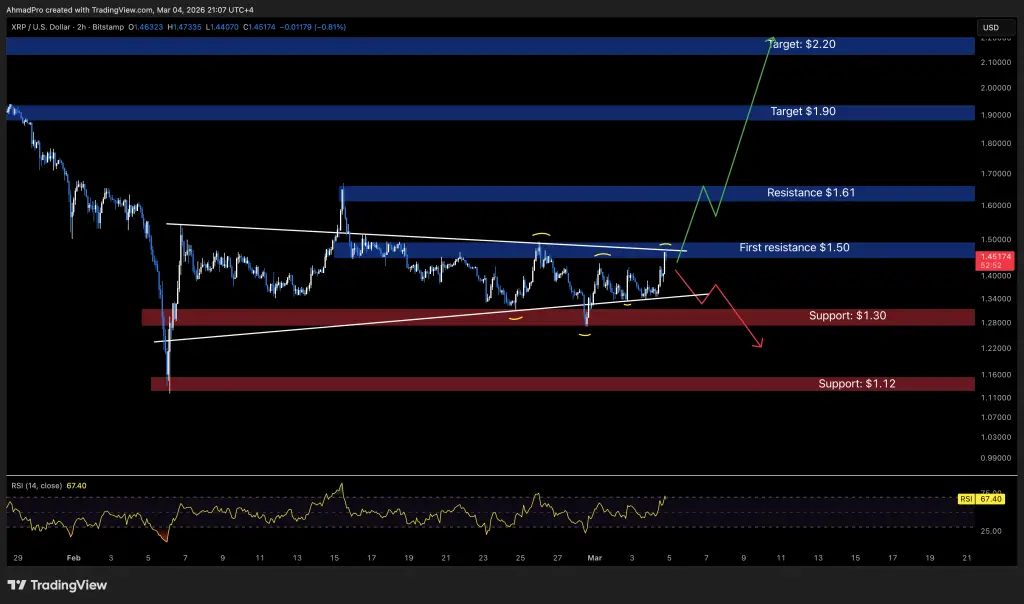
Technical Outlook: $1.50 as a Short-term Support/Resistance Level
 (Source: Trading View)
From a technical perspective, XRP is approaching the critical resistance zone at $1.50. This level has repeatedly blocked upward attempts over the past few weeks and overlaps significantly with the descending trendline dominating the overall downtrend, making it the most important technical decision point currently.
If XRP can effectively break through and hold above $1.50, a short-term structural shift will be preliminarily confirmed. The upward technical targets are sequentially $1.61, $1.90, and if bullish momentum continues, further attention will be on $2.20. Conversely, if resistance at $1.50 holds again, support levels are at $1.30 and $1.12, and the current correction trend may continue.
Frequently Asked Questions
What is the main purpose of Ripple implementing AI tools?
According to RippleX engineering director J. Ayo Akinyele, the core goal of AI tools is to identify and eliminate security vulnerabilities before deploying to the mainnet. The focus is on detecting boundary cases that traditional code reviews struggle to cover, reducing the likelihood of similar batch transaction vulnerabilities recurring.
How does agent-based fuzzing improve XRP ledger security?
Agent-based fuzzing is an automated security testing technique that uses AI agents to simulate numerous random or boundary input conditions in testing environments. It proactively detects abnormal behaviors under extreme scenarios and identifies potential attack vectors. Ripple plans to use this as a core defense tool to conduct systematic security stress testing before official deployment.
What are the current key technical support and resistance levels for XRP?
XRP faces a key resistance at $1.50. Breaking through this level targets $1.61, $1.90, and potentially $2.20. If it fails to break through, support levels are at $1.30 and $1.12. The short-term trend depends on the outcome of the battle at $1.50.
Related Articles
Elon Musk X Money partners with Ripple linked bank as RealFi expands XRP use
Ripple Integrates AI Security Tools Into XRP Ledger Development After Batch Transaction Bug Discovery
Overview of popular cryptocurrencies on March 5, 2026, with the top three in popularity being: Bitcoin, Ethereum, XRP