


Fell from 12.3 billion to 555 million! Digital asset fund inflows hit a 15-month low

According to data from DeFiLlama, the monthly capital inflow into digital asset vaults (DAT) has slowed to approximately $555 million, the lowest level since October 2024, representing a decline of over 95% compared to the peak of more than $12.3 billion at the end of 2024. The market warns that unless digital asset vault companies can transform into operational models capable of generating cash flow, they face risks of stagnation or even elimination.
15-Month Funding Inflow Trend: Structural Contraction After Election Fever Subsides
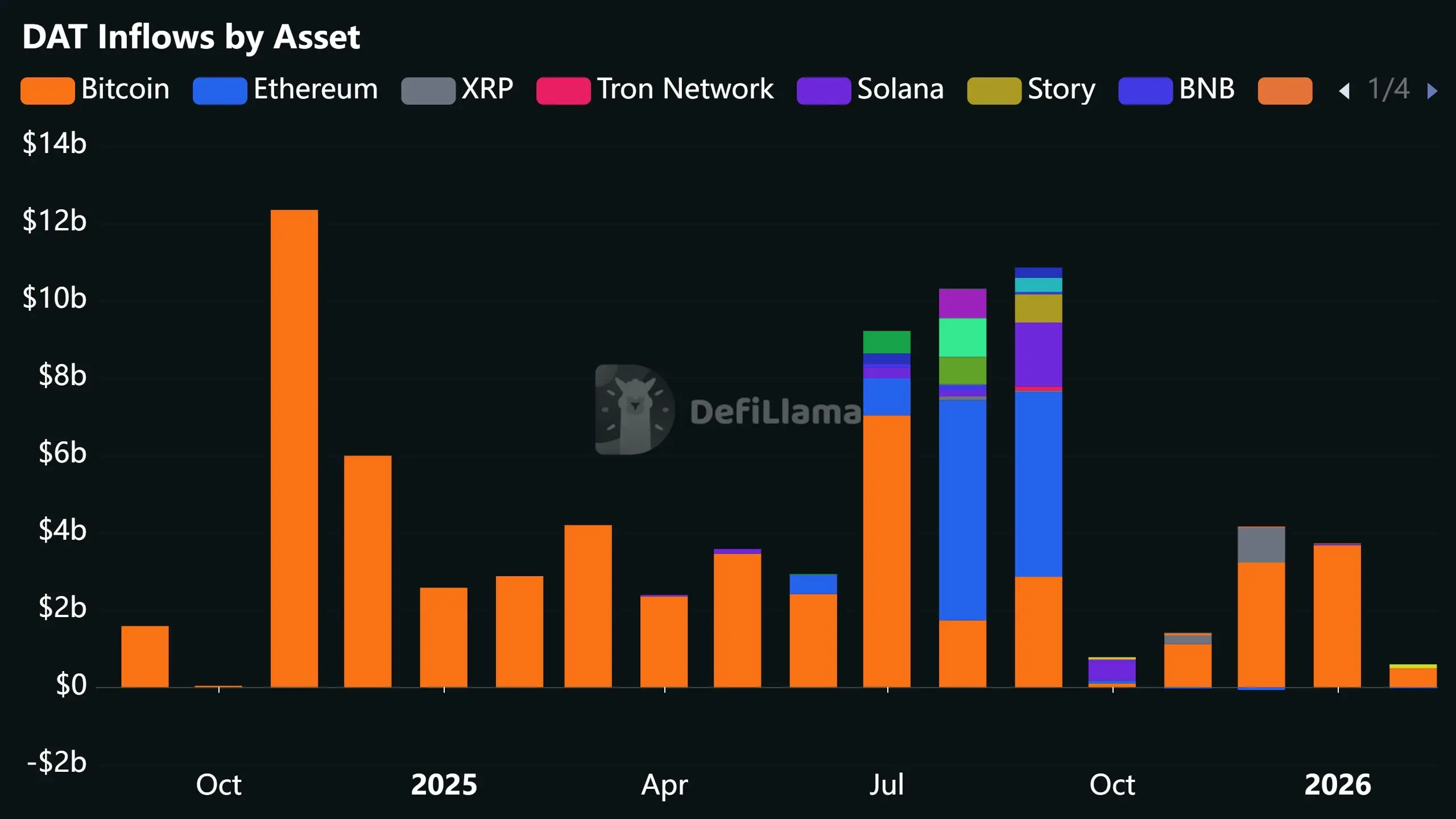
(Source: DeFiLlama)
DeFiLlama data reveals a clear cycle of capital inflows: one month before the 2024 US election, monthly inflows dropped to about $32.4 million; after the election results were announced and regulatory policies shifted toward a crypto-friendly stance, funds rapidly surged, with peaks surpassing $12.3 billion. Into 2025, monthly inflows remained below $10 billion, with a brief rebound in August 2025 followed by a sharp decline again.
The crypto market crash in October 2025 further accelerated this trend, with a prolonged bear market pulling crypto prices back to pre-election levels. Market risk appetite shrank significantly, institutional interest in new digital asset vaults cooled, ultimately driving monthly inflows down to the recent low of $555 million.
Except for August and September 2025, the monthly inflows into digital asset vaults have been predominantly Bitcoin-centric, indicating that most companies still heavily rely on a single-asset accumulation strategy.
Holding Tokens Alone Is No Longer Sufficient: Cash Flow Generation as the Core Competitiveness of Digital Asset Vaults
Patrick Ngan directly pointed out the industry’s core issue: “Bitcoin treasury companies now need to prove they can actually utilize these assets, not just hold them.” He believes that during bear markets, digital asset vaults with stable cash flow operations will outperform purely holding companies in the long run.
Paths for Cash Flow Creation in Digital Asset Vaults
- Staking and Validation Services: Providing node validation for Proof of Stake (PoS) networks, continuously earning staking rewards
- Proof of Work Mining: Generating active income through mining Bitcoin and other PoW cryptocurrencies
- DeFi Lending: Using held crypto assets to lend within DeFi protocols to earn interest
- Physical Business Cross-Subsidization: Creating stable cash flow through essential businesses like real estate to continuously purchase crypto assets
Digital asset vaults adopting hybrid models have gained increasing attention. Among them, real estate—due to its “non-optional” rigid demand—has been viewed by some industry insiders as the most complementary underlying business to crypto assets. Rental income and asset appreciation can sustainably fund Bitcoin purchases.
Frequently Asked Questions
Q: What is a Digital Asset Vault (DAT) company?
A: A digital asset vault company is an enterprise that systematically holds Bitcoin or other crypto assets as its core asset-liability strategy. Its business logic is to provide investors with indirect exposure to crypto assets through the stock market. MicroStrategy is a representative example of this model, currently holding over 500,000 Bitcoin.
Q: Why did the monthly capital inflow into digital asset vaults fall to a 15-month low?
A: The crypto market crash in October 2025 triggered a multi-month bear market, with crypto prices falling back to pre-2024 election levels. Institutional investors’ willingness to allocate to new digital asset vaults also contracted accordingly. Additionally, the market gradually realized that a pure holding model lacks defensiveness in bear markets, further suppressing capital inflows.
Q: How can digital asset vaults remain competitive during bear markets?
A: Industry recommendations include shifting from passive holding to active income generation through staking, DeFi lending, mining, or physical businesses (such as real estate) to establish stable cash flows, thereby reducing reliance on token prices alone. Operating digital asset vaults with active business models tend to have stronger balance sheet resilience during downturns and can leverage bear cycles to accumulate crypto assets at lower costs.
Related Articles
Bitmine buys the dip again! Tom Lee is optimistic about Ethereum with "three major bullish factors" supporting it
Bitcoin ETF attracts $462 million, BTC briefly surpasses $73,000
Trump's statement triggers a surge in Bitcoin-related stocks, Coinbase and MicroStrategy shares soar
Bitcoin rebound absorbs funds, altcoin community enthusiasm drops to 24-month lows
Data: 49,998,000 SHX transferred from Wintermute to Wintermute, valued at approximately $2.64 million