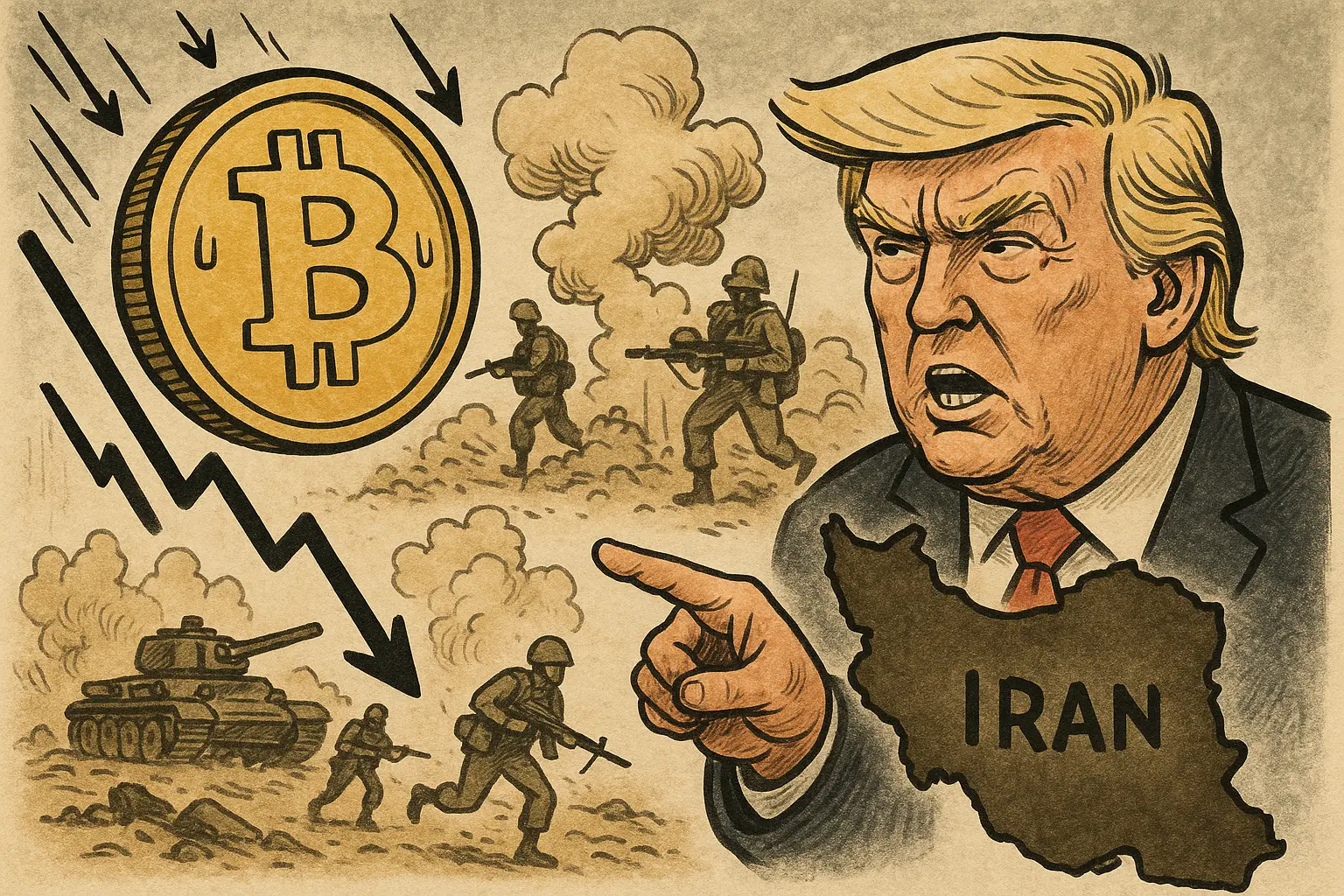
On March 6, after Bitcoin briefly broke through the $72,000 resistance level, the price began to decline back toward the $70,000 zone. The rapid escalation of geopolitical tensions became the primary macroeconomic pressure that day: Trump publicly called for leading the selection of Iran’s next Supreme Leader, Iran’s Foreign Minister explicitly stated readiness to confront a ground invasion by U.S. forces, and U.S. Secretary of Defense Pete Hegseth announced that firepower strikes against Tehran would “significantly increase.”
Geopolitical Tensions Rise: U.S.-Iran Conflict Triggers Triple Pressure
During an interview on Thursday, Trump said he needs to personally intervene in the selection of Iran’s Supreme Leader successor, describing the late Supreme Leader Khamenei’s son Mujeh Taba Khamenei as a “non-entity,” and citing his intervention model in Venezuela: “I have to be directly involved in the appointment process, just like with Venezuela.” He added that any new leader continuing Khamenei’s policies would be unacceptable, or else the U.S. would be forced to “restart hostilities within five years.”
Iran’s Foreign Minister Amir Abdollahian responded sharply in an interview, clearly stating that Iran does not seek a ceasefire nor plans to negotiate with the U.S. “No, we are waiting for them. It will be a disaster for them,” he added provocatively.
On the military front, Secretary Hegseth declared that U.S. military actions against Iran would further escalate, including deploying more fighter squadrons, increasing bomber sorties, and significantly intensifying strikes on Tehran, supported by additional overseas bases.
Technical Perspective: $72,000 is the Current Bull-Bear Divide
(Source: TradingView)
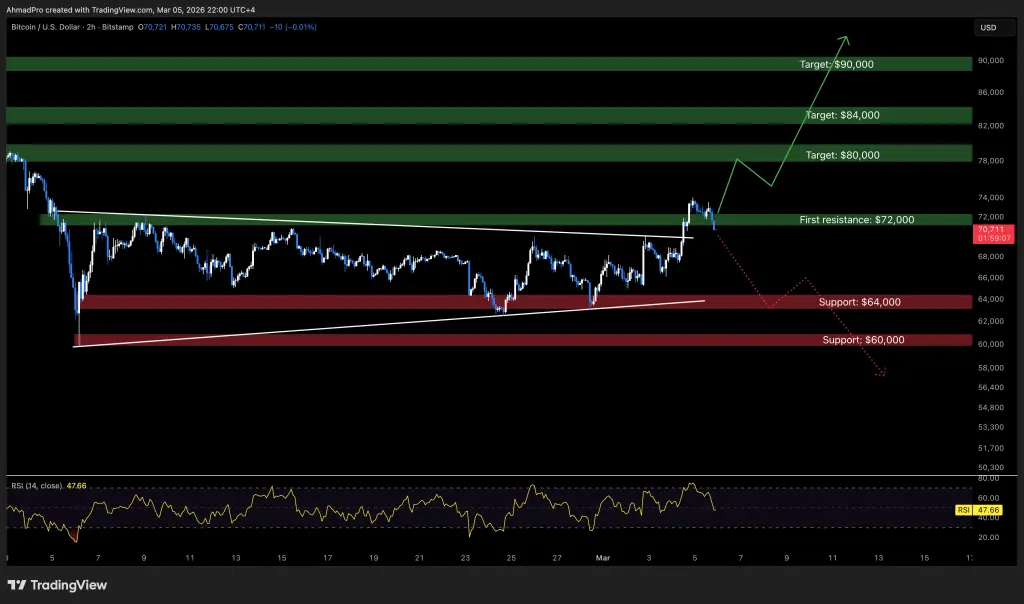
The technical trigger for Bitcoin’s decline today is clear: over the past few weeks, Bitcoin broke through the long-standing resistance at $72,000 multiple times, which had previously hindered upward movement. However, after breaking through, it failed to hold, and under geopolitical pressure, the price started to retreat toward $70,000.
Current Key Technical Levels
Core Support: $72,000 — if successfully defended and turned into support, the bullish outlook remains intact.
Upward Targets: $80,000 → $84,000 → if momentum continues, extend to $90,000.
Downside Risk: Falling below $72,000 will quickly shift pressure to the $64,000 support zone; if that is lost, the next critical level is $60,000.
Market Sentiment: Optimism Grows but Divergence Remains
(Source: Polymarket)
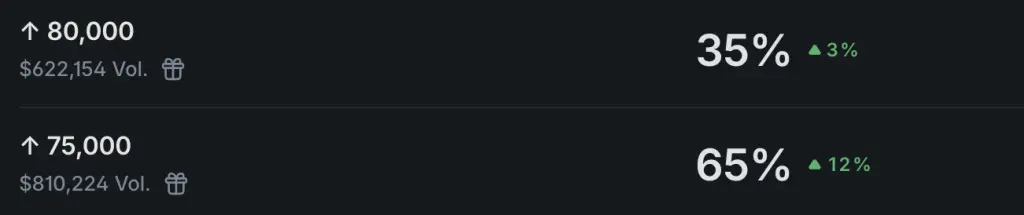
Notably, despite Bitcoin’s decline today, overall market sentiment has subtly shifted over the past few weeks. Data from prediction market platform Polymarket shows traders currently expect Bitcoin to reach $80,000 in March, then possibly fall back to $55,000, which some analysts still see as the final bottom of the bear market.
Some analysts believe the worst downturn is over and market momentum is improving; others insist that the current rebound is only a relief rally in a turbulent market, unable to confirm a trend reversal. Bitcoin’s dip near $70,000 today directly reflects this split in bullish and bearish views, and the market needs to establish a clear direction in this zone.
Frequently Asked Questions
What is the main reason for Bitcoin’s decline today?
Bitcoin’s decline today was driven mainly by two factors: first, the rapid escalation of geopolitical risks, with U.S.-Iran tensions intensifying amid Trump’s tough statements, Iran’s refusal to cease fire, and U.S. military announcements of increased strikes, triggering risk-off sentiment; second, technical pressure, as Bitcoin failed to sustain support after breaking $72,000, falling back toward $70,000 and triggering short-term stop-loss selling.
What does the $72,000 level mean for Bitcoin’s trend?
$72,000 has been a key resistance level that repeatedly blocked Bitcoin’s upward movement over the past weeks. A successful break and hold above this level could signal a short-term technical bullishness, targeting $80,000 to $84,000. Failure to hold it, however, increases the likelihood of a quick drop toward $64,000.
How does the Iran situation affect Bitcoin’s price?
Escalating Iran tensions increase global risk aversion, prompting investors to withdraw from risk assets like Bitcoin and shift toward traditional safe havens such as gold. Geopolitical events typically cause short-term volatility in Bitcoin, but if the conflict escalates into a broader regional war, the impact on financial markets could be more lasting.
Disclaimer: The information on this page may come from third parties and does not represent the views or opinions of Gate. The content displayed on this page is for reference only and does not constitute any financial, investment, or legal advice. Gate does not guarantee the accuracy or completeness of the information and shall not be liable for any losses arising from the use of this information. Virtual asset investments carry high risks and are subject to significant price volatility. You may lose all of your invested principal. Please fully understand the relevant risks and make prudent decisions based on your own financial situation and risk tolerance. For details, please refer to
Disclaimer.


