
Chief Judge Sarah Morrison of the Ohio federal court on Monday ruled against Kalshi’s request to prevent the Ohio Casino Control Commission and the state attorney general from regulating its sports betting contracts. Kalshi argued that the Commodity Futures Trading Commission (CFTC) has exclusive jurisdiction over such contracts and should take precedence over state sports betting laws, but the court found that neither argument met the legal standards required for issuing an injunction.
Core Logic of the Court’s Ruling: Both Arguments Fail
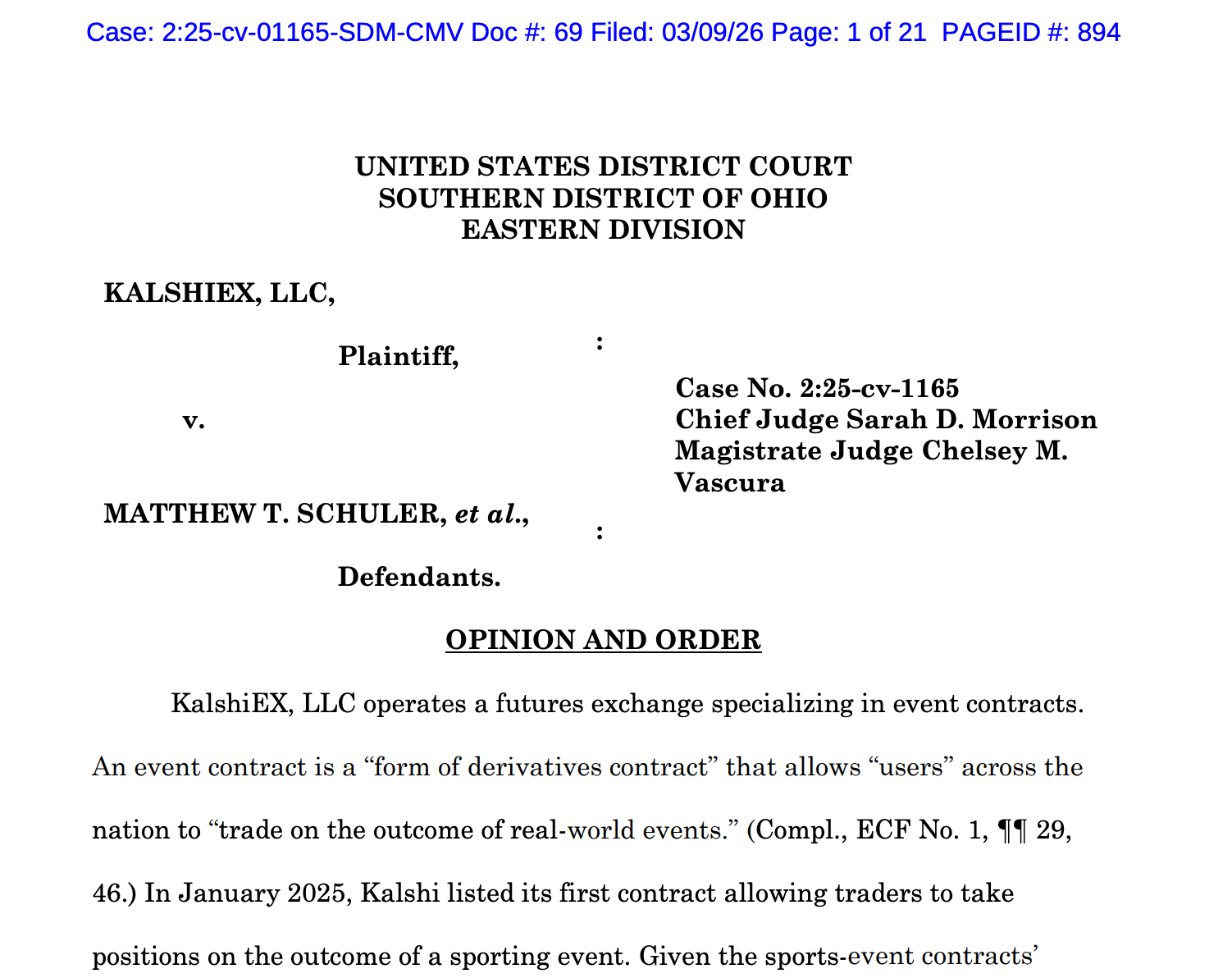
(Source: CourtListener)
Judge Morrison’s decision dismisses Kalshi’s legal claims on two levels, effectively rejecting the platform’s overall strategy.
First Level: CFTC’s Exclusive Jurisdiction Not Proven
The court stated that even if sports event contracts are considered swaps under CFTC regulation, Kalshi failed to provide sufficient legal basis to prove these contracts fall within the CFTC’s “exclusive jurisdiction.”
Second Level: Federal Preemption Cannot Be Established
The court further noted that even if CFTC’s jurisdiction is accepted, Kalshi did not demonstrate that the Commodity Exchange Act (CEA) was intended to “supersede state laws on sports betting.” The ruling states: “Kalshi has not demonstrated that Congress intended the CEA to displace state laws regarding sports betting.”
Another noteworthy part of the ruling addresses the CFTC’s lack of clear regulatory action on sports event contracts:
“The agency’s inaction does not prove that these sports contracts are regulated by the CEA or permitted under it — and this court concludes they are neither regulated nor permitted under the law.”
Direct Clash with CFTC Chair’s Position
This ruling directly conflicts with CFTC Chair Selig’s public stance from February this year. Selig claimed that federal regulators have “exclusive jurisdiction” over prediction markets and threatened to sue any state or local agencies claiming similar jurisdiction. However, the Ohio federal court’s decision effectively negates this claim at the judicial level — even if the CFTC asserts jurisdiction, the court finds that this does not automatically override state gambling laws.
It’s worth noting that Selig is currently the only CFTC commissioner confirmed by the Senate, out of a typical five-member commission. Last week, Selig stated that the CFTC is working to provide guidance on prediction markets “in the near future,” which is highly anticipated by industry stakeholders.
Kalshi’s Response and Ongoing Multi-State Legal Battles
Kalshi’s spokesperson told Cointelegraph that the company “disagrees with the court’s ruling, which conflicts with a decision from a Tennessee federal court weeks earlier, and will seek an immediate appeal.”
The Tennessee ruling appears more favorable to Kalshi, and the split between the two federal district courts may eventually require higher courts, possibly the Supreme Court, to resolve the jurisdiction issue over prediction markets. Currently, Kalshi and other prediction market platforms face similar lawsuits in multiple states, mainly centered on the legal classification of “unlicensed operation of sports betting.”
Frequently Asked Questions
Q: What immediate impact does this Ohio ruling have on Kalshi’s operations?
A: The court denied the “preliminary injunction,” meaning Ohio regulators can continue to oversee and enforce regulations on Kalshi’s sports contracts. Kalshi cannot block state enforcement by claiming federal jurisdiction. However, this is not a final ruling; Kalshi has announced it will appeal, and the case will continue through the legal process.
Q: Why did the judge use CFTC’s “inaction” as a basis to deny jurisdiction?
A: The logic is: if sports contracts are legitimately within the CFTC’s regulatory scope, the agency should actively regulate them. The CFTC’s long-standing lack of clear regulation or approval indicates that the federal legal status of these contracts remains uncertain, and thus cannot be used to claim federal protection under the CEA.
Q: What does this case mean for the prediction market industry overall?
A: The ruling in the short term strengthens the legal basis for state enforcement against prediction platforms, weakening the industry’s strategy of citing federal jurisdiction to avoid state regulation. The long-term outlook depends heavily on whether the upcoming CFTC prediction market guidance can clarify the federal jurisdiction framework, and how the jurisdictional split between Tennessee and Ohio courts will be resolved at higher levels.
Disclaimer: The information on this page may come from third parties and does not represent the views or opinions of Gate. The content displayed on this page is for reference only and does not constitute any financial, investment, or legal advice. Gate does not guarantee the accuracy or completeness of the information and shall not be liable for any losses arising from the use of this information. Virtual asset investments carry high risks and are subject to significant price volatility. You may lose all of your invested principal. Please fully understand the relevant risks and make prudent decisions based on your own financial situation and risk tolerance. For details, please refer to
Disclaimer.


