Britain, France, Germany, Italy, the Netherlands, and Japan issued a joint statement on the 19th, expressing their willingness to take “appropriate measures” to ensure the safety of navigation through the Strait of Hormuz. However, the declaration deliberately did not specify what these actions entail, widely interpreted as strategic ambiguity leaving room for political maneuvering among the countries.
(Background: Iran’s largest gas field was attacked, retaliatory strikes hit the three Gulf countries: Brent crude surpasses $110, diesel hits a four-year high)
(Additional context: Downward trend intensifies! BTC drops below $69,000, ETH falls below $2,100, and liquidations across the network exceed $450 million)
Table of Contents
Toggle
- Three specific demands in the statement
- Ambiguity of “appropriate measures” raises questions
- Oil price fluctuations and Bitcoin as a safe haven narrative
The UK, France, Germany, Italy, the Netherlands, and Japan jointly issued a statement last night (19th), expressing their willingness to contribute “appropriate efforts” to ensure the safe passage through the Strait of Hormuz. Interestingly, the full text of the declaration never clarifies what exactly “appropriate” refers to.
This cautious wording is not coincidental. Former President Trump previously warned on social media that if allies continued to do nothing about the situation in the Strait of Hormuz, he might hand over responsibility for its security to the countries that actually use the waterway.
The joint declaration by the six countries is widely seen as a response to pressure on Trump, but the deliberately vague language preserves policy flexibility for each nation.
We state that we are prepared to make appropriate contributions to ensure the safe passage through the strait. We welcome participation and commitments from all countries.
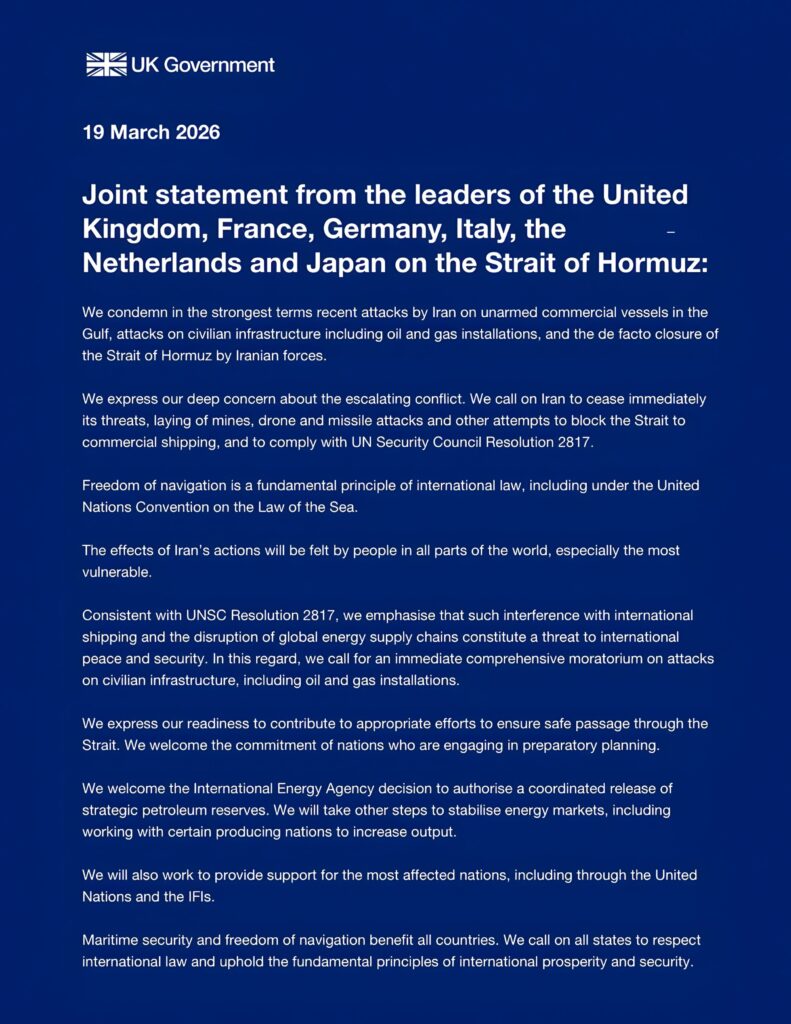
Image source: www.gov.uk
Three specific demands in the statement
The declaration strongly condemns Iran’s recent series of attacks on unarmed commercial ships in the Persian Gulf, and puts forward three clear positions:
First, demand Iran comply with UN Security Council Resolution 2817 and immediately cease actions threatening international shipping.
Second, reaffirm that freedom of navigation is a fundamental principle under international law, including UNCLOS, and call on all countries to uphold it.
Third, the six countries support the International Energy Agency’s (IEA) decision to release strategic petroleum reserves, and plan to increase production through cooperation with specific oil-producing nations to stabilize global energy markets.
The declaration also states that support will be provided to the most affected countries through international financial institutions.
We will also strive to support the most impacted nations, including through the United Nations and international financial organizations.
Ambiguity of “appropriate measures” raises questions
The biggest controversy surrounding this declaration lies in what it does not say. Analysts believe that “appropriate measures” is a deliberately vague phrase, allowing each country to interpret its level of involvement—from diplomatic pressure and intelligence sharing to actual naval escort deployments—within the scope of “appropriateness.”
The statement only mentions “welcoming participation in planning,” but provides no timeline, command structure, or verifiable commitments to action.
It’s also noteworthy that Iran’s stance is internally conflicted. Iran’s foreign minister previously stated that sanctions targeted only US and Israeli ships, and that Indian oil tankers had successfully passed through the strait; however, the Islamic Revolutionary Guard Corps (IRGC) issued a much more hardline statement, threatening to destroy any ships attempting to pass by force.
These conflicting signals make the situation more complex to assess.
Oil price fluctuations and Bitcoin as a safe haven narrative
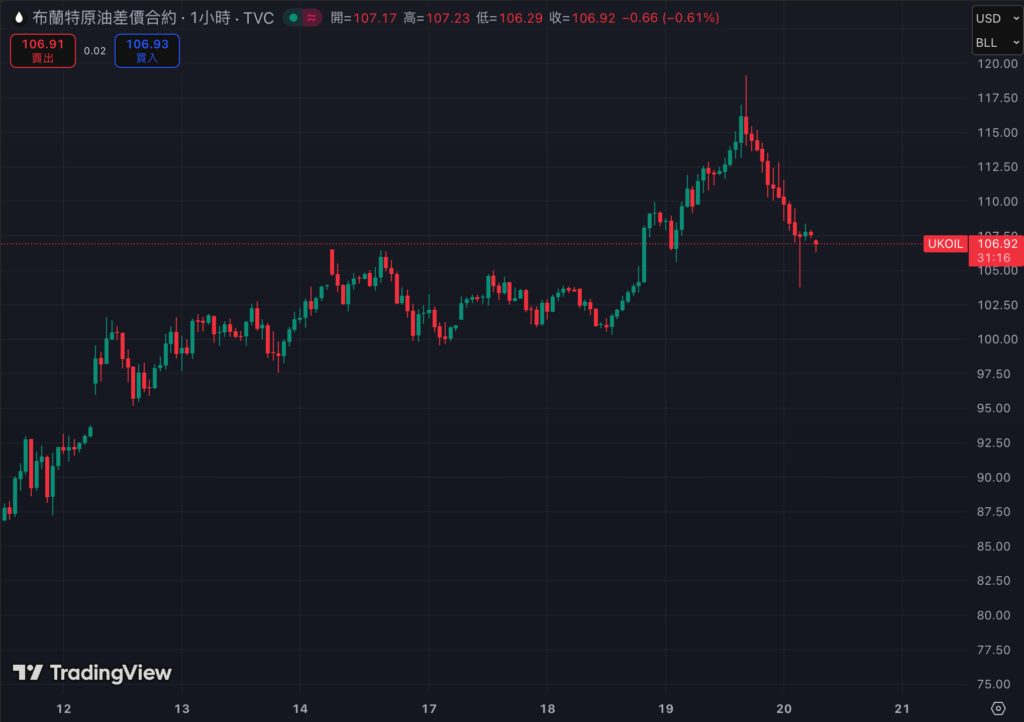
Following the joint statement, Brent crude oil prices retreated slightly, currently at $106.9 per barrel. However, if the “appropriate measures” remain only declarative and Iran’s blockade escalates further, oil prices could surge again. Whether the crypto market can maintain its current relatively resilient stance will be a key point to watch.

Disclaimer: The information on this page may come from third parties and does not represent the views or opinions of Gate. The content displayed on this page is for reference only and does not constitute any financial, investment, or legal advice. Gate does not guarantee the accuracy or completeness of the information and shall not be liable for any losses arising from the use of this information. Virtual asset investments carry high risks and are subject to significant price volatility. You may lose all of your invested principal. Please fully understand the relevant risks and make prudent decisions based on your own financial situation and risk tolerance. For details, please refer to
Disclaimer.


