Pi Network’s native token, PI, fell to $0.165 on April 13, hitting a 7-week local low and retreating to levels seen before the outbreak of the Iran war. According to PiScan on-chain data, the token unlock peak for the three days from April 15 to 17 is about to arrive—more than 60 million PI tokens are expected to be released over the weekend’s three days, further increasing downside pressure.
The only catalyst in recent months has already become a thing of the past: Kraken listing hype fades
Over the past few months, the only event that temporarily had a positive impact on the PI token price was the Kraken listing announcement made in March this year. Before and after the news broke, PI surged from $0.18 to nearly $0.30, with a short-term gain of more than 60%.
However, as soon as the token began trading on Kraken, it quickly turned into a typical “buy the rumor, sell the news” scenario. Hype sentiment faded within about 48 hours, and PI plunged more than 50% during that period. After that, PI failed to hold the $0.20 support level; that level has now turned into resistance, and the current trading price is even below the level before Kraken went live.
Why multiple positive developments are still ineffective: community criticism focuses on two key pain points
In recent months, the Pi Network core team has released a steady stream of technical progress, but none of it has been able to translate into lasting price support:
Summary of recent core developments
Protocol upgrade roadmap: Version 19.6 → 19.9 → Version 20.2 released on March 14 (Pi Day), laying the groundwork for introducing smart contract capabilities to the network
Version 21 goes live: Completed on April 6. The core team also announced a migration plan in parallel, allowing token holders to migrate their assets to the mainnet
Testnet RPC server introduced: Strengthening the developer infrastructure for the Pi testnet
First batch of validator rewards distributed: After more than 1 million participants complete 526 million validation tasks, the first rewards have been directly distributed to eligible validators’ mainnet wallets
However, under posts made by the core team on X, the comments are still mostly critical, focusing on two core issues: some holders say that even after completing KYC verification, they still cannot properly access their assets; and the continued decline of the PI token has disappointed long-term supporters.
Unlock peak is about to hit: 60 million tokens to be released over three days from April 15 to 17
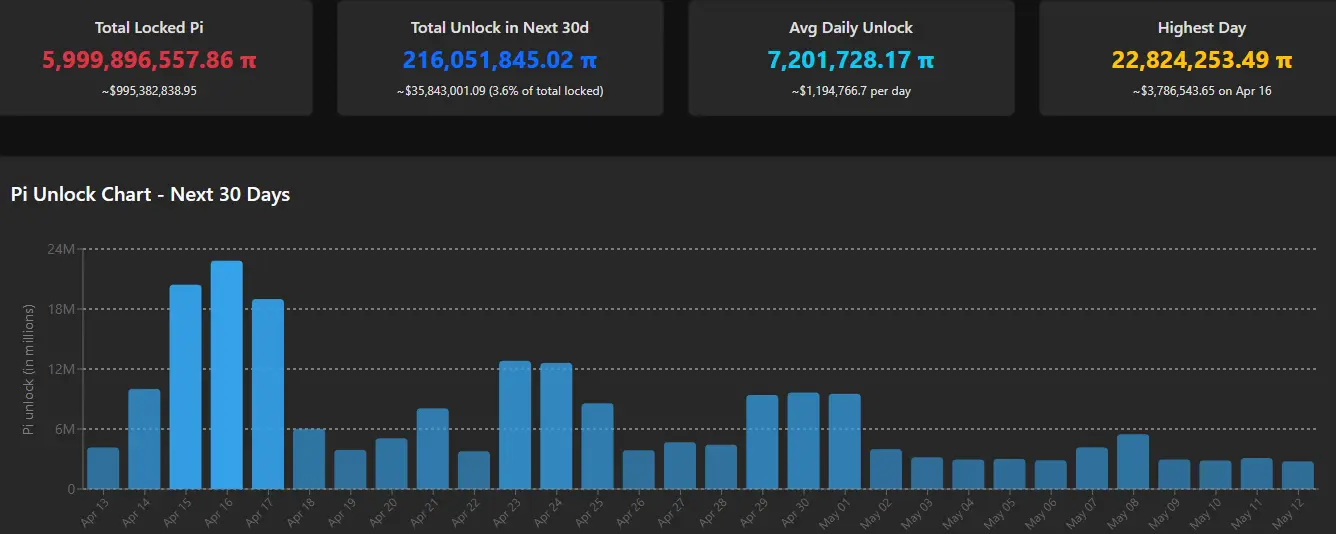 (Source: PiScan)
Downside pressure comes not only from market sentiment—unlock scheduling on the supply side poses a more concrete short-term risk. PiScan’s on-chain data shows that April 15, 16, and 17 will each bring a token unlock volume peak; over just these three days, more than 60 million PI tokens will be released into circulation.
Looking at a longer time horizon, the average unlock amount over the next month is still above 7 million tokens. If holders choose to sell immediately after the unlock, the short-term increase in supply will directly intensify selling pressure in the market and may create conditions for PI to break further below the current $0.165 area.
Frequently asked questions
Why can’t Pi Network’s frequent positive updates boost the PI price?
Pi Network’s update frequency in recent months has been quite high, but market responses show that the release of technical milestones has not translated into confidence among holders. Widespread complaints that users still cannot access their assets after completing KYC, along with the ongoing supply increase brought by token unlock pressure, have jointly suppressed buy-side willingness—making it difficult for the price impact of good-news headlines to last.
How will the unlock peak from April 15 to 17 affect the PI price?
According to PiScan data, more than 60 million PI tokens will be unlocked and released over the three days in total, and the monthly average unlock amount is also over 7 million tokens. If a concentrated sell-off occurs after the unlock, the increase in short-term supply will directly add to downward pressure. Against the backdrop of PI already breaking below multiple key support levels, the impact of the unlock peak cannot be ignored.
Can Pi Network’s smart contract functionality bring a turnaround for PI?
Version 20.2 introduces the underlying infrastructure for smart contract functionality for Pi Network, but there is still a considerable gap from technical foundations to a mature DeFi ecosystem. Typically, the market needs to see real application scenarios built on smart contracts and associated capital flows before lasting confidence forms. At present, preparation at the protocol layer alone is not yet sufficient to independently support a structural reversal in the token’s price.
Disclaimer: The information on this page may come from third parties and does not represent the views or opinions of Gate. The content displayed on this page is for reference only and does not constitute any financial, investment, or legal advice. Gate does not guarantee the accuracy or completeness of the information and shall not be liable for any losses arising from the use of this information. Virtual asset investments carry high risks and are subject to significant price volatility. You may lose all of your invested principal. Please fully understand the relevant risks and make prudent decisions based on your own financial situation and risk tolerance. For details, please refer to
Disclaimer.
Related Articles
Pi Network launches the PiRC1 token framework, banning projects that have no real-world applications from issuing tokens
Pi Network unveiled the Pi Token Design Framework PiRC1 on April 22 as part of the Protocol V22 upgrade. PiRC1’s core rule is: only projects that already have deployable applications within the Pi ecosystem and that have real user demand are eligible to issue tokens. Token proceeds do not flow to the project team; instead, they flow into a perpetual liquidity pool anchored by Pi Coin to prevent rug-pull behavior.
MarketWhisper04-24 03:27
OpenClaw 2026.4.22 Unifies Plugin Lifecycle Across Codex and Pi Harnesses, Reduces Plugin Load Time by Up to 90%
Gate News message, April 23 — OpenClaw, an open-source AI Agent platform, released version 2026.4.22 on April 22, with its biggest change being the alignment of Codex harness and Pi harness lifecycles. Previously, plugins behaved inconsistently across the two harness pathways, with some hooks
GateNews04-23 14:41
Pi Network releases an opinion solicitation draft for PiRC2, opening contract review for the testnet subscription
Pi Network core team released the second Pi Request for Comments draft (PiRC2) on April 23, announcing that the testnet will open subscription smart contracts for technical review and community feedback, and inviting developers to test the subscription feature integration, review contract design, and identify potential vulnerabilities. As of the time of reporting, the PI token is about $0.17, unchanged from the previous day.
MarketWhisper04-23 05:15
Pi Network founder May 7 discussed human identity verification in the AI era at Consensus 2026
Pi Network founder Nicolas Kokkalis will attend the Consensus 2026 conference in Miami on May 7, joining an expert panel to discuss online human identity verification issues in the age of artificial intelligence (AI). According to the official event schedule, this panel discussion will bring together experts in the fields of identity, privacy, and digital trust.
MarketWhisper04-21 06:20
Pi Network issues a node upgrade warning: if you haven’t upgraded by April 27, you risk being disconnected
Pi Network has issued an official notice to node operators, requiring them to complete the mandatory upgrade of the agreement version 22.1 (v22.1) by April 27, 2026; otherwise, they face the risk of their nodes being cut off from network connectivity. According to a Pi Network announcement, this upgrade must be carried out in strict version order. Currently, the system is running on version 21.2; the next step is to upgrade to v22.1, and no versions may be skipped.
MarketWhisper04-20 06:51


