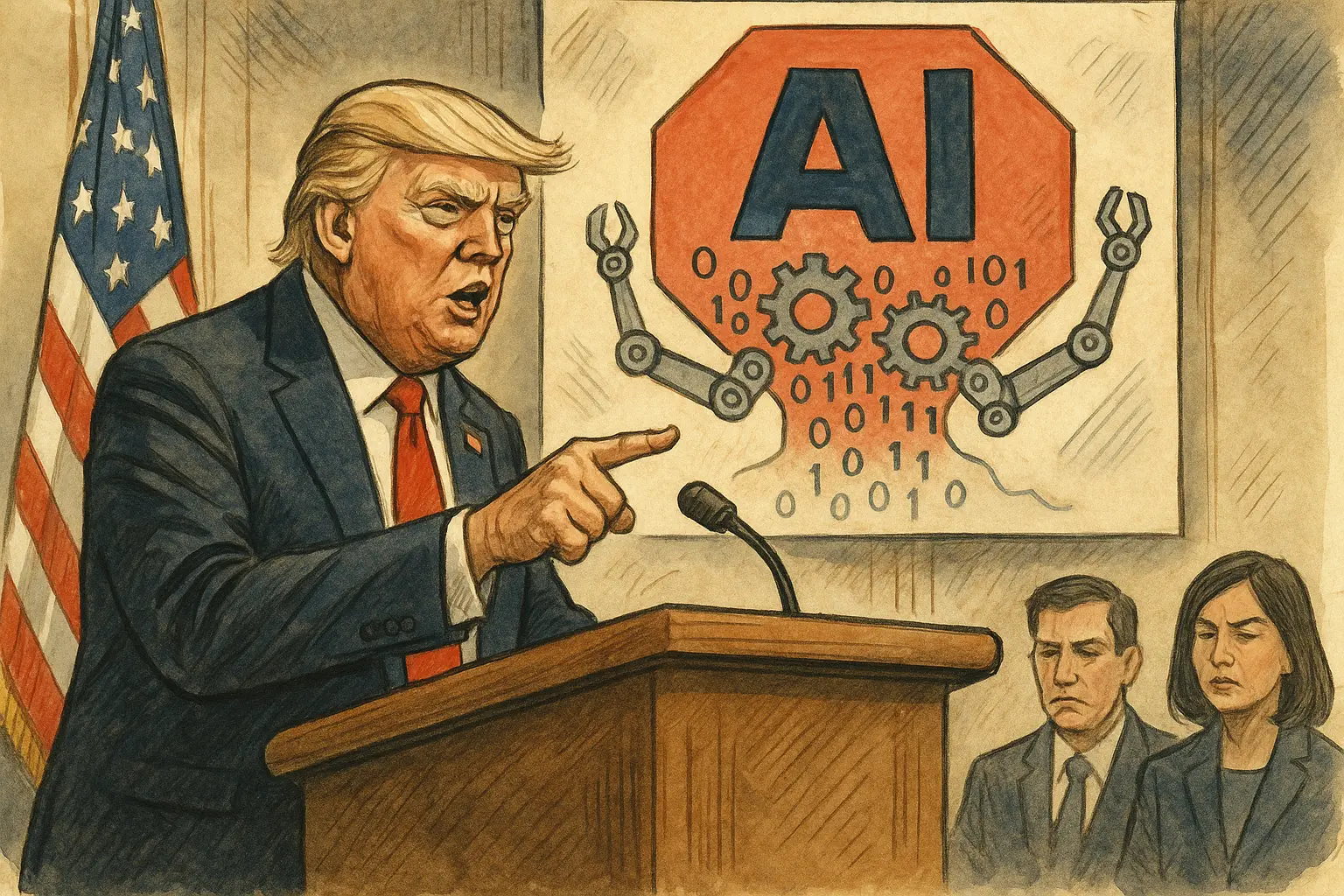
On April 23, the White House Office of Science and Technology Policy (OSTP) Assistant to the President Michael J. Kratsios released an official statement saying the Trump administration has information showing that foreign entities (mainly located in China) are deliberately targeting major U.S. artificial intelligence companies by systematically extracting U.S. AI model capabilities through “tens of thousands of proxy accounts” and jailbreak technology systems, while also announcing four response measures.
Attack Methods and Security Warnings Confirmed by the White House OSTP
According to the White House OSTP official statement, the attack methods used by foreign entities include two tactics: using “tens of thousands of proxy accounts” to evade detection, and “leveraging jailbreak technology to leak proprietary information.” The OSTP statement’s original wording says: “These coordinated actions systematically extract capabilities from U.S. artificial intelligence models, using U.S. expertise and innovation.”
In his statement, Kratsios said that models developed through such distillation activities “cannot completely replicate the performance of the original version,” but they “do enable foreign vendors to roll out products that appear quite competitive on certain benchmarks at very low cost.” The White House also warned that models developed through distillation may lack safety protocols and no longer be “neutral and committed to truth.”
Anthropic Accuses Three Chinese AI Companies: DeepSeek, Moonshot, MiniMax
According to an official statement released by Anthropic in February 2026, the company accuses Chinese AI companies DeepSeek, Moonshot, and MiniMax of launching distillation attacks against its Claude model using approximately 24,000 scam accounts, generating more than 16 million transaction request attempts. According to Anthropic’s official announcement, the capabilities allegedly extracted include:
· Intelligent reasoning capabilities
· Code generation and data analysis
· Rating tasks based on scoring criteria
· Computer vision capabilities
The Trump Administration Announces Four Response Measures
According to the White House OSTP official statement, the Trump administration plans to respond to foreign AI distillation threats through the following four measures: sharing with U.S. AI companies information related to potential large-scale attacks; helping the private sector build more effective coordinated response mechanisms; partnering with the private sector to establish strong technical defenses; and exploring related measures to “hold foreign actors accountable.” The statement did not disclose specific legal action timelines or targets for sanctions.
Frequently Asked Questions
What specific methods are used in the “AI distillation attack” referred to in the White House OSTP statement?
According to the White House OSTP official statement, the attack methods include two categories: using “tens of thousands of proxy accounts” to evade detection mechanisms used by U.S. AI companies, and using jailbreak technology to bypass model safety restrictions to leak proprietary information, with the goal of systematically extracting core capabilities of U.S. AI models.
What are the three Chinese companies accused by Anthropic, and what are the allegations?
According to an official statement released by Anthropic in February 2026, the three accused companies are DeepSeek, Moonshot, and MiniMax. They are alleged to have launched distillation attacks against the Claude model using approximately 24,000 scam accounts, generating more than 16 million transaction request attempts. The capabilities allegedly extracted include multiple areas such as intelligent reasoning, code generation, and computer vision.
Has the Trump administration taken specific legal action against the relevant Chinese companies?
According to the White House OSTP official statement, as of the date the statement was released, the government is “exploring measures to hold foreign actors accountable,” and the statement did not disclose any specific executed sanction decisions or legal prosecution actions.
Disclaimer: The information on this page may come from third parties and does not represent the views or opinions of Gate. The content displayed on this page is for reference only and does not constitute any financial, investment, or legal advice. Gate does not guarantee the accuracy or completeness of the information and shall not be liable for any losses arising from the use of this information. Virtual asset investments carry high risks and are subject to significant price volatility. You may lose all of your invested principal. Please fully understand the relevant risks and make prudent decisions based on your own financial situation and risk tolerance. For details, please refer to
Disclaimer.
Related Articles
Cursor reveals the reason for XAI training: the compute power is stuck, and SpaceX has separately secured acquisition options worth $60,000,000,000
Anysphere announced that Cursor will work with xAI to train a new model using Colossus infrastructure to overcome compute bottlenecks; SpaceX has proposed a $60 billion acquisition option (fully acquirable within 2026), and if not, it would pay about $10 billion as collaboration compensation. The two transactions are happening at the same time, reshaping who can train Cursor and who can buy Cursor. Cursor still allows many model backends, but in the long run it depends on whether SpaceX exercises its acquisition option.
ChainNewsAbmedia14m ago
Anthropic’s secondary-market valuation breaks $1 trillion: Forge Global overtakes OpenAI’s $880 billion
According to a report by Decrypt, Forge Global’s Anthropic secondary valuation is about $1 trillion, while OpenAI is about $880 billion, with the first leading reversal appearing in the secondary market. Anthropic’s ARR grew from about $9 billion at the end of 2025 to about $30 billion in March 2026—an increase of 233% over three months—boosting private-market valuations. Secondary valuations differ from primary fundraising, reflecting confidence in exits; going forward, expectations remain on four tracks: technology, policy, business, and narrative.
ChainNewsAbmedia15m ago
Meta Platforms Plans 10% Workforce Reduction on May 20, Affecting Approximately 8,000 Positions
Gate News message, April 24 — Meta Platforms plans to reduce its workforce by approximately 10%, affecting roughly 8,000 positions, on May 20. The layoffs are intended to improve operational efficiency while increasing investment in artificial intelligence.
The planned restructuring reflects the
GateNews1h ago
DeepSeek releases the V4 open-source preview, with a technical score of 3206 surpassing GPT-5.4
DeepSeek officially launched the V4 preview series on April 24, with open-sourced model weights under the MIT license, and the model weights have been also released on Hugging Face and ModelScope. According to the DeepSeek V4 technical report, V4-Pro-Max (the highest inference intensity mode) scored 3206 points on the Codeforces benchmark, surpassing GPT-5.4.
MarketWhisper1h ago
Cambricon Completes Day 0 Adaptation of DeepSeek-V4, Marking Milestone for China's AI Chip Ecosystem
Gate News message, April 24 — Cambricon announced today that it has completed Day 0 adaptation of DeepSeek-V4, the latest large language model from DeepSeek, using its proprietary NeuWare software ecosystem and vLLM framework. The adaptation code has been open-sourced simultaneously, marking the
GateNews2h ago
Tencent open-sourced Hy3 preview version, code benchmark tests improved by 40% over the previous generation
Tencent officially open-sourced the Hy3 preview version of a large language model on April 23 on GitHub, Hugging Face, and the ModelScope platform, and simultaneously provided paid API service via Tencent Cloud. According to Decrypt’s report on April 24, the Hy3 preview version began training in late January and reached the publication calendar in less than three months.
MarketWhisper2h ago


