Key Takeaways:
- ZKsync and BitGo released a complete protocol stack of tokenized bank accounts
- Custody, wallets, and private blockchain settlement are combined to achieve compliance in infrastructure
- No centralized complex systems are required within banks to issue and settle deposits onchain
Banks are increasing their transition to blockchain-based infrastructure, and this most recent collaboration is an important stride in the same direction. ZKsync and BitGo are now providing a pre-launched system that is tailored to regulated financial institutions.
Table of Contents
- A Turnkey System for Tokenized Deposits
- Why Banks Are Moving Toward Tokenization
- How the Infrastructure Works
- Built for Compliance and Institutional Adoption
A Turnkey System for Tokenized Deposits
The new infrastructure enables banks to issue, transfer and settle tokenized deposits: computerized versions of traditional bank liabilities – onchain. As compared to stablecoins, these deposits stay a part of the banking system, which is regulatively aligned and protects customers.
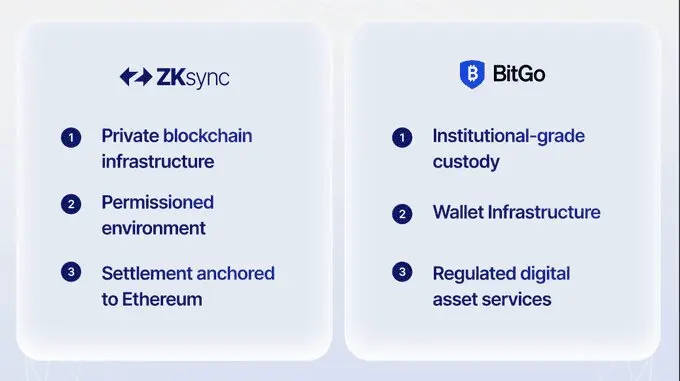
The center of the solution is Prividium, a permissioned blockchain based on Ethereum that is hosted by ZKsync. It is privacy and compliance oriented and allows financial institutions to conduct business in a regulated environment.
BitGo adds to this institutional grade custody and wallet infrastructure and regulated services. Collectively, they create a single stack and reduce the necessity of banks to code their blockchain systems.
Read More: ZKsync Powers Tokenized Deposits in Major U.S. Bank Network
Why Banks Are Moving Toward Tokenization
Deposits in token form are on the rise due to their obvious benefits in operation. The transactions can complete in real-time, 24/7 and contain programmable services such as conditional payments.
This model enables banks to transform treasury and payment treatment but without shifting money out of their current systems. It also minimizes the use of historic settlement procedures, which tend to be sluggish and disjointed.
How the Infrastructure Works
Three key elements are combined in the joint platform:
- Secure custody for safeguarding assets
- Wallet infrastructure for managing transactions
- Private, compliant blockchain settlement
Payments may be automatic provided that conditions are set. In trade finance, money may be discharged once shipments are confirmed, enhancing transparency and minimizing risk.
Read More: $10B YZi Labs Backs BitGo IPO as $82B Custody Giant Debuts on NYSE
Built for Compliance and Institutional Adoption
One of the partnership areas is alignment in the regulations. The infrastructure is not meant to disrupt current structures as the banks retain their control over operations whilst taking the strengths of blockchain.
The executives of both firms have stressed that practical solutions developed by financial institutions are required rather than experimental tools. Through a privacy-secure blockchain infrastructure, along with a controlled custody solution, the platform offers a direct route to production utilization.
The system is in testing with restricted organizations, and is planned to be more widely implemented later this year. This test stage will aid the process of integrating with current banking functionality and scalability.
The cooperation is indicative of a larger trend: crypto infrastructure companies are wrapping blockchain-based technology into enterprise-friendly solutions. Trying to make banks work through technical complexity, providers are providing plug-and-play systems.
Disclaimer: The information on this page may come from third parties and does not represent the views or opinions of Gate. The content displayed on this page is for reference only and does not constitute any financial, investment, or legal advice. Gate does not guarantee the accuracy or completeness of the information and shall not be liable for any losses arising from the use of this information. Virtual asset investments carry high risks and are subject to significant price volatility. You may lose all of your invested principal. Please fully understand the relevant risks and make prudent decisions based on your own financial situation and risk tolerance. For details, please refer to
Disclaimer.
Related Articles
Plasma Teases Stablecoin-Related Product Launch in June 2026
Gate News message, April 23 — Plasma announced plans to launch a new stablecoin-related product in June 2026, stating "your stablecoin finally has a home, June 2026."
According to promotional materials, the product will feature a stablecoin payment card, consumer spending functionality, and
GateNews3m ago
Bonanza Factory Completes PoC for Vietnam MB Bank Digital Asset Exchange VND Integration
Gate News message, April 23 — Bonanza Factory, a South Korean compliance solutions provider, has completed a proof-of-concept (PoC) with Vietnam's Military Commercial Joint Stock Bank (MB Bank) for VND-based deposit and withdrawal integration between the bank and digital asset exchanges, and is
GateNews13m ago
WBTC to Complete Cross-Chain DVN Configuration Upgrade by April 26
Gate News message, April 23 — WBTC announced it is upgrading its cross-chain DVN (Decentralized Verification Network) configuration in response to the recent rsETH incident. The project stated the adjustment is a precautionary measure designed to strengthen security standards for cross-chain
GateNews13m ago
Bunq Surpasses €100 Million in Crypto Trading, Launches Stock Baskets Feature
Gate News message, April 23 — Bunq, a European neobank, has surpassed €100 million in crypto trading volume within the first year of launching its digital asset offering in April 2025, across approximately 500,000 trades. The platform recorded a 41% increase in total signups in 2026, reflecting
GateNews22m ago
DeepSeek Open-Sources TileKernels, GPU Kernel Library for Large Model Training and Inference
Gate News message, April 23 — DeepSeek has open-sourced TileKernels under the MIT license, a GPU kernel library written in TileLang for large language model training and inference. TileLang is a domain-specific language developed by the tile-ai team for expressing high-performance GPU kernels in
GateNews39m ago
GoPlus AgentGuard Launches Checkup Mode to Strengthen AI Agent Web3 Security
Gate News message, April 23 — GoPlus AI security component AgentGuard has officially released its Checkup feature, designed to address security blind spots in AI agents' autonomous decision-making and asset control, elevating AI agent security from "fragmented interception" to "systematic
GateNews1h ago


