PleaseCallMeSha

vip
Diamond Hands
Futures Trading Strategist
Crypto Market Researcher
No content yet
  • Reward
  • Comment
  • Repost
  • Share
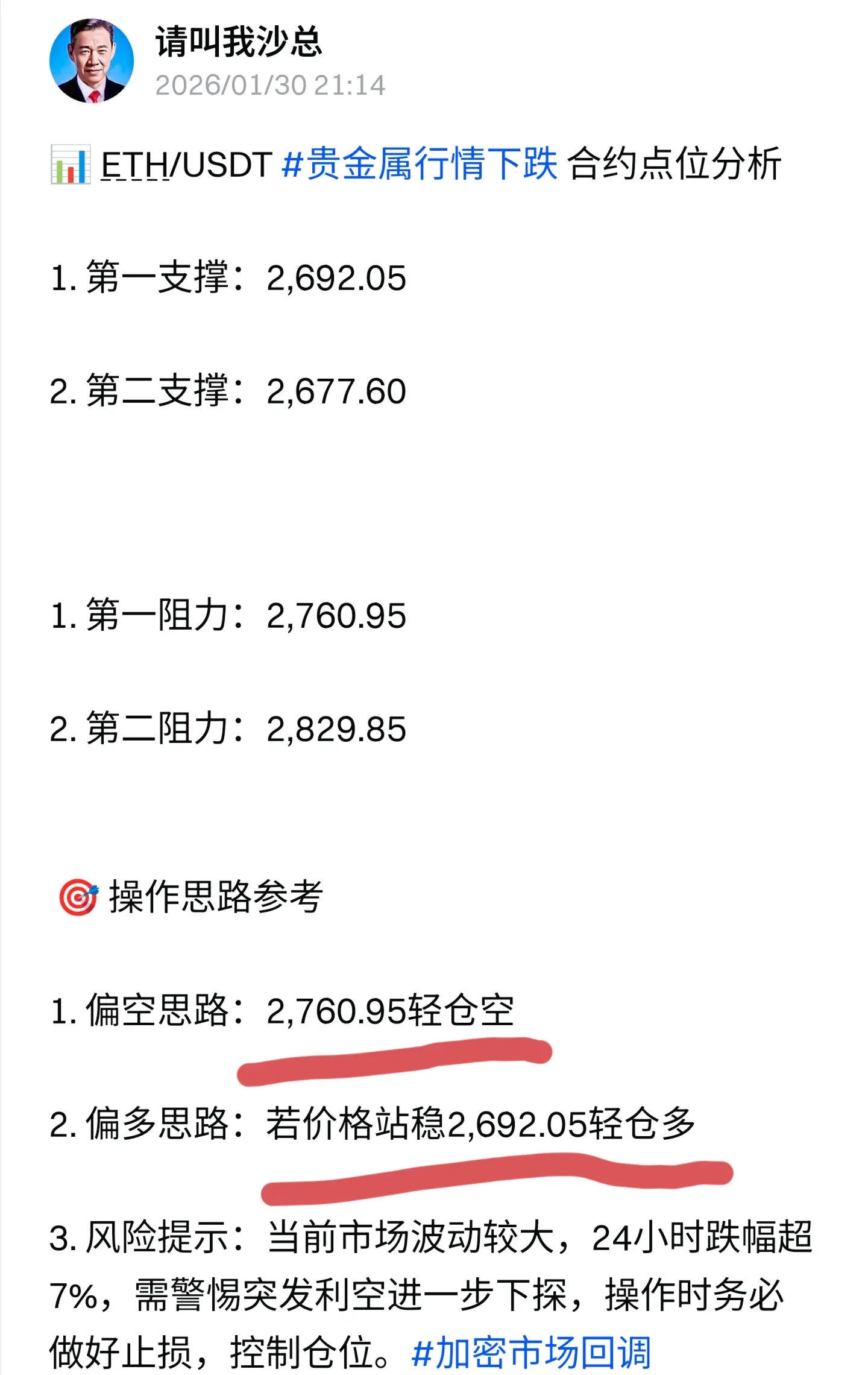
📊 ETH/USDT #贵金属行情下跌 Contract Point Analysis
1. First Support: 2,692.05
2. Second Support: 2,677.60
1. First Resistance: 2,760.95
2. Second Resistance: 2,829.85
🎯 Trading Strategy Reference
1. Bearish Approach: Short position at 2,760.95 with a small position size
2. Bullish Approach: If the price stabilizes above 2,692.05, go long with a small position
3. Risk Reminder: The current market is highly volatile, with a 24-hour decline of over 7%. Be alert to sudden negative news causing further downward movement. Always set stop-loss orders and control your position size during trading. #加密市场回调
ETH-2,68%
View Original
  • Reward
  • Comment
  • Repost
  • Share
🎯 Ethereum Trading Point Recommendations
Long (Buy) Strategy
- Entry Point:
- Conservative Entry: Wait for the price to stabilize above 2,750 (breakthrough of the middle band of Bollinger Bands), or confirm with a MACD golden cross before entering.
- Aggressive Entry: Enter a small position in the 2,700-2,720 range (support at Bollinger Band lower band), with a stop loss below 2,680 (break below the previous low of 2,677.60).
- Take Profit Targets:
- First Target: 2,780 (near the middle band of Bollinger Bands)
- Second Target: 2,847.59 (resistance at the upper band)
Short (Sell) Strategy
- E
ETH-2,68%
BTC-1,09%
View Original
  • Reward
  • Comment
  • Repost
  • Share
📊 ETH/USDT Market Analysis
- Current price: 2,727.99 USDT, down 7.46% from the 24-hour high of 2,948.52 USDT, indicating a rapid correction.
- Four-hour candlestick chart shows consecutive large bearish candles, suggesting that the bears are in control in the short term, and market sentiment is panic-driven.
2. Bollinger Bands (BOLL) Indicator
- The current price of 2,727.99 is approaching the lower band (LB: 2,714.00), indicating short-term oversold conditions and a technical rebound demand.
- The Bollinger Bands are expanding, showing increased volatility, which may lead to continued wide-r
ETH-2,68%
View Original
  • Reward
  • Comment
  • Repost
  • Share
YiboMarketAnalysisvip
Dollar Fluctuations and Why Cryptocurrencies "Dance" Along: Understanding the Pitfalls
Open your crypto market app, and you might notice a strange phenomenon: sometimes when the dollar is strong, Bitcoin, Ethereum, and other coins seem to lose momentum; conversely, when the dollar weakens, the crypto market might become lively and rally. What exactly is the relationship between the dollar and cryptocurrencies? Why do fluctuations in the dollar trigger waves in the crypto market? Today, let’s explain it in plain language.
First, let’s talk about their core relationship: the dollar is the world's "hard currency." Whether for international trade settlements or cross-border investments, everyone recognizes the dollar. Cryptocurrencies, on the other hand, are more like "high-risk investments." Their prices fluctuate more wildly than stocks or funds, mainly driven by speculative capital and safe-haven demand. These two are probably "frenemies": when the dollar strengthens, people prefer to convert their money into dollars to buy government bonds or deposit in banks for safety, making high-risk assets like cryptocurrencies less attractive, and prices tend to fall; when the dollar weakens, people worry about the dollar losing value and seek ways to preserve wealth, some funds flow into the crypto market, pushing coin prices up.
So, what determines the dollar’s rise and fall? First, it depends on the "mood" of the Federal Reserve. When the Fed raises interest rates, savings become more attractive, and global funds tend to flow into the US, causing the dollar to appreciate; if the Fed prints money (quantitative easing), more dollars flood the market, leading to dollar depreciation. For example, in 2022, the Fed raised interest rates seven times in a row, and the dollar index surged to 114, while Bitcoin dropped from $48,000 to $16,000 during the same period—an ugly scene; meanwhile, in 2020, the Fed engaged in unlimited money printing, and the dollar index fell below 90, while Bitcoin reached $29,000 by year-end. Besides policies, US economic data are also crucial—good inflation rates (CPI), employment figures (non-farm payrolls), and GDP growth indicate a strong US economy, which makes the dollar more attractive. Geopolitical events, like wars or trade frictions, also play a role—during such times, everyone seeks safe assets, and the dollar, as a "safe haven," demand increases, pushing its price up.
Next, how does the dollar’s volatility specifically impact cryptocurrencies? When the dollar strengthens, funds tend to flow out of the crypto market into dollar assets, shrinking the "crypto wallet," reducing liquidity, and making prices prone to decline. Additionally, higher interest rates increase borrowing costs; many traders leverage their crypto positions, and when costs rise, they become hesitant to operate, leading to decreased market activity. Even stablecoins pegged to the dollar (like USDT) may see reduced supply, further affecting crypto trading. Conversely, when the dollar weakens, fears of inflation and dollar devaluation prompt people to use cryptocurrencies as a "hedge," especially Bitcoin, often called "digital gold." Low interest rates also make borrowing to trade cheaper, increasing market volume; stablecoins may also be issued more, injecting more funds into the crypto market and driving prices higher.
What signals should ordinary investors pay attention to? Data-wise, key indicators include the Fed’s interest rate decisions every 6-8 weeks, monthly inflation data (CPI), non-farm employment reports, and real-time dollar index (DXY) movements. For example, a 1% rise in the dollar index typically correlates with an 0.8% decline in the market cap of the top 50 cryptocurrencies; good non-farm data may lead to expectations of Fed rate hikes, which could pressure the crypto market. Market news also matters—Fed policy statements, global trade tariffs, geopolitical news, and market sentiment signals like the VIX spike often coincide with crypto declines; large-scale issuance of stablecoins might be a sign that funds are preparing to buy the dip.
Finally, here are some practical trading tips. First, monitor the dollar index to judge trends—if the dollar index shows a big monthly rally, it could mean the crypto market is entering a bear phase, so be cautious. Second, control risk—avoid high leverage when dollar volatility is high, and consider hedging strategies, like selling crypto while buying dollar futures to reduce losses. Also, set phased stop-loss levels—if the dollar breaks key levels, sell part of your holdings to avoid heavy losses. Additionally, in extreme conditions, prioritize holding liquid mainstream coins rather than holding onto illiquid altcoins that are hard to sell.
In summary, the relationship between the dollar and cryptocurrencies is very close. Understanding the logic behind dollar fluctuations, combined with market signals and risk management, can help you avoid detours in crypto trading. After all, investing involves risks, especially with highly volatile assets like cryptocurrencies. The more you understand the underlying logic, the more rational your decisions will be.

repost-content-media
  • Reward
  • Comment
  • Repost
  • Share
YiboMarketAnalysisvip
This guide is specifically prepared for investors trading cryptocurrencies like Bitcoin, Ethereum, and others. The core focus is teaching how to use "trading volume" to judge market trends and assist trading. Here's a simple summary:
1. Understand the basics: What exactly is trading volume?
Trading volume refers to the total amount of cryptocurrency traded within a certain period. Its main role is to assess market activity and capital participation. The key is to look at the "price-volume relationship": when prices rise, trading volume should increase simultaneously, indicating that the rally is supported by funds and the trend is reliable; if prices go up but volume shrinks (not many traders involved), the upward movement is likely unsustainable and may reverse.
A little extra knowledge: different exchanges may have varying rules for calculating volume, which can sometimes be manipulated; on-chain data (actual transfer records on the blockchain) can exclude fake trades and provide more reliable reference.
2. How to interpret trading volume across different timeframes?
- Intraday short-term (same day): focus on 1-minute and 5-minute volume. For example, if the price breaks above the previous day's high with low volume, it might be a "false breakout"; if the price hits a new high but volume doesn't follow, a pullback is likely.
- Mid-term (weeks to months): monitor 5-day and 20-day average volume. If short-term average volume remains higher than long-term, it indicates a stable uptrend; a breakout from a sideways range with increased volume on weekly charts may signal the start of a mid-term rally.
- Long-term (major trend): combine with large on-chain fund movements. For instance, in the bottom phase, if volume keeps increasing but prices stay stable, it could be "smart money" quietly accumulating, hinting at a big move ahead.
3. How to use volume in extreme market conditions (sharp rise/fall, sideways)?
- During sharp rises: if prices keep climbing but volume gradually decreases, it signals a potential top; a breakout with historically large volume suggests a solid move with room to run; if volume suddenly spikes but price stalls, it might be a trap set by big players to lure retail investors.
- During sharp declines: consider the "pyramid averaging" method (adding small amounts as the price drops), but stop adding after a 10% drop to avoid further losses; prioritize reducing positions to control risk; also, monitor large on-chain fund movements to avoid bottom-fishing at the wrong time.
- During sideways consolidation: volume drops below 30% of the yearly average, indicating market sentiment is low and bulls and bears are at a stalemate; a subsequent increase in volume usually precedes a breakout—either upward or downward.
4. Differences in volume analysis between mainstream coins and altcoins
- Mainstream coins (Bitcoin, Ethereum): more reliable, with clear volume-price patterns (volume increases on uptrends, decreases on downtrends), ample liquidity, and large trades generally won't significantly impact prices; can also incorporate derivatives volume (futures, options) to confirm trends.
- Altcoins: higher risk, small funds can cause sharp price swings; sudden volume surges often indicate hype or manipulation by whales; the trend may lack sustainability, and you might see "price rising but volume falling" anomalies; always cross-check large on-chain transfers to verify signals.
5. How to apply these techniques in actual trading?
- Master basic indicators: such as OBV (to judge capital flow) and VWAP (institutional average cost), avoiding relying solely on price signals, which can lead to misjudgments.
- Multi-dimensional validation: for key breakouts, volume should be at least 1.5 times the daily average; combine data from different timeframes and exchanges to avoid false signals from a single platform.
- Practice + strict risk control: test strategies with demo accounts first (e.g., "buy on volume breakout, sell on volume decline"), and in real trading, set strict stop-loss and take-profit levels; never base decisions solely on volume signals.
- Adjust strategies flexibly: different market phases require different volume interpretations; altcoins are suitable for short-term trading with quick entries and exits, while mainstream coins can be part of long-term plans—don't stick to one method for all scenarios.
Summary: Trading volume is a core tool for judging market authenticity and understanding capital movements. The key is to adapt its use based on different timeframes, coins, and market conditions, combined with other data and risk management rules, to effectively improve trading success rates.
repost-content-media
  • Reward
  • Comment
  • Repost
  • Share
Learn how to turn an exchange into an ATM in 5 minutes
$ETH $BTC Today I share a simple method to master the crypto world in 1 minute, making the exchange work for you. This method doesn't guess price movements or watch the charts. After 5 years of practical experience with zero liquidation, I turned 5000U into a seven-figure amount. $TRUTH
In 2017, I started with 5000U in the market. While some around me got liquidated and mortgaged their houses, my account curve was upward at a 45° angle. My principal never drew down more than 10%.
Treat the market like a gambling machine, and yourself as th
ETH-2,68%
BTC-1,09%
LUNA-0,19%
View Original
  • Reward
  • Comment
  • Repost
  • Share
https://www.gate.com/zh/competition/f1rb/2025?ref=VLNBAFSKAG&ref_type=165&utm_cmp=AXHKa1jS#Gate11月透明度报告出炉 #广场发帖领$50 #美联储降息
  • Reward
  • 1
  • Repost
  • Share
GateUser-9755d3c0vip:
Is there a way to contact trader Luke? I ordered from him but don't know how to reach him. I saw you're following him, and I’d like to trouble you for a favor, to pass along a message 😭
ETH Market Analysis for the Afternoon of December 8
ETH is consolidating and recovering around the 3050 support level, with a V-shaped rebound leading to intensified long-short battles. Technical recovery and fundamental bullish news are resonating.
Core Support: Stabilized after testing 2907, with the 200-day moving average reinforcing the base. Fusaka upgrade empowerment plus rising rate cut expectations. Whale accumulation provides a strong floor, with solid on-chain buying.
Trend Forecast: Short-term is expected to break through the 3070 resistance, aiming for 3150-3180. Holders should rel
ETH-2,68%
View Original
  • Reward
  • Comment
  • Repost
  • Share
【ETH Price Trend Analysis】
1. Candlestick Patterns:
- The recent K-line shows a clear upward trend, especially since January 30th, when the price quickly rose from 3112.54 to the latest price of 3330.13.
- A series of positive candlesticks has formed on the daily chart, indicating strong buying pressure in the market.
2. Technical indicators:
- MACD: On the hourly chart, both DIF and DEA are positive values and the MACD histogram shows a bullish arrangement, indicating strong upward momentum in the short term.
- RSI: The current RSI14 is approaching 70, which is in the overbought zone, but
ETH-2,68%
View Original
  • Reward
  • 7
  • Repost
  • Share
NightWalkerAvip:
Just charge it 💪
View More
Happy New Year
View Original
  • Reward
  • 1
  • Repost
  • Share
NightWalkerAvip:
Hold on HODL💎
#ETH Price Trend Analysis】
1. K-line pattern:
- The recent price has fluctuated in the range of 3400 to 3300, showing an overall oscillating trend.
- The appearance of multiple long upper and lower shadows indicates strong selling pressure and support in the market.
2. Technical Indicators:
- MACD: Currently, both DIF and DEA are negative values, and the MACD histogram shows that bearish momentum is dominant, but there are signs of weakening.
- RSI: The RSI14 value is 45.48, which is in the neutral zone and has not entered the overbought or oversold zone.
- EMA: The short-term EMA7 (335
ETH-2,68%
View Original
  • Reward
  • 1
  • Repost
  • Share
PleaseCallMeShavip:
As long as 3300 is not broken in the short term, you can buy low near each pullback, and make a profit of 60-100 points each time. Shorting should only be entered near 3360 or above to avoid being passive.
#ETH Price Trend Analysis
Pay more attention and have more dynamics
1. Candlestick Patterns:
- The recent price has fluctuated in the range of 3350 to 3450, showing a volatile consolidation trend.
- Multiple long upper and lower shadow lines indicate strong selling pressure and support in the market.
2. Technical Indicators:
- MACD: The current DIF is close to the zero axis with DEA, and the MACD histogram shows a relatively balanced power between long and short positions, but there are signs of weakening.
- RSI: The RSI14 value is 44.70, in the neutral zone, not entering overbought or o
ETH-2,68%
BTC-1,09%
MEME-0,1%
View Original
  • Reward
  • 1
  • Repost
  • Share
Like and follow, don't get lost in market analysis. I have been analyzing the ETH market and hope my analysis is helpful to you.
#ETH Price Trend Analysis
1. K-line pattern:
- The recent price has been oscillating around 3400, with strong support and resistance levels.
- After a sharp decline in the early stage, there was a rapid rebound, and it is currently in a high-level consolidation phase.
2. Technical Indicators:
- MACD: The current DIF and DEA are both negative, but the MACD histogram is gradually shrinking, indicating a weakening bearish force, and the possibility of forming a gold
ETH-2,68%
View Original
  • Reward
  • Comment
  • Repost
  • Share
#ETH Buy/Sell Point】
- Buy Point 1: 3350 USDT (near the previous low, psychological support level)
- Buy Point 2: 3300 USDT (further probing to a stronger integer support level)
- Long stop-loss point: 3275 USDT (25 points below the second buying point to prevent false breakouts)
- Sell Point 1: 3450 USDT (near recent high, psychological resistance level)
- Sell Point 2: 3500 USDT (further upward to a stronger integer pressure level)
- Short stop-loss point: 3525 USDT (25 points above the second selling point to prevent false breakthroughs)
ETH-2,68%
View Original
  • Reward
  • Comment
  • Repost
  • Share
🎆 New year, new luck! Join the Ultimate Lucky Draw Celebration Event!
🎉 Gate.io community honor points New Year lucky draw - Phase six has officially begun!
Start the draw now 👉 https://www.gate.io/activities/creditprize?now_period=6
🌟 How to participate?
1️⃣ Go to the [Credit Center] published by gate, complete tasks such as publishing, commenting, liking, and get credit points.
2️⃣ Lower participation threshold: You can get a chance to participate in the draw by earning 300 points!
🎁 Participate to win MacBook Air, exclusive products, points, futures coupons, and more in the lucky draw!
View Original
  • Reward
  • Comment
  • Repost
  • Share
#ETH Price Trend Analysis
1. Candlestick Patterns:
- The price has been fluctuating around 3400 recently, forming a small upward channel.
- There was a significant drop and volume surge in the early stage, and it is currently in the rebound phase.
2. Technical Indicators:
- MACD: DIF and DEA are diverging upwards, and the MACD histogram is positive, indicating that the current market is in a bullish trend.
- RSI: The RSI14 is currently around 63, close to the overbought zone, but has not yet entered the extreme zone, showing some upward momentum.
- EMA: Short-term EMA7 (3390.38) is h
ETH-2,68%
View Original
  • Reward
  • 4
  • Repost
  • Share
PleaseCallMeShavip:
- Sell point 1: 3450 USDT (near the previous high point, may generate selling pressure)

- Sell point 2: 3500 USDT (round number, psychological resistance level)

- Short stop-loss point: 3525 USDT (25 points above sell point 2, to prevent further pump after breakthrough)
View More
#BTC Price Trend Analysis
1. Candlestick Patterns:
- The price has been fluctuating around 95000 recently, showing an overall oscillating trend.
- There have been multiple long upper and lower shadows on the daily K-line, indicating strong selling pressure and support in the market.
2. Technical Indicators:
- MACD: The MACD on the hourly chart is below the zero line, but there are signs of convergence pointing upwards, indicating a possible rebound in the short term. The MACD on the daily chart is still below the zero line, indicating a bearish trend remains unchanged.

- RSI: The ho
BTC-1,09%
View Original
  • Reward
  • 1
  • Repost
  • Share
PleaseCallMeShavip:
- Sell point 1: 96000 USDT (near the resistance level above the current price, integer level)

- Sell point 2: 97000 USDT (further pump to higher resistance level, with an interval of more than 1%)

- Short stop loss point: 97500 USDT (500 points above Sell point 2, to prevent breaking through important resistance)
#ETH price trend analysis
1. Candlestick Pattern:
- The price has been fluctuating in the range of 3300 to 3400 recently, showing an overall oscillating trend.
- There have been multiple long lower shadows on the daily K-line, indicating strong support below.
2. Technical Indicators:
- MACD: The hourly MACD fast and slow lines are gradually converging, indicating a trend of forming a golden cross, indicating a possible rebound in the short term. The daily MACD is still in the bearish zone, but the green bar is shrinking, indicating a weakening bearish momentum.

- RSI: The hourly RSI
ETH-2,68%
View Original
  • Reward
  • Comment
  • Repost
  • Share
Now the pump trend, BitETH long position has been cleared #BTC #ETH
ETH-2,68%
BTC-1,09%
View Original
  • Reward
  • 1
  • Repost
  • Share
PleaseCallMeShavip:
All in All in 🙌
  • Pin