GateUser-67ade612

vip
Age 0.9 Yıl
Peak Tier 0
No content yet
DeFi TVL has been stuck around $96B for months now, basically just moving sideways.
But something's happening underneath that caught my attention.
When total TVL stays flat but individual protocols are growing fast, you're not seeing new money flowing in but rather money moving around between protocols.
And Hyperliquid's been on the receiving end lately.
The TVL numbers are confusing tbh:
> DeFi protocol TVL: $4.4B (across chains)
> Bridged TVL: ~$7.4B (approx. incl. $5.5B+ open interest)
> Stablecoin market cap: $4.6B (ecosystem liquidity)
Different ways to measure it, but the key thing: Over
HYPE-1,7%
AAVE7,28%
MNT2,9%
ARB8,02%
  • Reward
  • Comment
  • Repost
  • Share
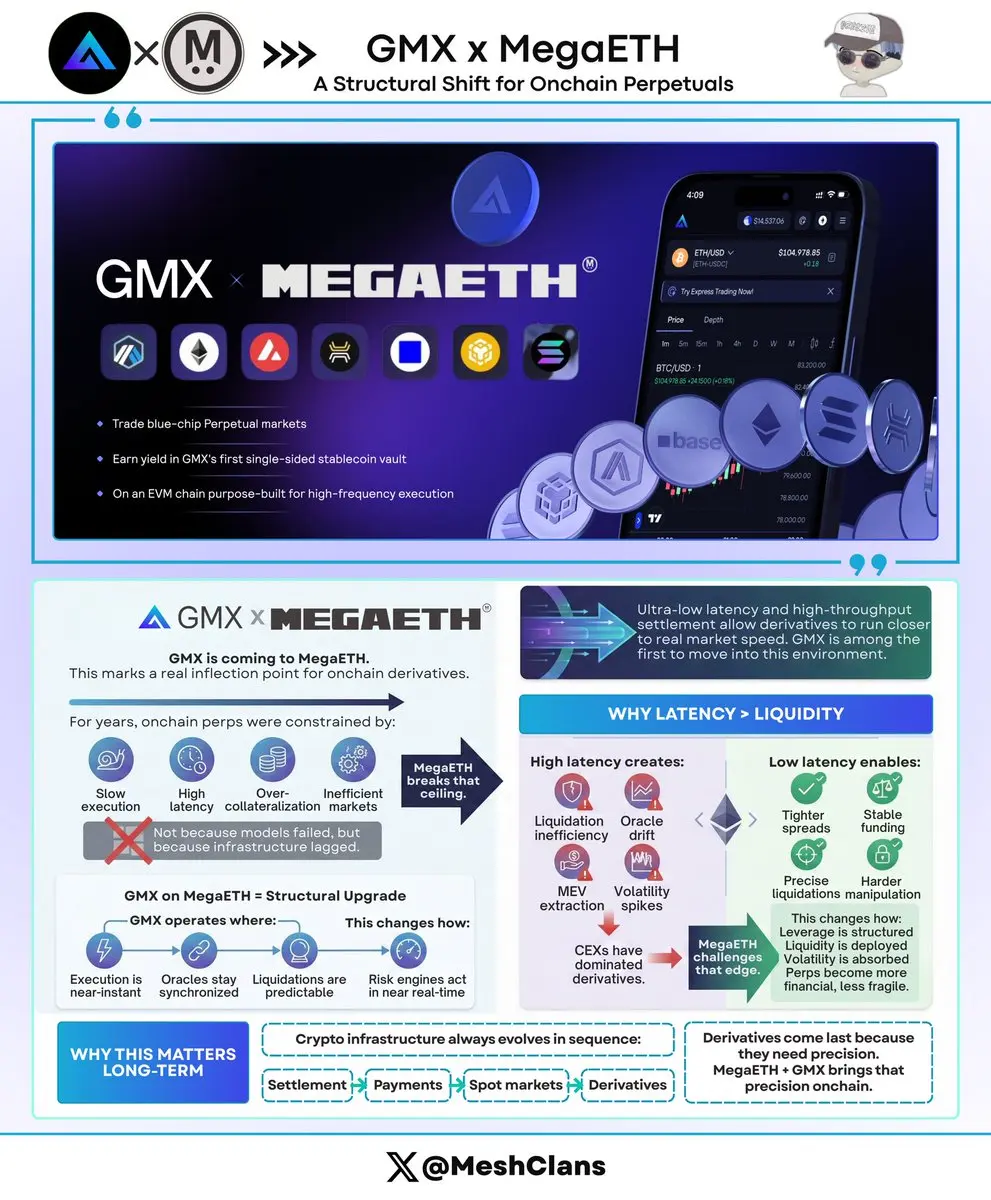
GMX is coming to MegaETH. And this is set to meaningfully change the structure of onchain derivatives.
For so long , perpetual trading onchain has lived inside a constraint box
Execution had to be slower, latency had to be tolerated, liquidity had to be over-collateralized.
And market efficiency had to be compromised.
Not because the models were flawed, but because the infrastructure baseline was low.
MegaETH breaks that inflection point.
By combining ultra-low latency execution with high-throughput settlement, it introduces an environment where derivatives can finally begin to operate closer
GMX1,83%
post-image
  • Reward
  • Comment
  • Repost
  • Share
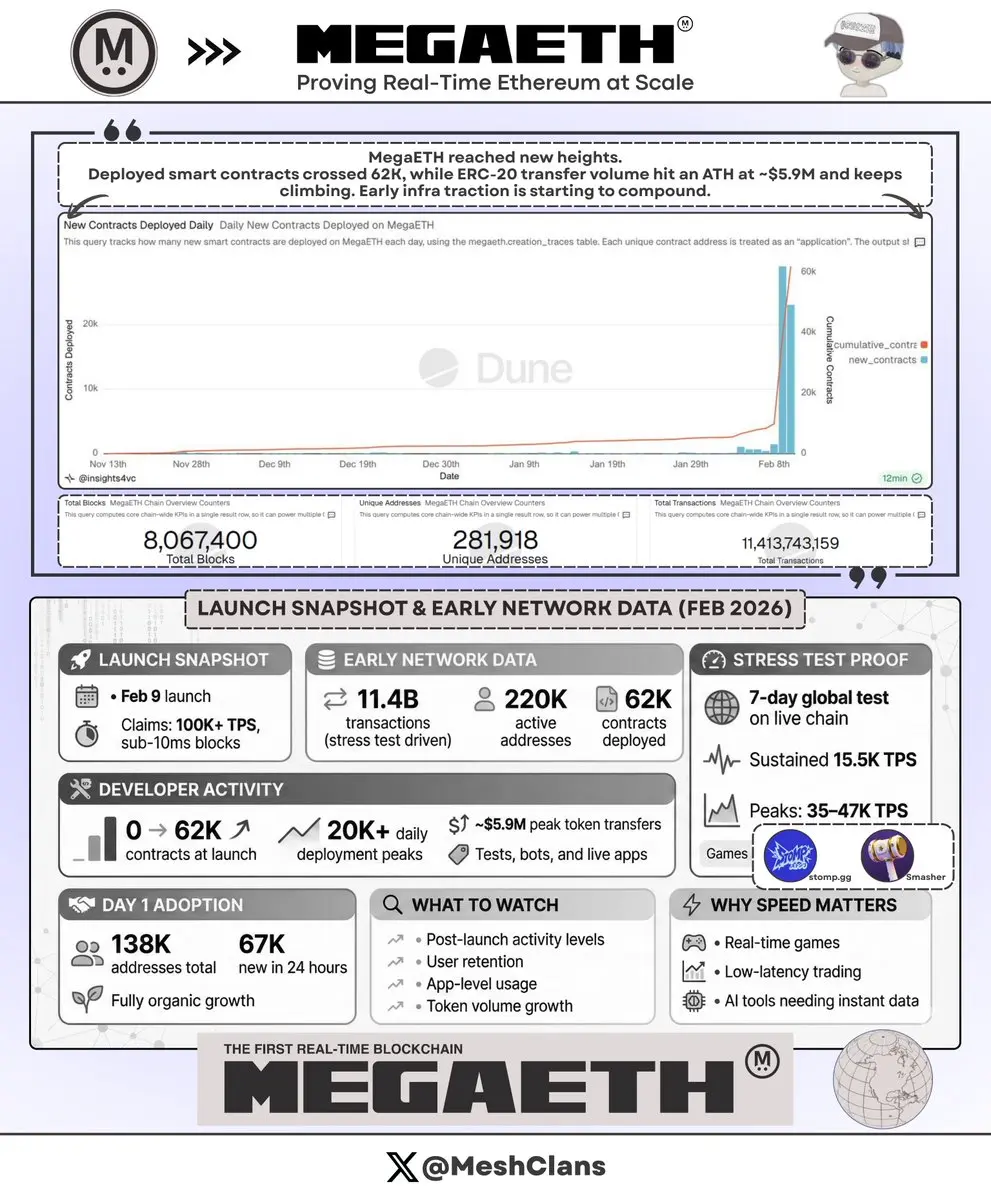
MegaETH launched Feb 9 claiming over 100,000 TPS and sub-10ms block times. Here's what the data shows.
Smart contracts deployed went from zero to 62K around launch. Daily peaks hit over 20K contracts. This includes test contracts, automated setups, and real apps going live.
Launch numbers tell the story:
> 11.4B transactions (largely from January stress test on live chain)
> 220K addresses active
> ~$5.9M in token transfers peak
> 62K contracts deployed on network
They ran a 7-day global stress test in late January that processed Ethereum's 10-year history in one week. Sustained 15,500 TPS, pe
TOKEN4,11%
ETH5,4%
LINK4,88%
SOL6,24%
post-image
  • Reward
  • Comment
  • Repost
  • Share
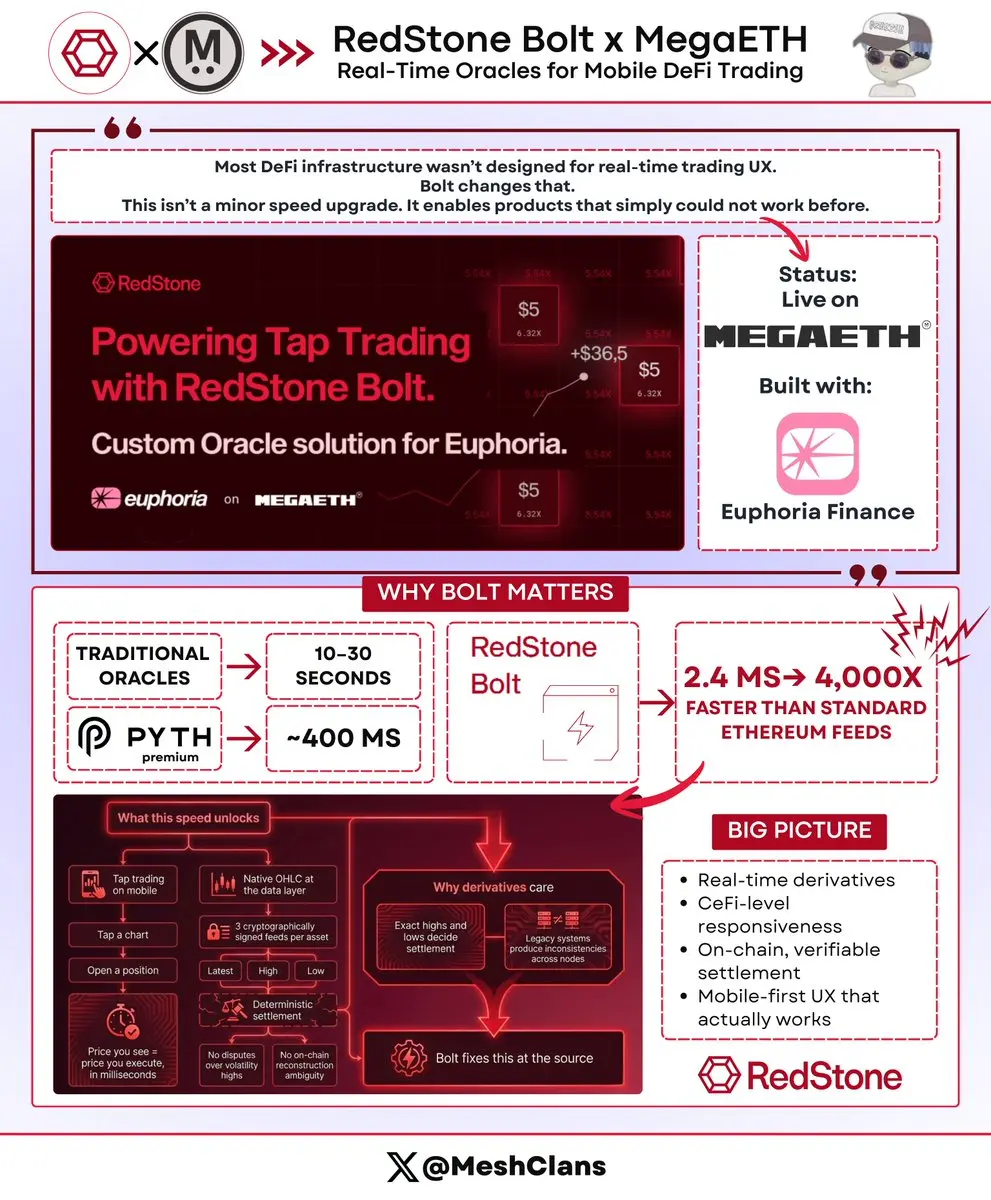
So @redstone_defi recently just shipped Bolt on MegaETH's testnet with Euphoria Finance.
The technical specs here actually matters a lot because they enable a product that couldn't exist on previous infrastructure.
Oracle update speeds:
🔸 Traditional oracles: 10-30 seconds
🔸 Pyth premium tiers: ~400ms
🔸 RedStone Bolt: 2.4 milliseconds
That's over 4,000x faster than standard Ethereum oracle feeds.
The speed metric matters, but what becomes possible matters more.
@Euphoria_fi's building tap trading on mobile (tap a chart to open a position). For that to work, the oracle needs to be part of th
RED0,92%
PYTH6,97%
ETH5,4%
post-image
  • Reward
  • Comment
  • Repost
  • Share
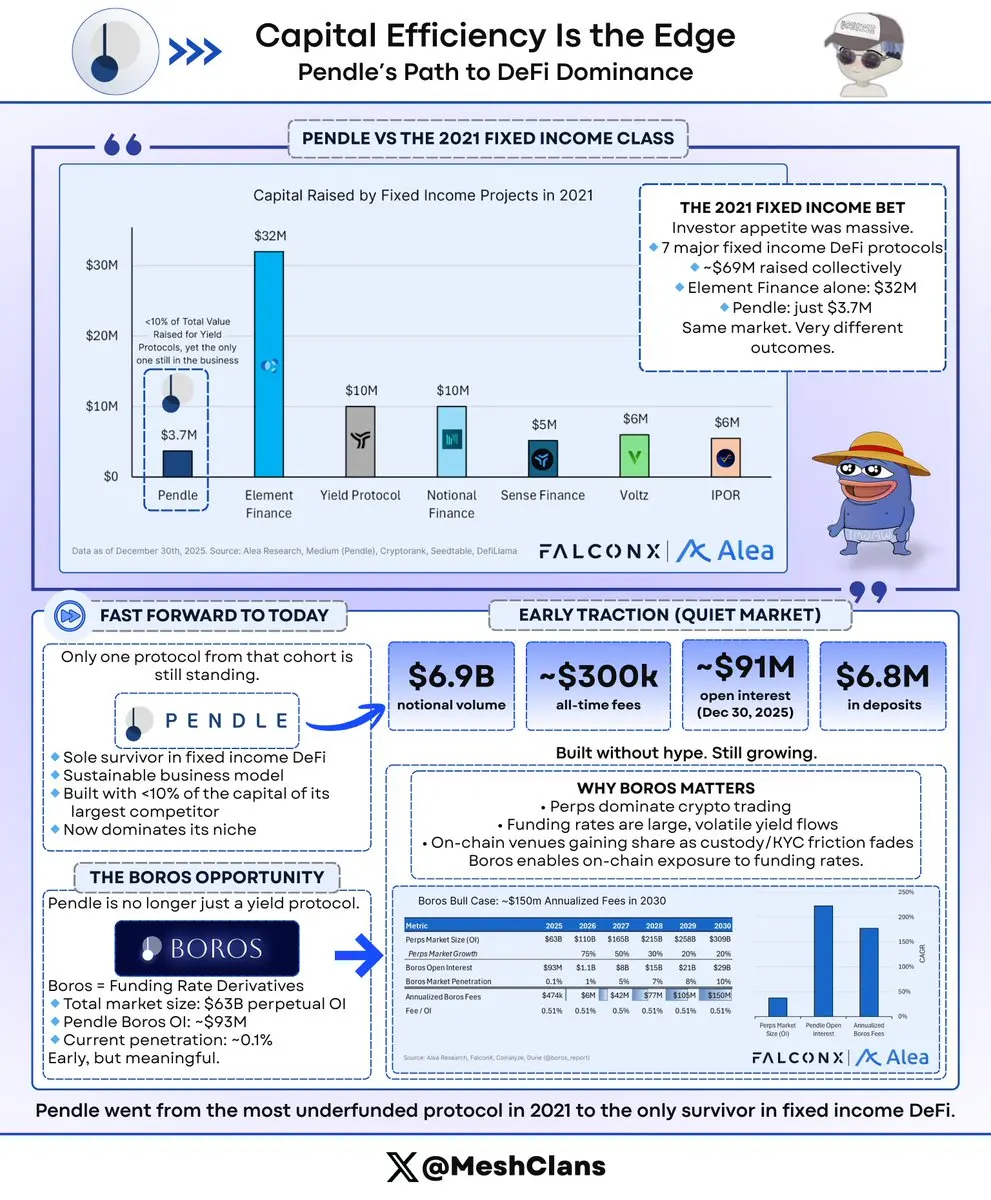
DeFi landscape has produced a fascinating case study in capital efficiency and product-market fit.
While Element Finance raised $32 million in 2021, nearly 10x what pendle secured, only one of these protocols remains operational today.
@pendle_fi , with its modest $3.7 million raise has emerged as the sole survivor and now dominates its niche.
zooming out, it's realistic to see how capital efficiency vs market dominance becomes evident:
The 2021 funding landscape for fixed income protocols told a story of significant investor appetite, with seven major protocols collectively raising approxim
IN1,51%
MAJOR1,49%
post-image
  • Reward
  • Comment
  • Repost
  • Share
The stablecoin market is already decided
Look at those colored bands in the Artemis chart - USDT (teal) and USDC (blue) aren't just dominant, they're the entire visual while everything else barely registers.
Total supply hit $308B+ with USDT and USDC controlling ~85% of the market. The percentage isn't what matters though - it's about who owns the rails.
Daily transfer volume shows the dominance clearly:
> USDT: $100B+ daily
> USDC: $20-50B daily
That volume represents years of accumulated infrastructure:
> Exchange base pairs
> DeFi integrations
> Liquidity pools
> Protocol-level adoption bui
USDC0,01%
USDE0,09%
PYUSD-0,06%
  • Reward
  • Comment
  • Repost
  • Share
. @re just crossed $174M in total written premium. Which, if you've been watching the space, puts them right up there with Nexus Mutual ($139M) in terms of actual capital deployed.
That's... kind of a big deal tbh cuz nexus has been the name in DeFi insurance for years.
Here's what's actually going on:
- This isn't your standard DeFi insurance play : They're not covering protocol hacks or bridge exploits. what they are doing is tokenizing real-world reinsurance like the stuff that backs auto policies and workers comp.
You know, the boring insurance that nobody thinks about until they actuall
USDC0,01%
USDE0,09%
BTC4,18%
  • Reward
  • Comment
  • Repost
  • Share
Traditional banks are stuck in a paradox where blockchain offers everything they need (speed, efficiency, programmability), but they legally can't touch it because public ledgers expose data that banks are prohibited from revealing.
---
The reason? Privacy regulations and institutional mandates mean sensitive transaction data cannot exist on transparent ledgers. Operating within internal systems works, but it creates impossible tradeoffs when banks need to:
🔸 Access DeFi liquidity (can't expose balances publicly)
🔸 Execute cross-border settlement (revealing counterparties creates legal issue
DEFI0,03%
RLS1,4%
TOKEN4,11%
post-image
  • Reward
  • Comment
  • Repost
  • Share
DeFi vaults have a problem: they can only invest in things that settle instantly. If it can't complete in one block, it's off the table.
This isn't some minor edge case. It locks vaults out of most of what tradfi does.
Why? ERC-4626 (the standard that powers vaults like Morpho and Euler) requires atomic transactions. Everything happens now, or it reverts. That works fine when you're dealing with liquid pools, but it completely fails for:
🔸 Real World Assets (compliance doesn't happen in one block)
🔸 Fixed-term positions like Pendle PTs
🔸 Cross-chain strategies (bridging isn't instant)
🔸 An
MORPHO-2,12%
EUL5,16%
CFG-1,35%
  • Reward
  • Comment
  • Repost
  • Share
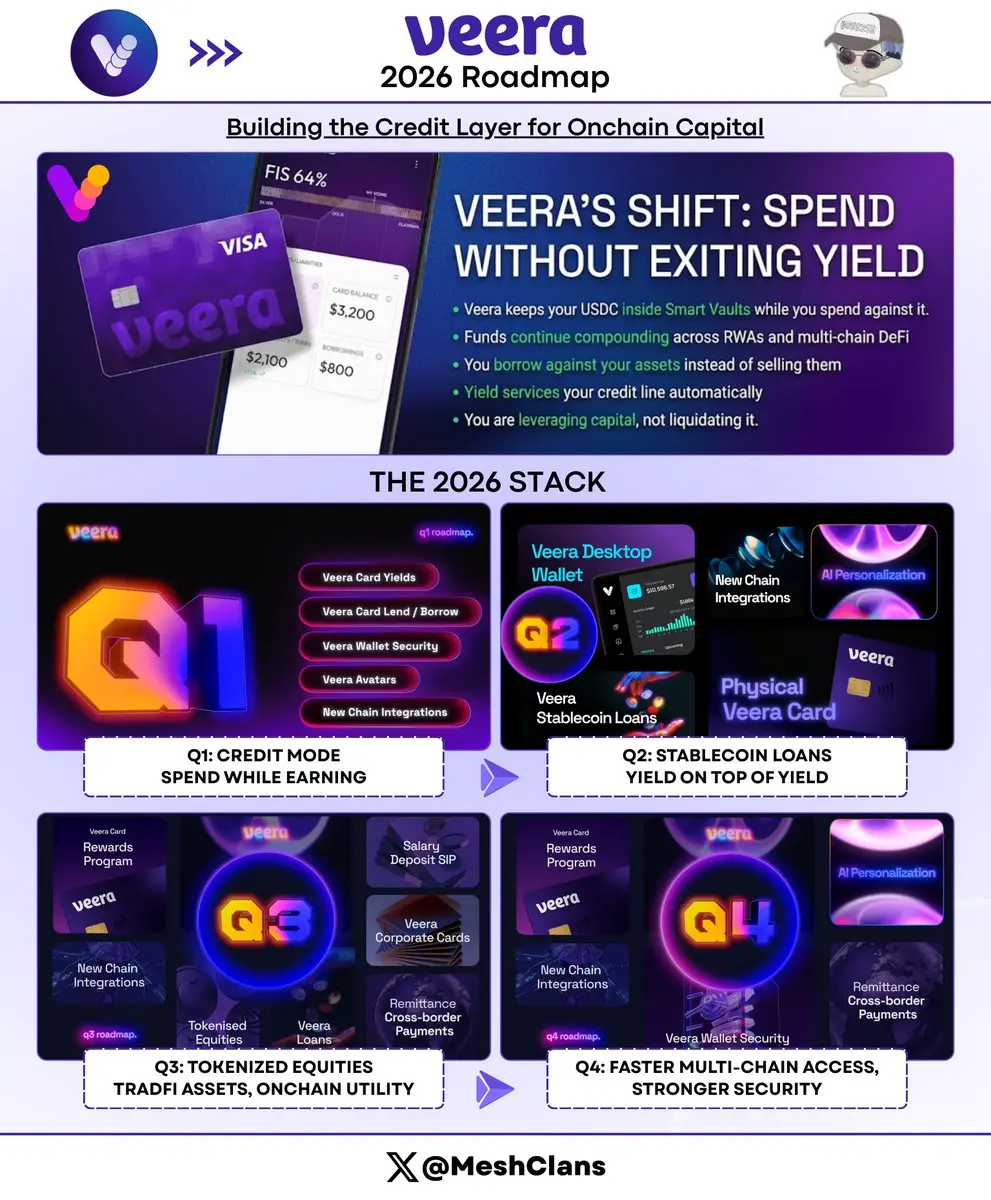
Veera 2026 Roadmap: The Credit Layer Thesis
Credit Mode launching Q1 changes the game. Not another feature drop. This rewires how capital moves between yield strategies and real spending.
Current cards are all the same trade. Load = liquidate. Crypto. com, Coinbase, Wirex force you to exit positions and park in fiat. Yield stops when you swipe.
@On_Veera chnages the whole thing. Your USDC stays in Smart Vaults compounding (RWA plays, multi-chain DeFi) while you borrow against it. The yield covers your credit line automatically. You're leveraging, not selling.
Three layers that stack over 2026
USDC0,01%
ETH5,4%
DEFI0,03%
FIS-1,94%
post-image
  • Reward
  • Comment
  • Repost
  • Share
. @alturax launched its mainnet vault on December 24, and the timing actually makes sense. They're claiming 20% base APY, but the important part is where that yield comes from - it's not just printing tokens and calling it a day.
The protocol runs on HyperEVM, which is Hyperliquid's new EVM layer. If you've been watching the Hyperliquid ecosystem, you know they've built some seriously deep on-chain liquidity.
Altura is tapping into that.
How they're making money for depositors:
- Funding arbitrage where they capture premiums from traders holding leveraged positions
- Making markets on Hyperl
post-image
  • Reward
  • Comment
  • Repost
  • Share
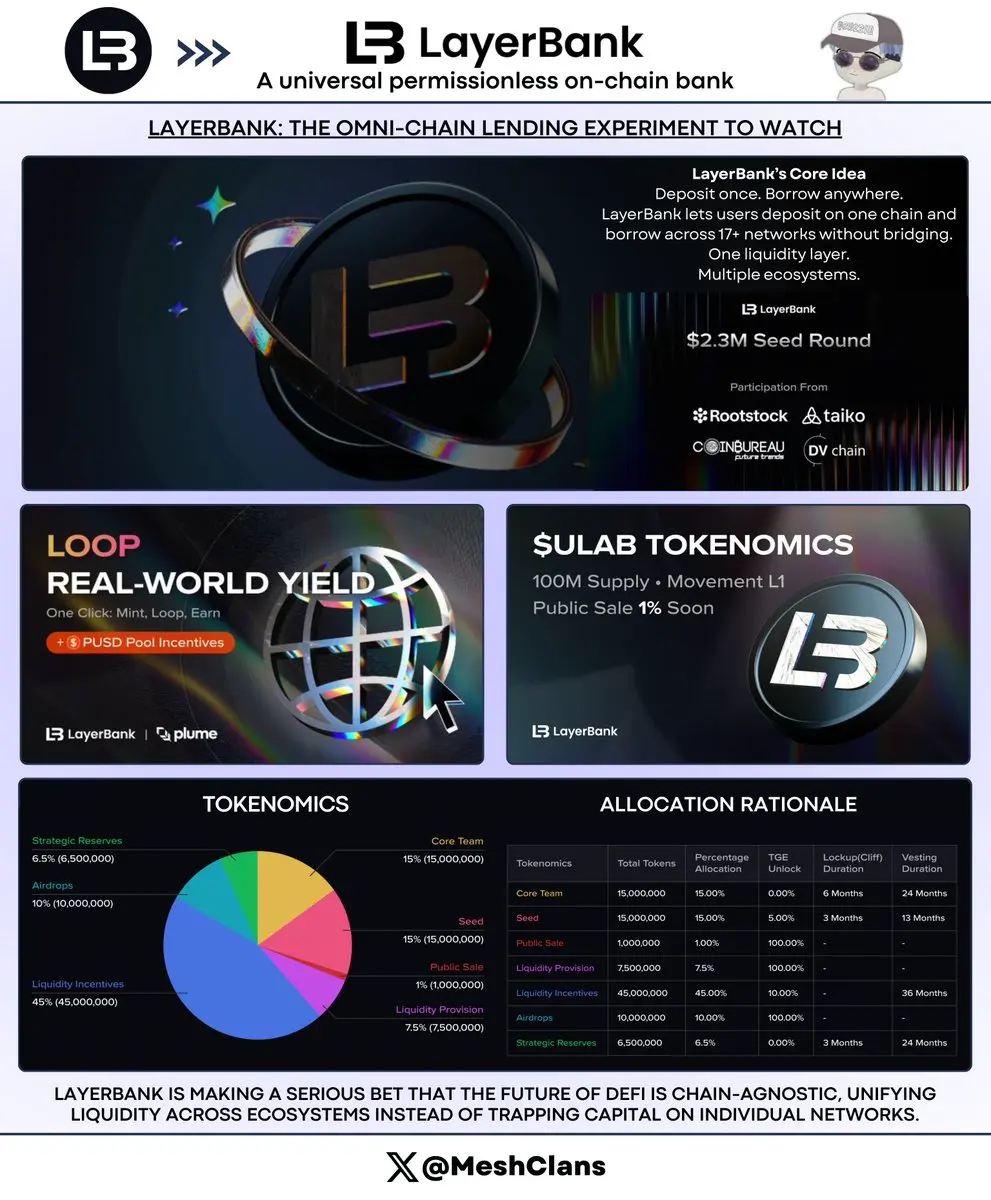
So @LayerBankFi might just be the most interesting cross-chain experiment in DeFi right now, and here's why I'm paying close attention.
They're tackling a real problem: having your assets locked on one chain while the best lending opportunities are somewhere else.
Imagibe You've got ETH on Ethereum, but the best rates are on Movement or Linea. With LayerBank, you can deposit on one chain and borrow on any of their 17+ supported networks without bridging. That's the unified liquidity vision DeFi needs.
The tech behind this is genuinely innovative:
> Cross-chain liquidity pools connecting 17+
ETH5,4%
BTC4,18%
post-image
  • Reward
  • Comment
  • Repost
  • Share
  • Pin