Gate Layer: High-Performance Execution Layer Based on OP Stack
Gate Layer is positioned as a fully EVM-compatible Layer 2 execution network. Following the Optimistic Rollup model, it executes large volumes of transactions off-chain and submits them in batches, increasing overall throughput and reducing costs.
Key technical features of Gate Layer include:
- Built on OP Stack, inheriting the Optimistic Rollup architecture
- Full EVM compatibility, supporting the existing Ethereum development toolchain
- Transaction sequencing and fast confirmation via Sequencer
- Data availability cost optimization using Blob data structures
With these designs, Gate Layer achieves over 5,700 TPS processing capacity while significantly reducing gas costs, supporting large-scale application scenarios such as DeFi, gaming, and social apps.
For developers, the main advantage of this architecture is “low migration cost.” Existing Ethereum-based applications can be deployed on Gate Layer with almost zero changes to the underlying logic.
Gate Layer × Gate Chain: Layered Execution and Settlement Architecture
One of Gate Layer’s key innovations is its layered collaboration with Gate Chain. This design explicitly separates “execution” from “security,” enabling high performance without compromising security.
The division of responsibilities can be understood as follows:
Gate Layer (L2 Execution Layer)
- Responsible for transaction execution and state updates
- Provides low-cost, fast-confirmation user experience
- Manages transaction flow via Sequencer, Batcher, Proposer
- Supports cross-chain protocols (e.g., LayerZero) for interoperability
Gate Chain (Settlement & Data Layer)
- Provides finality confirmation
- Stores transaction batches and state roots (Blob data)
- Ensures security via GT staking and validator network
- Hosts governance and economic mechanisms
This structure embodies the core idea of Layer 2:
👉 “Execution on Layer 2, trust anchored in Layer 1”
In other words, users enjoy instant experiences on Gate Layer, but ultimate security depends on Gate Chain’s consensus and validation mechanisms.
Rollup Lifecycle: From Transaction Submission to Final Confirmation
On Gate Layer, a transaction’s lifecycle can be broken down into several stages, reflecting the logic of Optimistic Rollups:
1.Transaction Submission (User → RPC)
Users send transactions to the network through nodes
2.Fast Confirmation (Sequencer)
Sequencer orders transactions and creates blocks for “instant availability”
3.Batch Submission (Batcher)
Transaction data is bundled and written to Gate Chain’s Blob storage
4.State Submission (Proposer)
State root is submitted to L1 contract
5.Validation & Finality (Gate Chain)
Validator network and staking mechanism confirm final transaction validity
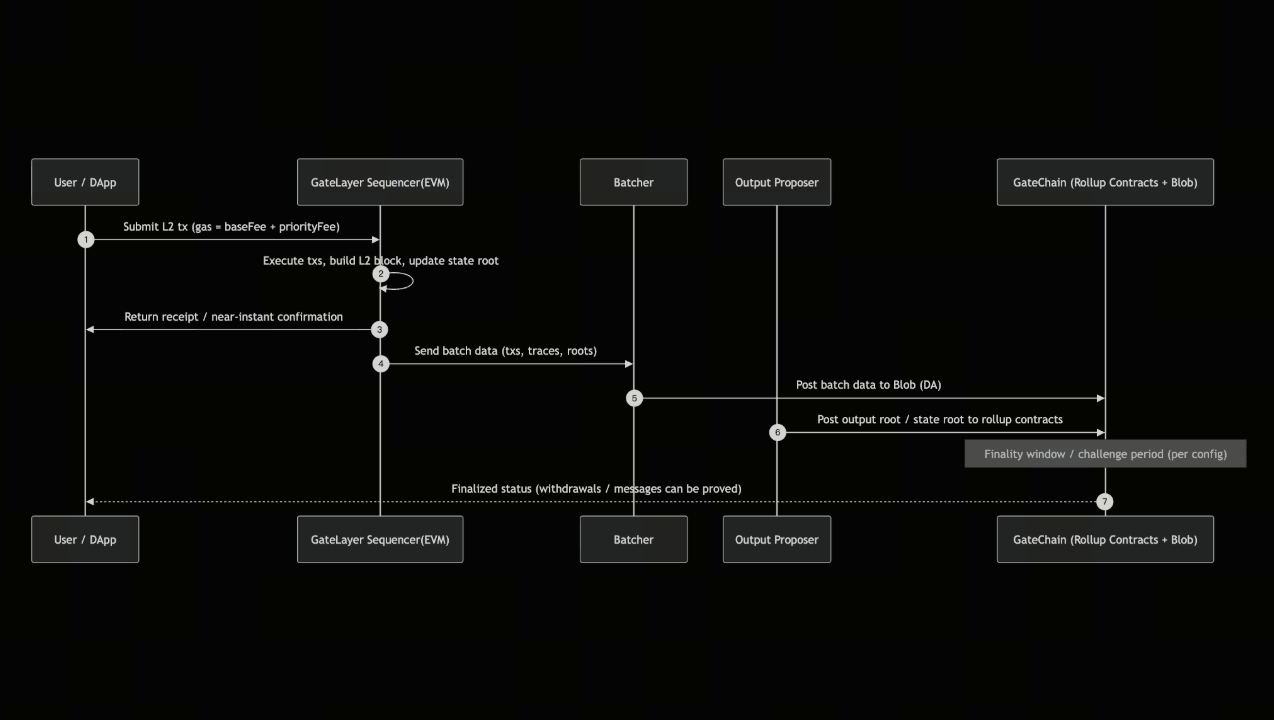
During this process, transactions transition from unsafe → safe → finalized. This staged confirmation mechanism is key to how Optimistic Rollups balance efficiency and security.
Fee Structure: L2 Execution Fee + L1 Data Fee
Gate Layer’s fee model consists of two parts—a typical design for current Rollup architectures:
1. L2 Execution Fee
- Pays for EVM computation resources
- Uses the EIP-1559 model (base fee + priority fee)
- Primarily earned by the Sequencer
2. L1 Data Fee
- Pays for writing data to Gate Chain (Blob) storage
- Ensures transaction data is verifiable and reconstructable
After users pay the total fee, the Sequencer allocates:
- A portion covers L1 costs
- The remainder is operational revenue
The significance of this structure is:
👉 Users pay not just for “computation,” but also for “security and data availability.”
Performance: High Throughput, Low Cost Scaling Advantages
In real-world performance, Gate Layer is competitive across several key metrics:
Core advantages:
- Throughput: Up to ~5,700 TPS, surpassing most L2s
- Block Time: About 1 second for faster confirmations
- Gas Capacity: 120M block limit to handle high-load scenarios
- Cost Efficiency: Around $30 for one million transfers
These figures show that Gate Layer maintains stable fees even under high concurrency, avoiding gas spikes due to network congestion.
From an application perspective, these performance characteristics are ideal for:
- High-frequency trading (e.g., perpetual contracts)
- Large-scale on-chain games
- Meme and social interaction applications
Cross-Chain & Interoperability: Expanding from Single Chain to Multi-Chain Ecosystems
Beyond performance enhancements, Gate Layer emphasizes cross-chain interoperability. By integrating protocols like LayerZero, it enables asset and information flow between different blockchains.
The core logic:
- The “security anchor” for cross-chain operations remains Gate Chain
- Final settlement of all cross-chain assets requires L1 confirmation
This means that even as assets move across chains, their security always reverts to the underlying settlement layer, mitigating common trust risks found in cross-chain bridges.
Application Scenarios: From Infrastructure to Ecosystem Expansion
With this architecture, Gate Layer is more than just a “faster chain”—it’s a complete application infrastructure capable of supporting various Web3 applications:
- DeFi: Low-cost, high-frequency trading environments
- Gaming: Real-time interactions and asset onboarding
- Social: On-chain content and behavior monetization
- Meme Ecosystem: High throughput for explosive transaction volumes
For developers, its permissionless and EVM-compatible environment greatly lowers entry barriers; for users, it offers a Web2-like seamless experience.