


Did Vitalik admit a mistake? Ethereum Layer 2 strategy has failed, resulting in a loss of 3 billion US dollars.
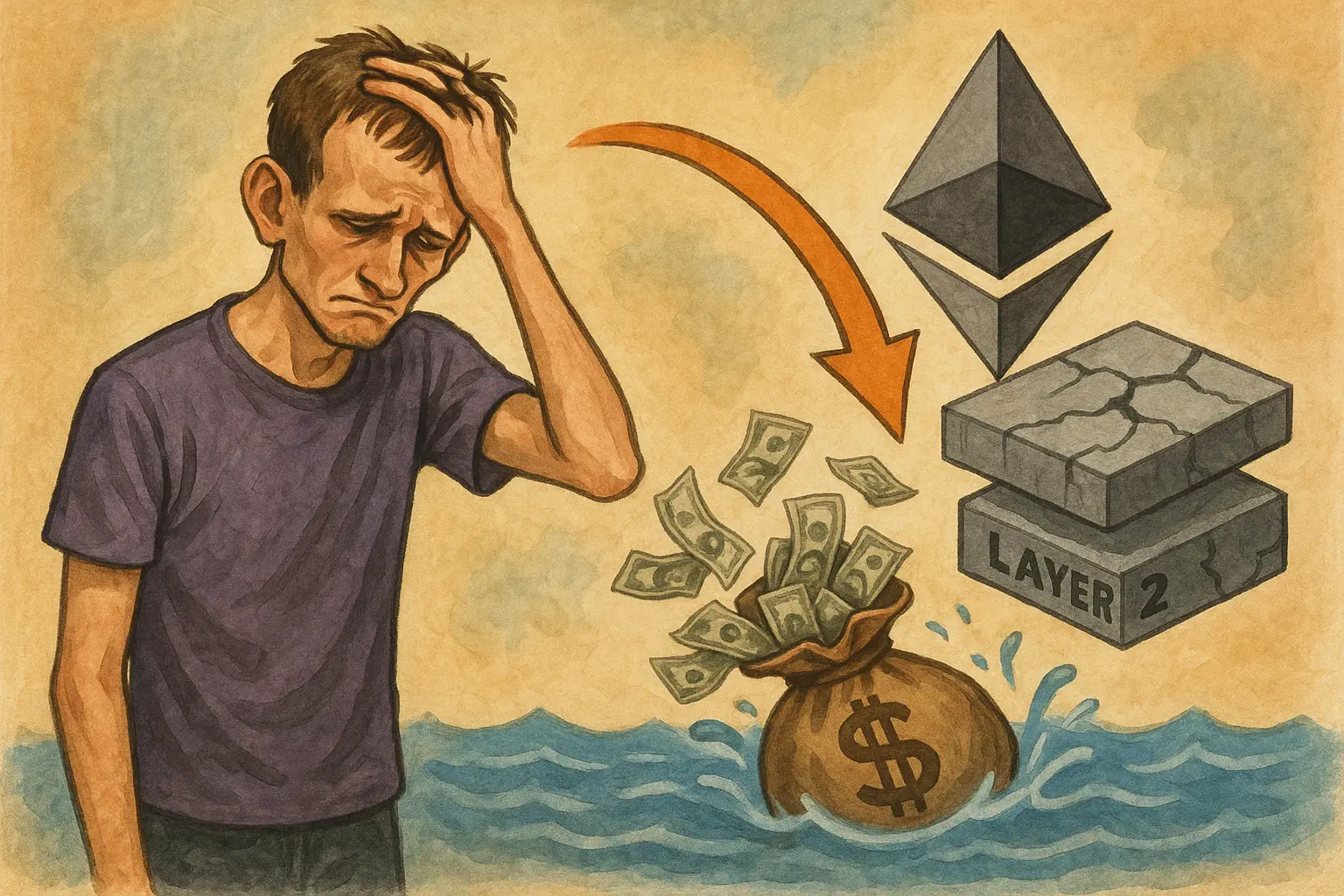
Ethereum Co-Founder Vitalik Buterin Reflects on Layer2 Strategy, stating that decentralization is far slower than expected and that the vision no longer holds meaning. Nearly a hundred Layer2 projects have raised over $3 billion, with a total FDV exceeding $10 billion, but only Base remains active. Only 1 of the top 20 has reached the second stage, while 12 are still at stage 0, relying heavily on multi-signature setups. Layer1 scaling becomes the new focus.
Layer2 Decentralization Fails, with Only Base Reaching Stage 1
It seems Vitalik has given up on his previous advocacy for a “rollup-centric” scaling model. The original roadmap centered around rollups defined Layer2 as Ethereum-supported sharding, providing trustless block space. But reality has fallen far short of expectations. Vitalik previously proposed a framework to measure the decentralization of rollups, which progresses in stages: Stage 0 (centralized trust committees can veto transactions), Stage 1 (smart contracts begin to have limited governance rights), and Stage 2 (completely trustless).
Despite nearly a hundred Ethereum Layer2 projects existing, only a few have reached Stage 1. Coinbase’s Layer2 project Base, incubated since 2023, only reached Stage 1 last year. Vitalik has criticized this multiple times. According to L2beat statistics, among the top 20 rollup projects, only 1 has achieved Stage 2—Aztec’s privacy protocol zk.money—but development on that product has stalled. Additionally, 12 projects are still at Stage 0, heavily reliant on auxiliary functions and multi-signatures.
Three Major Barriers to Layer2 Decentralization
Corporate Interests: Layer2 teams retain centralized control to pursue commercial benefits
Technical Challenges: Balancing security and performance in ZK-EVM is difficult
Regulatory Requirements: Some clients’ compliance needs demand ultimate control, hindering decentralization
Vitalik points out that Layer2 projects should at least upgrade to Stage 1; otherwise, these networks should be viewed as more competitive, vampire-like “Layer1 networks with cross-chain bridges.” This is a very harsh judgment—essentially implying that most Layer2s are not truly Layer2s but are instead centralized blockchains masquerading as Ethereum sharding, connected via bridges. Such “wolf in sheep’s clothing” behavior damages Ethereum’s brand and misleads investors.
Beyond the corporate interests that may slow down Layer2 decentralization, Vitalik highlights technical and regulatory concerns. “I even see at least one company explicitly stating they may never want to surpass Stage 1, not only due to ZK-EVM security reasons but also because their clients’ regulatory requirements demand ultimate control.” This reveals a fundamental conflict between decentralization and commercialization.
Layer1 Scaling Becomes the New Strategic Focus
Vitalik has not completely abandoned the concept of Layer2 but has expanded his view on what Layer2 should achieve. “We should stop viewing Layer2 as Ethereum’s ‘brand sharding’ with associated social status and responsibilities,” he states. “Instead, we can see Layer2 as a full spectrum, including chains fully trusted and credit-supported by Ethereum with various unique properties (not just EVM), as well as options with different degrees of connection to Ethereum, allowing everyone (or bots) to choose based on their needs.”
For future development, Vitalik suggests Layer2 projects focus on added value rather than just scaling. His recommended directions include: privacy-focused virtual machines, ultra-low latency serialization, non-financial applications (such as social or AI), application-specific execution environments, and pushing beyond the throughput limits of next-generation Layer1. These directions indicate that for Layer2 to survive, it must find differentiated value rather than merely copying Ethereum’s features.
Vitalik also revisits ZK-EVM proofs, which can be used to scale Layer1. This is a pre-compiled layer embedded into the base layer that “automatically upgrades with Ethereum.” Over the past year, with organizational restructuring at the Ethereum Foundation and two network upgrades, Layer1 has become one of the core strategies—aiming to gradually increase gas limits through multiple iterations, enabling Layer1 to handle more native transactions, asset issuance, governance, and DeFi settlements without overly relying on Layer2.
Industry Reactions: From Shock to Reflection
Wei Dai (1kx research partner) comments: “Glad to see Vitalik discussing the hindsight mistake of a rollup-centric roadmap. But the key is not what Vitalik will do, but what these Layer2 and application teams will do. Layer2 and its applications will always prioritize their own interests over Ethereum’s.”
Lan Hu (noted crypto researcher) analyzes: “Vitalik means that L2 leverages L1, but in terms of value feedback or ecosystem feedback, L2 hasn’t done enough. Now that L1 can expand itself, there’s no need to rely on L2 for scalability. L2 either aligns with L1 (native rollup) or becomes L1. What does this mean? Bad news for general-purpose L2s, good news for L2 application chains.”
Jason Chen (noted crypto researcher) states: “As Ethereum itself scales, the most obvious change is that gas fees drop to levels comparable with L2s, and as gas continues to stay low, plus the gradual adoption of ZK, speeds will be similar to L2s. So, L2s are in a very awkward position now. Born on Ethereum, but also dying on Ethereum—this conflict among the aristocrats and vassals has ended.”
Haotian (noted crypto researcher) says: “I’ve mentioned over 10 times in previous articles that the universal Layer2 strategy is no longer feasible. Each Layer2 should pivot to a specialized Layer2, which is essentially another form of Layer1. Unexpectedly, after guiding the long Stage2 strategy, many Layer2s still ended up as ‘discarded pawns.’”
For Layer2 token holders, Vitalik’s stance is undoubtedly a heavy bearish signal. While he doesn’t completely deny Layer2, downgrading it from the “core of Ethereum scaling” to an “optional auxiliary network” essentially strips Layer2 of its strategic importance. Future investors evaluating Layer2 projects will no longer give a premium for “Ethereum official endorsement” but will instead require proof of independent commercial value.
Related Articles
ETH (Ethereum) increased by 7.31% in the past 24 hours
Bitcoin surges to $70,000! Ethereum breaks through $2,140 and pulls back, "shorts liquidated for $473 million" Nvidia earnings boost US stocks higher
Once invested 70% of funds in Bitcoin! Mexican billionaire: Buy quickly while it's discounted, even the rich dad is increasing his stake.
Whale Purchases 7,008 ETH Worth $14.57M as Ethereum Rebounds Above $2,000
Data: Vitalik sells another 4,458 ETH, worth approximately $8.92 million