


Countering the AI Doomsday Theory: AI Will Not End the World but Instead Promote Prosperity
Author: The Kobeissi Letter
Translation: Felix, PANews
The stock market has lost $800 billion in market value as AI “ruling the world” becomes a consensus. This view is too obvious, and “obvious” trades often do not end up winning.
The reason this doomsday rhetoric is spreading wildly is because it touches a deep pain point in people’s hearts. It depicts AI as a macroeconomic destabilizer rather than a productivity tool, and believes it will trigger a negative feedback loop: layoffs lead to weak consumption, weak consumption leads to more automation, and automation accelerates layoffs.
The obvious fact is: AI is not just another software feature or efficiency boost. It is a general capability shock that impacts all white-collar workflows. Unlike any revolution in history, AI is simultaneously enhancing capabilities across all areas.
But what if the doomsday narrative is wrong? It assumes demand is fixed, that productivity improvements won’t expand markets, and that systems cannot self-correct faster than disruption.
A second path is seriously underestimated. Those “disruptive blows” from Anthropic that seem like signs of systemic collapse may ultimately be the beginning of the largest productivity expansion in history.
While the following analysis is not necessarily the outcome, remember: Humans always win, and free markets always self-correct.
Anthropic’s “Disruption” Is Real
First, we cannot ignore the market. Anthropic is disrupting the world with Claude, causing the market value of Fortune 500 companies to evaporate by hundreds of billions of dollars.
This is a story we’ve seen multiple times by 2026: Anthropic releases a new AI tool, Claude makes substantial progress in coding and workflow automation, and within hours, the target industry markets collapse. If you haven’t been paying attention, here are some examples:
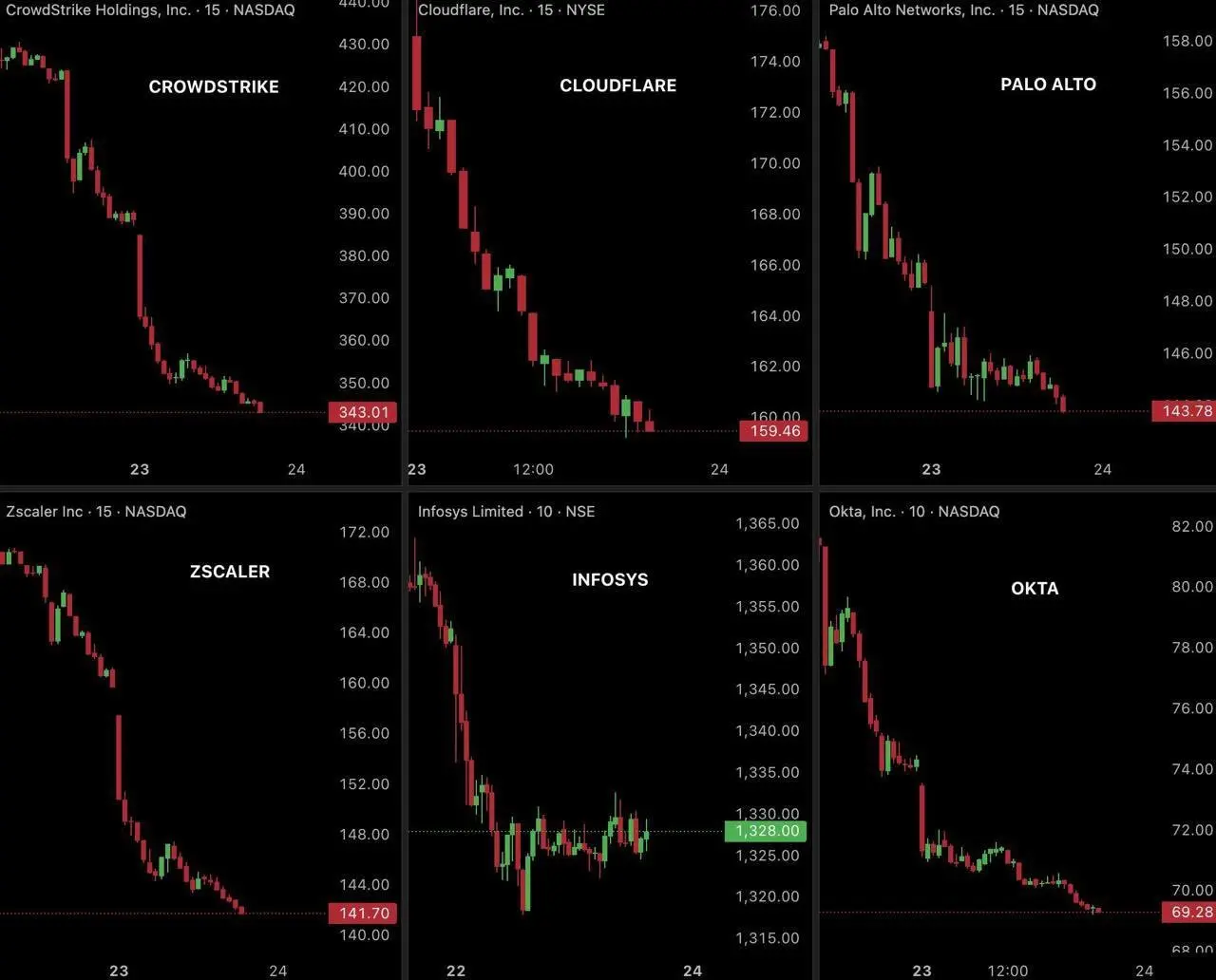
Market reactions to Claude-related announcements
- IBM’s stock hit its largest single-day decline since October 2000 after Anthropic announced Claude could simplify COBOL code.
- Adobe’s stock has fallen 30% year-to-date, due to generative features compressing creative workflows.
- The cybersecurity sector plummeted after the release of “Claude Code Security.”
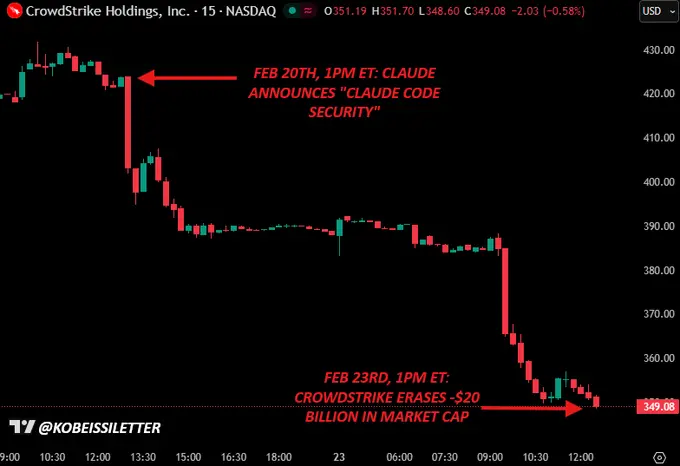
In these examples, CrowdStrike’s stock nearly plummeted the moment Claude announced “Claude Code Security.”
At 1 p.m. Eastern Time on February 20, Claude announced this tool. It is an automated AI that scans codebases for vulnerabilities.
Just two trading days later, CrowdStrike’s market cap had evaporated by $20 billion.
These reactions are not irrational. The market is trying to price in real-time profit margin compression. When AI replicates workers’ tasks, pricing power shifts to buyers. This is the first wave of impact, and it is very real.
Commercialization does not mean collapse. Instead, it is a way for technology to lower costs and expand access. Personal computers commodified computing, the internet commodified distribution, cloud commodified infrastructure, and AI is commodifying cognition.
Undoubtedly, some traditional workflows will face profit margin compression. The question is: will the reduction in cognitive costs lead to economic collapse, or will it trigger a vigorous economic expansion?
The “Vicious Cycle” Assumes Fixed Demand
Pessimists’ cycle is built on a simplified linear model: AI gets stronger -> companies cut staff and wages -> purchasing power declines -> companies reinvest in AI to maintain profits -> cycle repeats. This model assumes a completely stagnant economy.
Historical experience shows the opposite. When the cost of producing something drops significantly, demand rarely remains unchanged; it expands. When computing costs fall, it doesn’t just lead to cheaper consumption of the same amount of computing power, but to consumption of several orders of magnitude more, and the creation of entirely new industries.
As shown below, personal computer prices are 99.9% cheaper than in 1980.
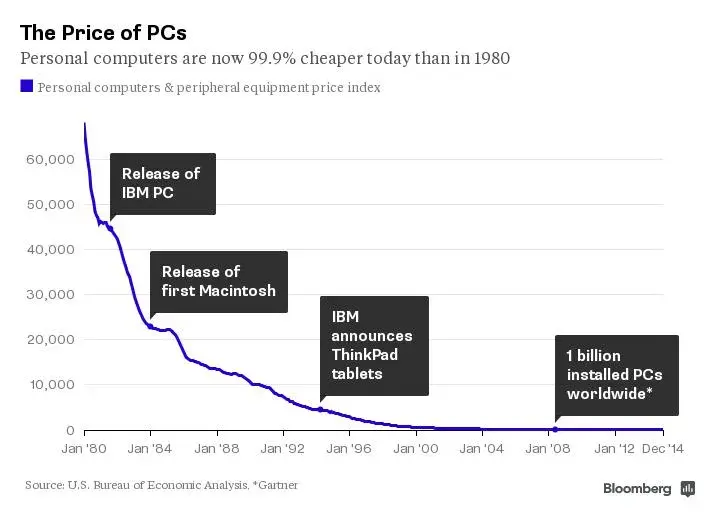
Personal computer prices: 1980-2015
AI reduces costs across industries, and when service costs decline, purchasing power increases regardless of wage growth.
Only if AI replaces labor without substantially expanding demand will the vicious cycle dominate. But if cheaper computing and higher productivity generate new categories of consumption and economic activity, an optimistic scenario emerges.
The Real Impact Is Price Collapse, Not Layoffs
Compared to price compression, layoffs are a story easier for investors to sell to the public, but the decline in service prices is the more important news. Knowledge-based work has always been expensive because knowledge is scarce — that sounds simple, but it is the truth. An abundant supply of knowledge leads to lower prices for knowledge work.
Think about healthcare management, legal documents, tax planning, compliance, marketing, basic coding, customer service, and education tutoring. These services consume significant economic resources mainly because they require trained personnel. AI lowers the marginal costs of this input.
In fact, as shown below, the US service sector contributes nearly 80% to US GDP.
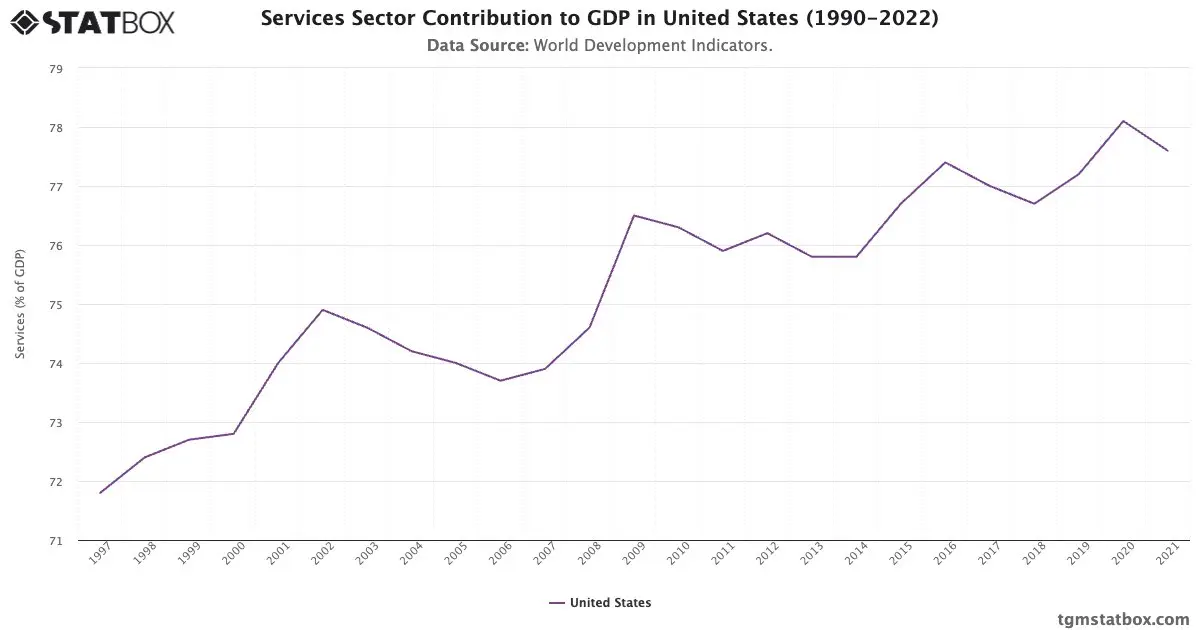
If operating costs for businesses decline, small and micro enterprises become easier to start; if access to services becomes cheaper, more households can participate. In a sense, AI’s progress can act as an “invisible tax cut.”
Companies that rely on high-cost cognitive labor for profits may suffer losses, but the overall economy benefits from reduced service inflation and increased real purchasing power.
From “Ghost GDP” to “Prosperity GDP”
Pessimists’ view relies on “Ghost GDP,” which is output shown in data but does not benefit households. The optimistic view calls it “Prosperity GDP,” where output growth combines with falling living costs.
“Prosperity GDP” does not require nominal income to surge; it requires prices to fall faster than incomes decline. If AI reduces the costs of many essential services, even if household wages slow, real income will increase. Therefore, productivity gains do not disappear but are transmitted through lower prices.
This may explain why productivity has outperformed wage growth over the past 70+ years.
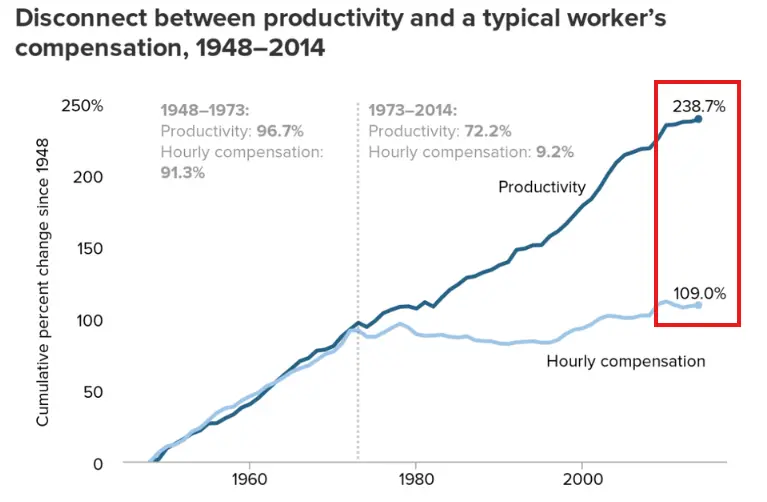
Although the internet, electricity, mass manufacturing, and antibiotics were disruptive and volatile at the time, each technology provided new ways to expand output and reduce costs. Looking back, these transformations permanently improved living standards.
A society that can reduce wasted time on system operations and repetitive services will be wealthier.
Workforce Restructuring, Not Disappearance
A core concern is that AI will disproportionately impact white-collar jobs, which drive discretionary consumption and housing demand. This is true and a reasonable worry, especially given the current huge wealth gap.
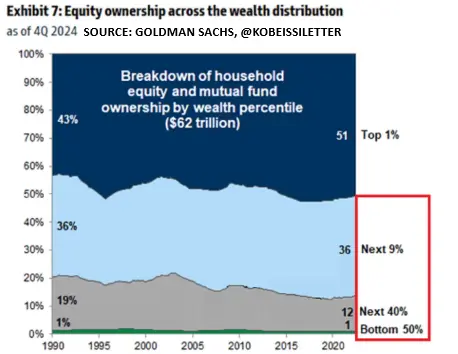
However, AI still struggles with flexibility in the physical world and human identity recognition. Skilled trades, hands-on healthcare, advanced manufacturing, and experience-driven industries still have structural demand. In many cases, AI is a complement rather than a substitute for these roles.
More importantly, AI lowers barriers to entrepreneurship. When one can automate accounting, marketing, support, and coding tasks, starting small businesses becomes easier.
In fact, eliminating entry barriers with AI could be a good solution to current wealth inequality issues.
The internet eliminated some job categories but also created entirely new ones. AI may follow a similar pattern, compressing some white-collar functions while expanding autonomous economic participation in others.
The “Death” of SaaS?
AI clearly pressures traditional SaaS business models. Negotiations with procurement teams become tougher, and some long-tail software products face structural resistance. But SaaS is a delivery mechanism, not the end of value creation.
Next-generation software will be adaptive, agent-driven, results-oriented, and deeply integrated. Winners will not be those offering static tools, but those best able to adapt to change.
Every technological revolution reshapes tech stacks, and companies pricing static workflows will struggle. Those mastering data, trust, computation, energy, and verification may thrive.
A certain level of profit compression does not mean the entire digital economy is collapsing; it signals a transition.
AI Reshaping Markets
Pessimistic narratives believe that agentic commerce will disrupt middlemen and eliminate fees. To some extent, this is true. As frictions decrease, collecting fees becomes more difficult.
As shown below, even before AI became widespread, stablecoin trading volume had surged. Why? Because markets always favor efficiency.

Reducing system frictions also expands trading volume. When price discovery mechanisms improve and transaction costs fall, economic activity becomes more vibrant. This is a positive trend.
Agents acting on behalf of consumers may compress profit margins for user-habit platforms. But they can also increase overall demand by lowering search costs and improving efficiency.
Productivity Is the Key Variable
The ultimate factor determining an optimistic outcome is productivity. If AI can continuously improve productivity in healthcare, government management, logistics, manufacturing, and energy optimization, the end result will be resource abundance and more opportunities for everyone.
Even a 1-2% ongoing productivity growth over ten years can generate enormous compound effects.
As shown below, AI is accelerating productivity gains. In Q3 2025, US labor productivity growth reached its highest in two years:
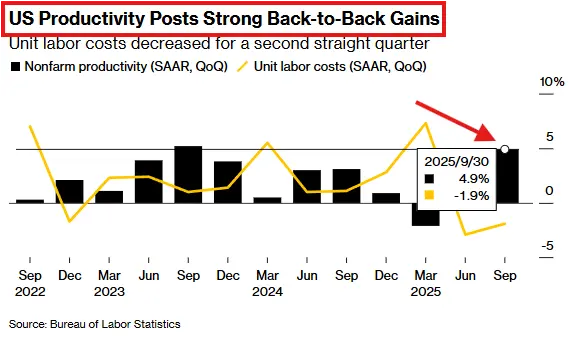
Pessimists argue that productivity gains will only benefit those building AI models, not produce broader benefits. Optimists believe that price compression and new markets will more broadly distribute gains.
Prosperity Not Only Lowers Costs but Also Reduces Conflict
One often overlooked aspect of AI-driven prosperity is its geopolitical impact. For most of modern history, wars have centered around scarce resources: energy, food, trade routes, industrial capacity, labor, and technology. When resources are scarce and growth is zero-sum, nations compete fiercely. But abundance changes everything.
If AI can significantly lower production costs across energy, manufacturing design, logistics, and services, the global economic pie will expand. When productivity rises and marginal costs fall, reliance on extracting advantages from others diminishes. This could end wars and usher in the most peaceful era in human history.
Economic warfare is also affected, as seen in the ongoing year-long trade war.
Today, many countries struggle with cost competition, and tariffs serve as protection. But if AI can drastically reduce global production costs, why impose tariffs? In an environment rich in resources, protectionism becomes economically inefficient.
History shows that during long periods of technological acceleration, global conflicts tend to decrease. Post-WWII industrial expansion reduced the incentives for major powers to confront each other directly.
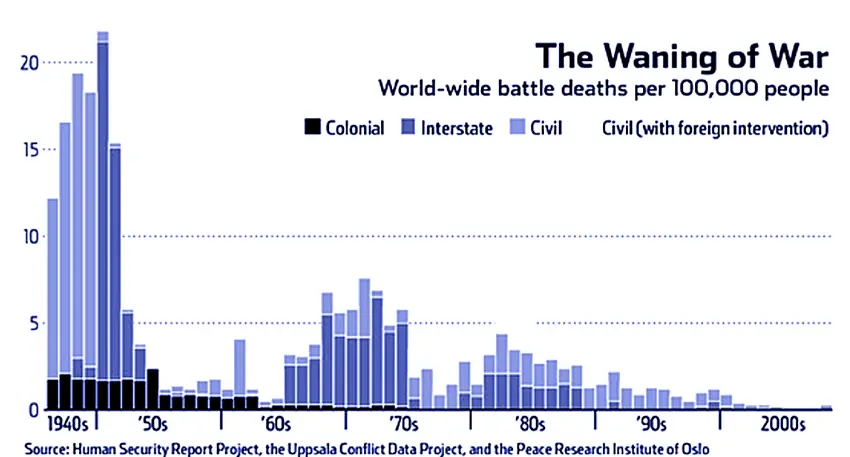
After WWII, war-related deaths declined.
AI-driven prosperity could accelerate this trend. More efficient energy management, resilient supply chains, and localized automation will make countries less vulnerable. As economic security improves, geopolitical aggression becomes less rational.
The most optimistic outcome of AI is not just higher productivity or stock indices, but a world where economic growth is no longer zero-sum.
Conclusion: What if the “End of the World” Doesn’t Happen?
AI will amplify various outcomes. If institutions cannot adapt, it will increase vulnerabilities; if productivity growth outpaces the shocks of change, it will foster prosperity.
Anthropic’s disruption signals indicate workflows are being re-priced, and cognitive labor costs are falling — a clear shift.
But change does not equal collapse, as every major technological revolution initially appears destructive.
The most underestimated possibility today may not be dystopian but prosperous. AI might compress rents, reduce frictions, and reshape the labor market, but it could also bring the greatest actual productivity growth in modern history.
The difference between “global intelligence crisis” and “global intelligence prosperity” lies not in capability but in adaptation.
And the world always finds a way to adapt.
Related reading: A memo from 2028: If AI wins, what will we lose?