


Japan launches stablecoin payment experiment! Shibuya PARCO allows testing of USDC self-custody payments
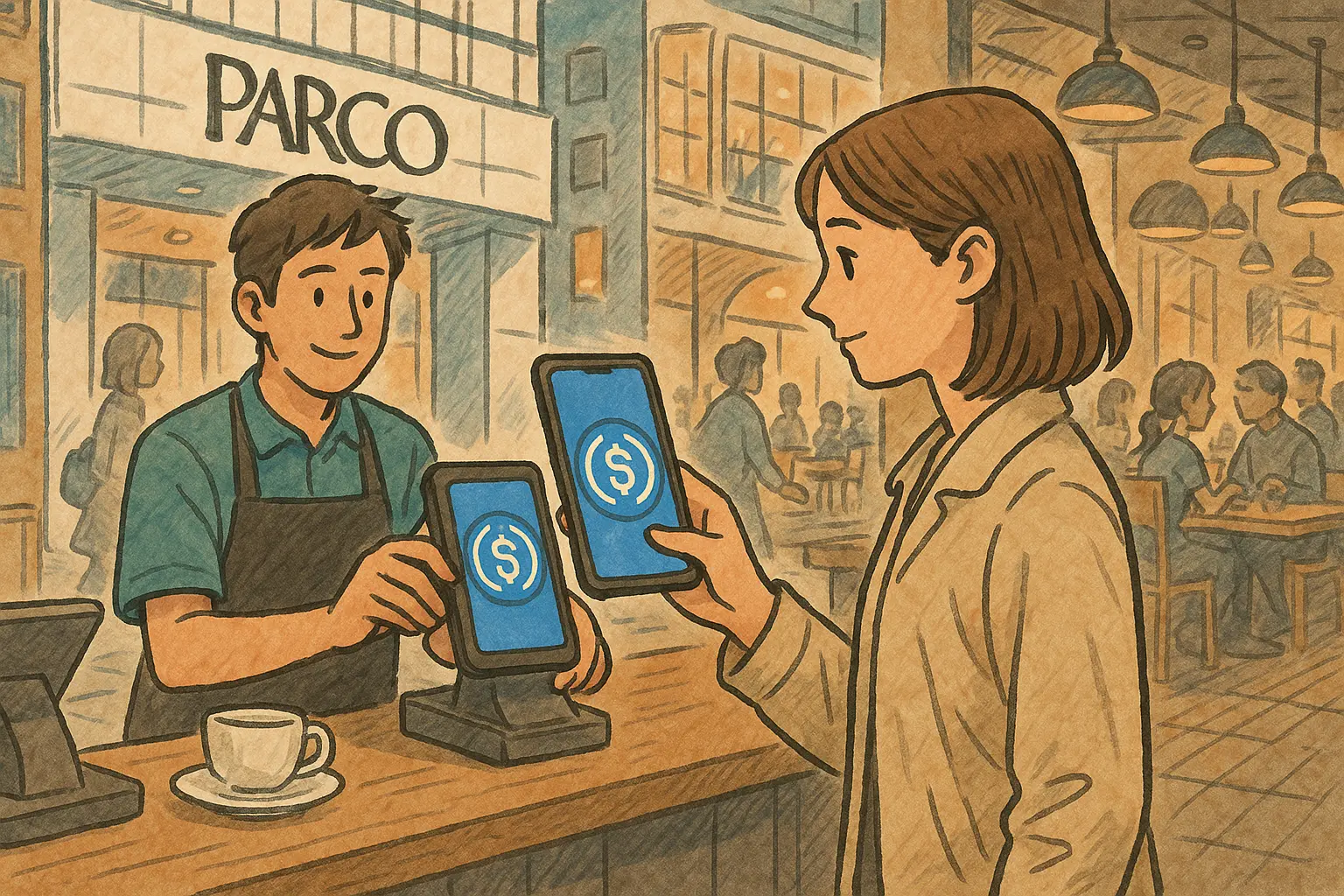
Japanese digital transformation company Digital Garage, credit card giant JCB, and financial holding company Resona jointly announced that they will conduct a stablecoin physical payment experiment from February 24 to March 2, 2026, at PARCO in Shibuya, Tokyo. The experiment will test self-custody wallet payments using USDC (Base chain) and JPYC (Polygon chain), with merchants settling and receiving payments in Japanese yen.
Payment Process Architecture: Dual-Track Model of Dual-Chain Stablecoin and Fiat Currency Clearing
This experiment centers on self-custody wallets, requiring users to hold and operate their digital wallets independently, rather than relying on exchanges or custodians to manage assets on their behalf. The payment interface is provided by “My Number Wallet,” utilizing “MynaPay” as the front-end tool—USDC transactions are executed via the Base App, while JPYC payments are completed through MynaWallet. After transactions, merchants automatically convert the received stablecoins into yen through JCB’s clearing mechanism, effectively eliminating the financial risk posed by cryptocurrency exchange rate fluctuations.
This dual-track model of “blockchain payment plus fiat currency clearing” reflects Japan’s pragmatic approach to exploring stablecoins: rather than attempting to overhaul the existing banking infrastructure, it aims to embed stablecoins into everyday payment scenarios within the current regulatory framework.
Roles and Responsibilities of Participants in This Experiment
Digital Garage: Overall project coordination and integration of Web3 technology, responsible for building blockchain payment infrastructure.
JCB: Providing cashless payment mechanisms and merchant yen clearing frameworks.
Resona HD: Participating as a financial institution to assess the feasibility of commercializing stablecoins within Japan.
My Number Wallet: Handling payment interface integration and user experience design for self-custody wallets.
Shibuya PARCO Pilot: Strategic Location and Commercialization Potential
The experiment is conducted at Pangaea Cafe & Bar on the 10th floor of the PARCO DG building in Shibuya, Tokyo, open to the public after 2 p.m. on weekdays. As a cultural landmark in Tokyo’s trendy district, Shibuya PARCO has long been a hotspot for testing new technologies, with its location naturally attracting tech enthusiasts and international tourists.
In recent years, Japan has continued to promote relaxed policies around Web3 and digital assets, with inbound tourism rebounding. If this experiment demonstrates the technical viability of stablecoins in retail and dining scenarios, foreign visitors could, in the future, spend directly with global stablecoins like USDC without needing to open a Japanese bank account, significantly reducing cross-border payment friction.
The participating organizations stated they will analyze the technical and operational data collected during the experiment to evaluate the potential for stablecoin commercialization in Japan. The ultimate goal is to enable both local residents and international visitors to seamlessly use stablecoins for everyday transactions.
Frequently Asked Questions
How can I participate in the Shibuya PARCO stablecoin payment experiment, and what are the restrictions?
The experiment runs from February 24 to March 2, 2026, at Pangaea Cafe & Bar on the 10th floor of the PARCO DG building in Shibuya, Tokyo. It is open to the public after 2 p.m. on weekdays. Participants can bring self-custody digital wallets containing USDC or JPYC to test on-site payments. Currently, this is a proof-of-concept stage and has not been extended to other channels.
What are the differences between USDC and JPYC, and why are both being tested simultaneously?
USDC is a USD-pegged stablecoin issued by Circle, operating on the Base chain; JPYC is a yen-pegged stablecoin on the Polygon chain. Testing both aims to evaluate different user scenarios: local residents who prefer JPYC and international tourists who favor USDC or other USD stablecoins. This provides comprehensive data to support future commercialization strategies.
How can merchants accept stablecoin payments without facing exchange rate risks?
The experiment employs a dual-track approach: customers pay with USDC or JPYC, and merchants automatically convert these into yen via JCB’s clearing mechanism. This setup allows merchants to avoid directly holding cryptocurrencies, thereby eliminating the financial risks associated with currency fluctuations. It is a key architectural strategy for integrating stablecoins into traditional retail environments.
Related Articles
Circle Sees USDC Use Explode Amid AI and Blockchain Convergence
Circle 2025 Financial Report Released: USDC Circulation Surpasses $75 Billion, Annual Revenue Soars 64%, $CRCL Jumps 18% Before Market Open
Circle announces Q4 and full-year 2025 performance: total annual revenue of $2.7 billion, up 64%
Circle Joins Agentic AI Foundation as Gold Member to Integrate USDC Payments for Autonomous AI Agents
TruStage partners with over 93% of American credit unions to pilot the stablecoin TSDA, launched in the first half of the year
Circle joins the Agentic AI Foundation, with stablecoins becoming the cornerstone of the AI agent economy