Bitcoin plummeted from $120,000 to around $90,000. Despite a short-term slight rebound, holders have realized losses of $4.5 billion, reaching a new high since 2022. Trump raised South Korea’s tariffs to 25%, triggering sell-offs. ETF weekly outflows reached $1.33 billion, stablecoins evaporated $7 billion. If the $80,000 support fails, it could test $70,000.
Trump’s Tariff Increase Sparks Global Risk Asset Sell-Off
On Monday (January 26), U.S. President Trump posted on Truth Social announcing an increase in tariffs on Korean goods from 15% to 25%, accusing Korea of “failing to fulfill agreements with the U.S.” Trump stated that he and South Korean President Lee Jae-myung reached a “very good agreement for both countries” on July 30, 2025, and reaffirmed the terms during his visit to Korea on October 29, 2025, but the Korean National Assembly has yet to complete ratification.
Trump questioned: “Why hasn’t the Korean National Assembly ratified it?” He then emphasized that because the Korean legislature “has not yet legislated this historic trade agreement (which is their right),” he decided to raise the “Korea reciprocal tariffs” from 15% to 25%, covering automobiles, timber, pharmaceuticals, and other related categories. This is Trump’s latest round of tariff pressure on allies.
This tariff escalation directly impacts why Bitcoin has been lackluster in rebounding today. Global investors’ risk appetite has sharply declined, capital is fleeing high-risk assets and moving into traditional safe havens like gold. Korea is a key market for cryptocurrency trading; tariff uncertainty has undermined investor confidence, increasing selling pressure. More importantly, Trump’s tariff policies are advancing on multiple fronts. Last week, he threatened to impose up to 100% tariffs on Canadian and Chinese trade arrangements if they are seen as providing “transshipment channels” for Chinese goods entering the U.S.
This confluence of geopolitical risks amplifies Bitcoin’s risk asset attributes. Although some investors view Bitcoin as “digital gold” long-term, in extreme market conditions, it still shows high correlation with stocks and other risk assets. The legal risks of Trump’s tariff policies are also unresolved. The U.S. Supreme Court held oral arguments last November on a case challenging the legality of Trump’s unilateral tariff hikes. No decision has been made yet, and this uncertainty further dampens market sentiment.
ETF Weekly Outflows of $1.33 Billion, Institutional Confidence Crumbling
One core reason Bitcoin has been sluggish in rebounding today is ongoing institutional capital withdrawal through formal channels. A Bitcoin ETF based in the U.S. netted out $1.33 billion in a week, the largest redemption since February 2025. This massive capital exodus indicates that institutional investors’ confidence in the crypto outlook has significantly weakened.
ETF capital flows are the most direct indicator of institutional sentiment. During Bitcoin’s rise from $40,000 to $120,000, U.S. Bitcoin ETFs played a key role, with BlackRock’s IBIT assets approaching $100 billion. However, the current net outflow signals a trend reversal. Institutional investors typically have more sophisticated risk management and longer-term perspectives; their collective withdrawal often signals a trend change.
More concerning is that this capital outflow is not just short-term volatility. Over the past two weeks, Bitcoin ETFs have experienced consecutive days of net outflows totaling over $2 billion. Unlike previous retail-driven sell-offs, this is organized redemption by institutions, indicating a fundamental shift in market structure. When institutions start reducing holdings, they take not only capital but also market confidence and liquidity support.
This capital flight aligns closely with Bitcoin’s decline from $120,000 to $90,000. ETF outflows accelerated after prices broke below the psychological $100,000 level, creating a negative feedback loop: falling prices trigger ETF redemptions, which force ETF issuers to sell Bitcoin in the spot market, further depressing prices. This mechanism is common in traditional finance and now applies to crypto markets.
Stablecoins Evaporate $7 Billion, Capital Fully Exits Crypto Market
(Source: CryptoQuant)
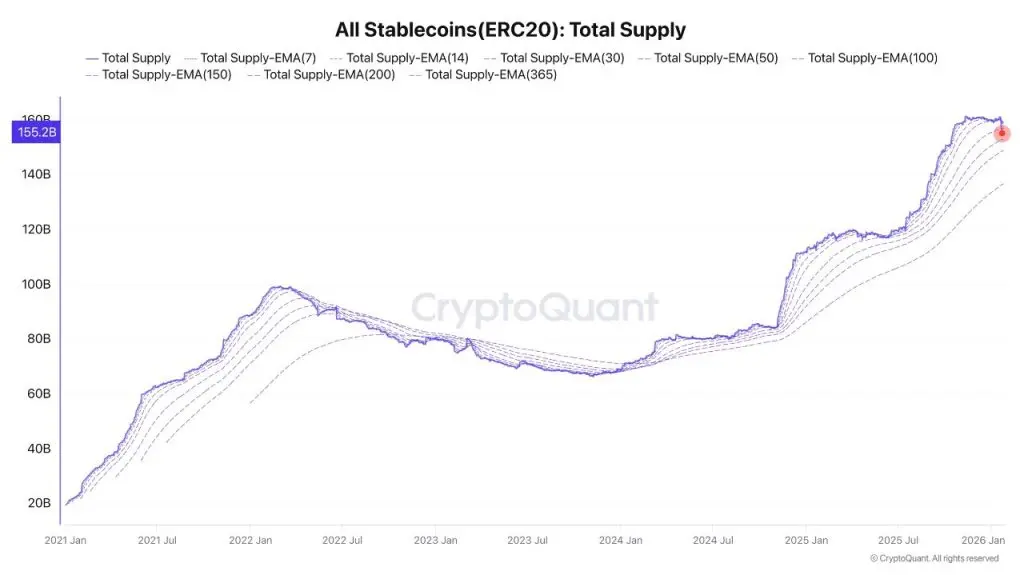
Adding to the woes, stablecoin market cap has shrunk significantly. CryptoQuant researcher Darkfost reports that the total market cap of Ethereum-based stablecoins decreased by $7 billion in just seven days, from $162 billion to $155 billion. Darkfost describes this as “a very negative signal,” explaining that as the crypto market continues to decline, investors are completely exiting the crypto space, shifting into precious metals and stocks.
Changes in stablecoin market cap directly reflect liquidity conditions in the crypto market. Stablecoins are considered “cash equivalents” in crypto; increasing market cap indicates new inflows or increased allocations by existing investors, while decreasing market cap signals capital exiting entirely. A $7 billion reduction is substantial, showing investors are not only selling Bitcoin and other assets but also withdrawing funds from the crypto ecosystem altogether.
This capital migration pattern is eerily similar to 2021. Darkfost notes that similar stablecoin declines previously confirmed Bitcoin entered a bear market, exacerbated at the time by Terra Luna’s collapse. Historical experience shows that when stablecoin market cap continues to decline, Bitcoin often struggles to rebound effectively, due to lack of new buying support. The current situation needs rapid improvement; otherwise, Bitcoin may confirm its bear trend, breaking below $80,000.
This liquidity shift also explains why Bitcoin is struggling to rebound today. Even if prices show a short-term technical bounce, the lack of stablecoin support makes sustained recovery difficult. More critically, the reduction in stablecoins weakens not only spot market liquidity but also leverage in derivatives markets, further limiting upward price potential.
$4.5 Billion Realized Losses Signal Bearish Risks
Bitcoin holders have suffered over $4.5 billion in realized losses after the price dropped from above $120,000 to below $90,000. This is the largest sell-off since the 2022 bear market. Data from on-chain analysis reflects actual loss-making transactions, not paper unrealized losses. Realized losses mean investors have genuinely sold holdings in panic, acknowledging losses.
Historical data shows that the last time Bitcoin experienced such large-scale realized losses, the price fell from $69,000 by over 50%, bottoming at $28,000. Such panic selling often marks a shift from greed to extreme fear in market sentiment, and this emotional reversal usually takes time to recover. The $4.5 billion loss scale suggests many investors have given up hope for a short-term rebound and are cutting losses.
This widespread stop-loss behavior heavily impacts Bitcoin’s lack of rebound today. After many investors have exited between $90,000 and $100,000, these levels lack new buying interest. Even if prices bounce back to these zones, previous stop-losses mean buyers are unlikely to re-enter immediately, potentially creating new selling pressure. In technical analysis, this phenomenon is called a “resistance zone,” where previous large-volume trades become future barriers.
$80,000 Support Determines Short-term Direction
(Source: TradingView)
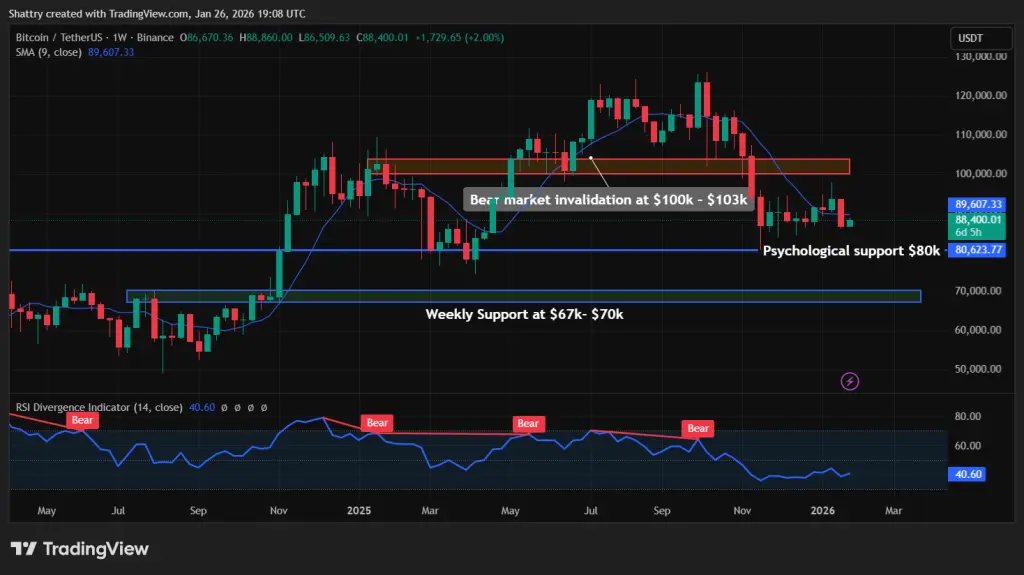
On the technical side, the weekly chart of BTC/USDT shows that Bitcoin has entered consolidation after encountering strong resistance in the $100,000 to $103,000 supply zone, which is confirmed as a non-bearish zone. Currently trading in the mid-$80,000s, slightly below the 9-week simple moving average, which has turned into a short-term dynamic resistance after the recent decline. Multiple failures to retake the $100,000 level confirm that sellers remain aggressive at high prices.
The $80,000 level is a key psychological and structural support. Bitcoin’s positive reaction near this zone indicates buyers are actively defending this level. As long as weekly closes stay above $80,000, the overall market structure remains in correction mode rather than outright bearish. Technical momentum indicators show caution in the short term; the RSI hovers around 40, with bearish divergences during the previous rally, indicating waning momentum.
The chart shows Bitcoin is in a range-bound correction phase. Holding above $80,000 preserves the possibility of building a bottom and potentially rebounding toward $90,000–$95,000. A decisive weekly close above $100,000 would invalidate the bearish structure. Conversely, a break below $80,000 could accelerate downward, testing the $70,000 zone.


