


ING Opens Cryptocurrency! German Retail Customers Can Buy Bitcoin, ETH, and SOL ETPs
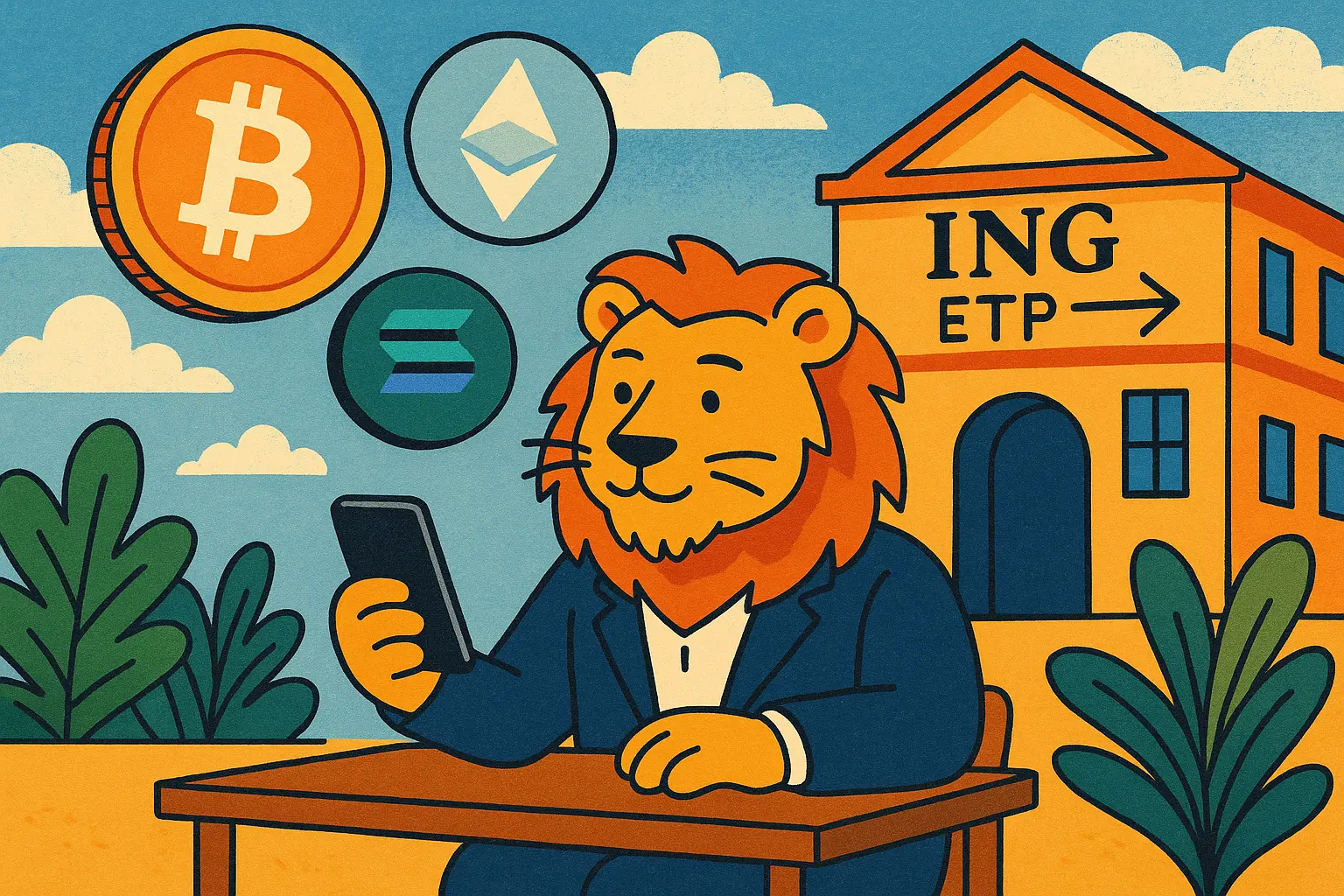
Germany’s major retail bank ING is opening up cryptocurrency ETNs, offering investments in Bitcoin, Ethereum, and Solana. Issued by 21Shares, Bitwise, and VanEck, clients do not need to manage wallets. Holding for over a year qualifies for tax exemption. ING still warns of extreme volatility, bankruptcy risks, and states that cryptocurrencies have no intrinsic value.
ING Integrates Crypto Investments into Traditional Banking Infrastructure
The launch of crypto ETP products accessible to retail clients by ING Deutschland marks a significant shift in the traditional banking industry’s attitude toward digital assets. These products are physically-backed financial instruments issued by well-known firms like 21Shares, Bitwise, and VanEck. They track the performance of individual cryptocurrencies and are traded on regulated exchanges through ING’s Direct Depot platform.
The most significant aspect of this integration is the lowered investment barrier. ING states that these products aim to reduce the entry threshold for crypto investing by utilizing familiar banking infrastructure, eliminating the need for clients to manage third-party wallet systems or private keys. For traditional investors, private key management, wallet security, and blockchain technology are major psychological hurdles to entering the crypto market. Now, they can invest in Bitcoin just like buying stocks or bonds via a familiar broker interface, with custody and security handled by the bank and ETP issuers.
VanEck Europe CEO Martijn Rozemuller said in a press release: “This opens another very low-threshold avenue for crypto investment through exchange-traded products. Many investors want a solution that integrates into existing securities custody systems and attracts investors with transparent costs. That’s the significance of this partnership—it brings crypto investments into investors’ custody accounts.”
From a regulatory compliance perspective, ING’s crypto ETP products fully comply with the EU’s MiCA (Markets in Crypto-Assets) regulation and German securities supervision requirements. These ETPs are listed on regulated exchanges, with issuers required to disclose holdings, fee structures, and risk factors. Investors enjoy the same legal protections as traditional financial products. This compliance framework removes concerns about regulatory risks, moving crypto investments from the “gray area” into the “mainstream.”
ING notes that in Germany, the tax treatment of ETN investments is similar to direct crypto holdings, including potential capital gains tax exemption for holdings held over a year. This tax benefit is highly attractive, encouraging long-term investment rather than short-term speculation. German tax law states that profits from selling cryptocurrencies held over a year are completely tax-free. This tax treatment extends to ETP products, making crypto investments via ING tax-efficient and operationally convenient compared to direct coin holdings.
Top Issuers 21Shares and VanEck Back the Products
The partners ING chose are top-tier issuers in the crypto ETP space. 21Shares is one of Europe’s largest crypto ETP issuers, with products listed on multiple European exchanges and managing assets worth billions of dollars. Bitwise is a well-known US-based crypto asset manager, known for its index funds and actively managed products. VanEck is a traditional financial giant that began applying for Bitcoin ETFs as early as 2017 and has been deeply involved in crypto for years.
These issuers share a common feature: they use a “physically-backed” model, meaning each ETP share is backed by actual crypto assets as collateral. This differs from synthetic or derivative ETPs, which only track prices without holding actual assets. Physically-backed ETPs offer higher transparency and security, giving investors confidence that their investments correspond to real Bitcoin, Ethereum, or Solana.
The products cover Bitcoin, Ethereum, and Solana, indicating ING’s relatively conservative but representative selection of major assets. Bitcoin, as the largest and most recognized cryptocurrency, is a natural choice. Ethereum, as the leading smart contract platform, has a vast DeFi and NFT ecosystem. Solana, as a high-performance emerging blockchain, has seen rapid institutional adoption in recent years. These three cover the main sectors of the crypto market, providing investors with diversified options.
Notably, ING did not choose to offer ETPs for XRP, Cardano, or other altcoins. This likely reflects a cautious approach, favoring large-cap, liquid, and more clearly regulated assets. For a traditional bank entering crypto for the first time, this conservative strategy is wise, minimizing reputational and regulatory risks.
ING’s Risk Warnings and Contradictory Stance
However, ING also issued strict risk warnings alongside the launch of crypto ETPs. The bank warns of significant risks, including “extreme” price volatility, potential total loss if the issuer goes bankrupt, liquidity challenges, market manipulation, and regulatory uncertainty. Such comprehensive disclosures are legally necessary but also reveal a conflicted attitude within traditional banks toward crypto assets.
More striking is ING’s description of the nature of cryptocurrencies. On a page explaining their essence, ING states: “Cryptocurrencies are speculative products with no intrinsic value… The value or price movements of cryptocurrencies largely depend on psychological factors—and these factors also influence the prices of crypto assets traded on exchanges.”
Top 5 Risks Listed by ING for Crypto ETPs
Extreme Price Volatility: Cryptocurrency prices can fluctuate over 50% in a short period
Issuer Bankruptcy Risk: If the ETP issuer collapses, investors could lose all their funds
Liquidity Challenges: Some ETPs have low trading volumes, leading to large bid-ask spreads
Market Manipulation: Crypto markets are less regulated than traditional finance, with manipulation risks
Regulatory Uncertainty: Crypto regulations are still evolving, which could impact ETP operations
This “product promotion while warning of no value” contradictory stance reflects the struggle of traditional financial institutions in the crypto space. On one hand, client demand and market trends push banks to offer crypto investment channels; on the other, their own perception of crypto as a “speculative tool” prevents full endorsement of its long-term value.
Strategic Shift of European Banks Embracing Crypto
ING is not the first European bank to offer crypto investment services, but as a major German retail bank, its entry signifies that cryptocurrencies are now entering the mainstream European financial system. ING is a historic Dutch banking group dating back to the 18th century, with millions of retail clients in Germany. When such a conservative traditional bank begins offering crypto products, it indicates that crypto assets have passed the institutional risk assessment threshold.
In recent years, ING has been involved in digital asset initiatives. Last September, ING formed a consortium with eight other European banks to develop a euro-based stablecoin aimed at becoming a “trustworthy European payment standard.” This stablecoin project shows ING’s commitment not only to crypto investment but also to infrastructure development within the blockchain ecosystem.
The shift in European banking attitudes toward crypto is partly driven by clearer regulation. The EU’s MiCA regulation, which begins implementation in 2024, provides a comprehensive regulatory framework for crypto assets, covering issuance, trading, custody, and consumer protection. This regulatory clarity alleviates banks’ compliance concerns, enabling them to confidently offer crypto products to clients. In contrast, the US regulatory environment remains uncertain, which explains why European banks are advancing faster in crypto.
For German retail investors, ING’s crypto ETPs offer unprecedented convenience. They can hold traditional stocks, bonds, and crypto ETPs within the same bank account, enabling unified asset allocation and tax management. This integration significantly reduces operational complexity, transforming crypto investing from an “elite tech hobby” into a mainstream option accessible to ordinary people.
Related Articles
ETH short-term surge of 1.30%: On-chain large transfers and concentrated liquidity drive price breakthrough of resistance
3 Cryptos to Invest in March 2026 — ETH, SOL, and XRP
Bitcoin, Ethereum, XRP Rally as ETF Inflows Hit $458M Amid Strait of Hormuz Crisis
ETH 15-minute decline of 1.25%: leveraged liquidation and on-chain fund outflows jointly drive short-term selling pressure