


Elon Musk's net worth drops below $800 billion! SpaceX and xAI push the valuation to $1.25 trillion
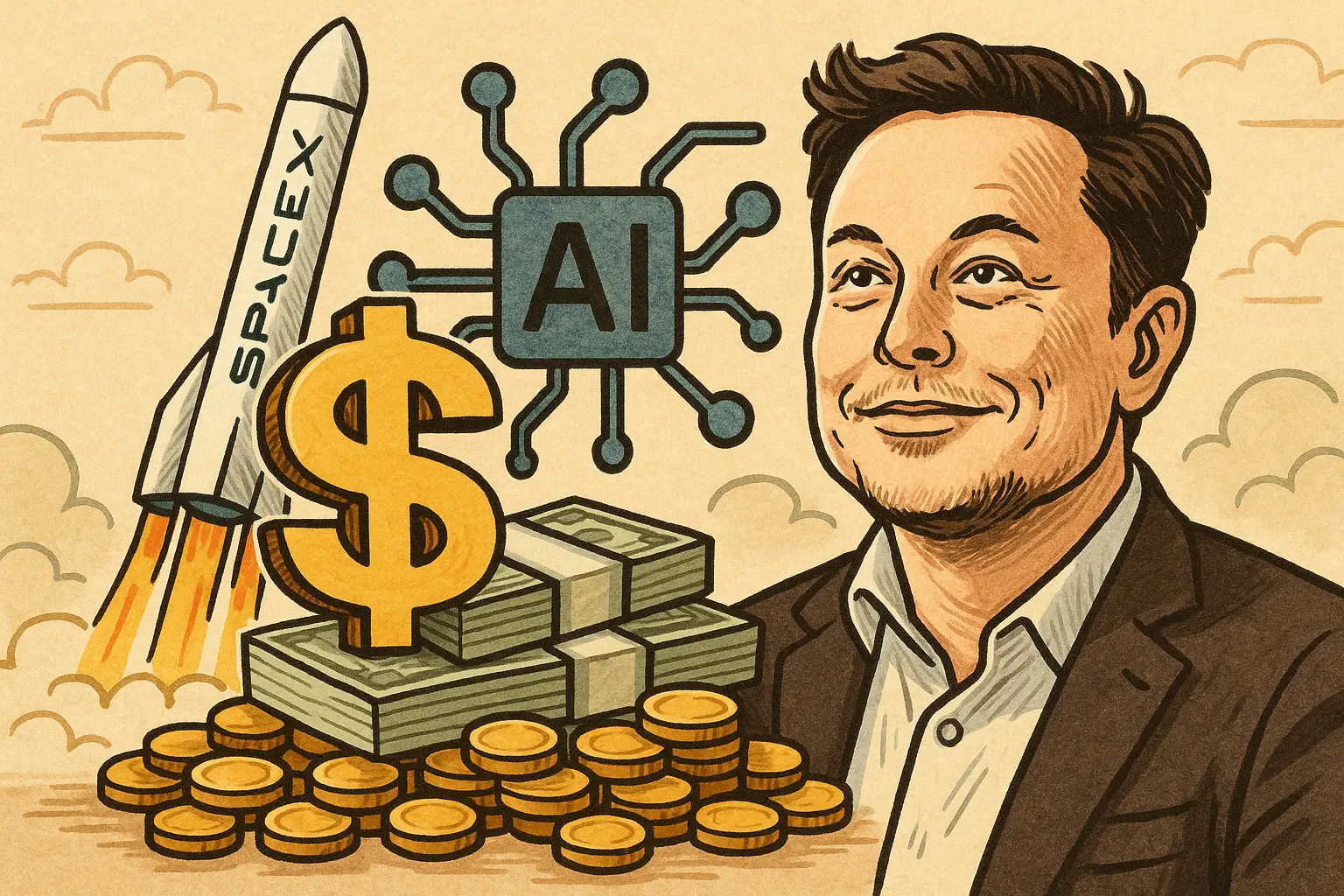
Elon Musk’s net worth has broken $800 billion, an increase of $123 billion in two months. SpaceX’s acquisition of xAI values the combined entity at $1.25 trillion, with Musk holding a 42% stake. Starlink’s million users generate over $10 billion in revenue, and Tesla’s brand value ranks first at $270 billion. The 4680 battery breakthrough helps hedge against tariff risks. Wealth controversies have ignited debates—supporters praise the disruption across three industries, while critics question income inequality and claim it’s just paper wealth.
SpaceX and xAI Drive $1.25 Trillion Valuation
The biggest driver behind Musk surpassing $800 billion is the deal to acquire xAI, which values SpaceX at $1 trillion and xAI at $250 billion. The combined entity is valued at a staggering $1.25 trillion. Musk owns about 42% of the merged company, worth approximately $425 billion, making it the largest component of his total wealth.
SpaceX itself is a money-printing machine. Starlink has surpassed one million users across over a hundred countries. Last year’s revenue alone exceeded $10 billion, making it a highly profitable venture. The satellite internet service has a monopoly advantage in remote areas, over seas, and in the air where traditional networks can’t reach. Each user pays about $100 per month, so a million users generate over $1 billion annually—excluding high-value contracts with enterprises and governments.
Even more impressive is SpaceX’s rocket launch business. The reusable Starship reduces launch costs to under $100 per kilogram, far below competitors’ thousands of dollars. This cost advantage has allowed SpaceX to dominate the global commercial satellite launch market, securing major contracts from NASA and the U.S. Department of Defense. When a company monopolizes both launch services and satellite internet, its valuation naturally soars.
Adding xAI introduces an AI dimension to this empire. The Grok chatbot developed by xAI, despite controversy, benefits from deep integration with X platform (formerly Twitter), providing unique data advantages and distribution channels. More importantly, SpaceX and xAI plan to build space-based data centers, leveraging infinite solar energy and natural cooling in space to address AI computing energy needs. If realized, this bold vision could revolutionize the AI industry.
The Four Pillars of Musk’s Wealth
SpaceX (including Starlink): Valued at $1 trillion, Musk owns about 42%, worth roughly $420 billion
xAI (merged with SpaceX): Valued at $250 billion, Musk’s stake about 42%, worth approximately $105 billion
Tesla: Market cap fluctuates, but brand value is $270 billion, top in the auto industry
Others: X platform, Neuralink, Boring Company, etc.
Tesla’s Brand Value $270 Billion and the 4680 Battery Breakthrough
The 2025 Hurun Auto Brand Rankings just released Tesla at a brand value of $270 billion, holding the top spot. Although Chinese BYD sales have overtaken Tesla, in terms of brand premium and technological recognition, Tesla still enjoys the most capital favor. Brand value isn’t the same as market cap, but it reflects consumer perception and willingness to pay a premium. Tesla’s leading brand value despite not being the top seller highlights its symbolic significance and technological leadership in EVs.
Notably, Musk has fulfilled a promise made before 2020—the 4680 battery. It was touted to significantly improve range and halve costs. However, the final product has been more of a semi-finished prototype, not as perfect or cheap as claimed. Recently, Musk tweeted praising the 4680 battery as a “resurrection,” claiming a major breakthrough in the dry electrode manufacturing process that has troubled mass production for years. This process could help Tesla hedge tariffs and supply chain risks.
The breakthrough in 4680 batteries is significant. The dry electrode process is revolutionary, eliminating solvents and drying steps used in traditional wet processes, greatly reducing costs and environmental impact. If mass production is achieved, Tesla’s battery costs could drop by 30-50%, making EVs more competitive. More importantly, in-house batteries reduce reliance on external suppliers like CATL, which is strategically valuable amid rising geopolitical tensions and tariff barriers.
China’s investment legend, Duan Yongping, also praises FSD (Full Self-Driving), saying Model Y is comfortable to drive and now his preferred choice. As the behind-the-scenes operator of BBK, OPPO, and vivo, Duan’s endorsement boosts Tesla’s image in China significantly.
Controversy Over $800 Billion Wealth and Paper Wealth
When the news broke, online voices heated up. Supporters praise Musk for disrupting aerospace, EVs, and AI, creating miracles and jobs. They argue his bold ideas are risky but have paid off, and his wealth is a fair reward for innovation and risk-taking that advances human technology.
Critics, however, point out the huge wealth gap—while billions struggle with basic needs, Musk’s net worth exceeds $800 billion. According to the World Bank, about 700 million people live in extreme poverty (less than $2.15/day), and Musk’s wealth is equivalent to the combined annual income of roughly 370 million such people. This extreme concentration of wealth raises fundamental questions about the fairness of capitalism.
Some also argue that Musk’s wealth is mostly paper—if stock prices fall, his net worth shrinks. Tesla’s market cap once evaporated over $100 billion in a single day, and his wealth has fluctuated wildly. His $800 billion is mainly based on stock valuation, not cash in the bank. When Tesla or SpaceX’s stock plunges—like the 70% drop in 2022—his net worth can decrease by over $200 billion, even causing him to lose the title of richest person.
Musk’s success stems from his confidence and precise judgment. He bets on the hardest, most profitable sectors—space exploration, EVs, AI, brain-computer interfaces—areas with high failure rates. Most investors shy away, but Musk bets big and often succeeds. This high-risk, high-reward strategy, combined with his execution and resilience, has created his wealth myth.
He’s also remarkably resilient. Even when stock prices crash, or public opinion turns against him, he can pivot to new ventures. This mental toughness is rare among entrepreneurs. Most would become cautious after major failures, but Musk seems to never give up, bouncing back each time.
He might soon become the world’s first trillionaire. If SpaceX and xAI merge and go public this year with a valuation exceeding $1.5 trillion, Musk’s 42% stake would be worth about $630 billion. Adding his holdings in Tesla and other companies, surpassing $1 trillion in net worth is entirely possible. At that point, he would be the first person in history to reach a $1 trillion fortune.
Related Articles
What signals did the US SEC send behind the new 2% discount regulation for stablecoins?
Citigroup Plans Bitcoin Integration for Institutional Clients
Bitcoin ETF inflow strength rebounds: over $500 million poured in in a single day, hitting a 3-week high
SUI Price Slips Below $1 as 21Shares ETF Lists on Nasdaq
Is the digital payment landscape about to undergo a major shakeup? News: Stripe considering acquiring PayPal
South Korean Stocks Hit All-Time High as Retail Turns Away from Crypto