


RWA earning? A comprehensive analysis of the "2.6 Notice" virtual currency regulation policy
Author: Xiao Sa Legal Team
On February 6, 2026, the People’s Bank of China and seven other ministries jointly issued the “Notice on Further Preventing and Disposing of Risks Related to Virtual Currencies and Other Activities” (referred to as the “2.6 Notice”). In my humble opinion, the 2.6 Notice is actually an advanced version of the “Notice on Further Preventing and Disposing of Risks of Virtual Currency Trading and Speculation” issued by ten ministries in 2021 (referred to as the “9.24 Notice”):
-
The regulatory standards for virtual currencies remain largely similar to those in the 9.24 Notice, with only some patches that require attention; no substantial changes.
-
There is still a regulatory blank space concerning NFTs and other digital assets, digital artworks.
-
Clear but stringent RWA (Real-World Asset) regulatory standards have been established.
Below, Sister Sa’s team will provide a detailed interpretation.

1. Detailed Explanation of RWA Regulatory Standards
A one-sentence summary of China’s current approach to RWA regulation: Strict conditions are permitted.
It must be noted that the 2.6 Notice is the first time in China’s regulatory documents that RWA is explicitly defined: “Tokenization of real-world assets refers to activities that use cryptographic technology and distributed ledger or similar technology to convert asset ownership, income rights, etc., into tokens (certificates) or other rights and bonds with token (certificate) characteristics, and then issue and trade them.”
In terms of regulatory principles, Article (Thirteen) of the 2.6 Notice clearly states: “Without the approval of relevant authorities in accordance with laws and regulations, domestic entities and their controlled overseas entities shall not issue virtual currencies abroad.” This sentence not only constrains RWA but also broadly restricts ICO activities. Whether NFTs fall within the scope of prohibition is worth further discussion. From a literal interpretation, Sister Sa’s team tends to believe that this article does not regulate the issuance of NFTs.
Regarding specific regulatory standards, China has clarified the “RWA issuance approval system.” Sister Sa’s team summarizes briefly:
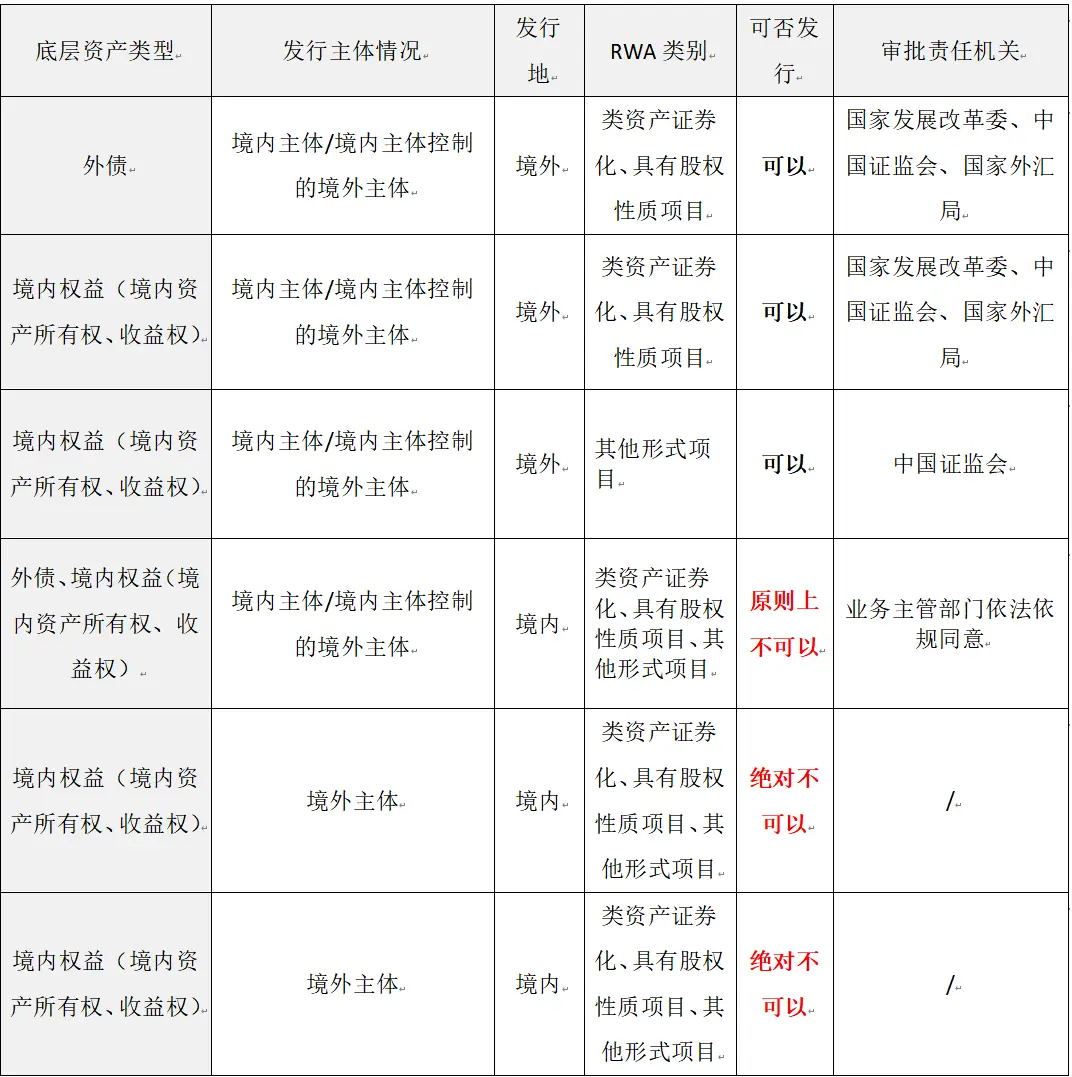
Back in 2025, when the concept of RWA was most popular, Sister Sa’s team repeatedly and explicitly warned that regardless of the method (e.g., issuing NFTs as a disguised form of RWA), scale (e.g., small-scale internal issuance of RWA), or underlying assets (e.g., agricultural products), any RWA issuance in China is difficult to separate from the ICO activities banned by the September 4, 2017, announcement. Such activities are non-compliant and may cross legal red lines. Article (Two) of the 2.6 Notice affirms this: “Activities involving the tokenization of real-world assets within the territory, as well as related intermediary and information technology services, suspected of illegal issuance of tokens or securities, unauthorized public issuance of securities, illegal operation of securities and futures businesses, illegal fundraising, etc., should be prohibited; except for related activities conducted with the approval of the competent business authorities in accordance with laws and regulations, relying on specific financial infrastructure.”
Some partners are optimistic about the exception clause for domestic issuance: “Activities conducted with the approval of relevant authorities and relying on specific financial infrastructure.” In my humble opinion, Sister Sa’s team believes that in the short term (several years), China’s regulatory authorities are unlikely to permit domestic entities to issue RWA projects. Only after testing through relatively large-scale offshore projects and accumulating regulatory experience might they consider turning this clause into a feasible pathway.
As for what constitutes “overseas entities controlled by domestic entities,” the specific issuance conditions and the responsibilities of intermediaries, Sister Sa’s team will provide detailed explanations in subsequent special articles on RWA compliance issuance.
2. Important “Patches” in the 2.6 Notice Regarding Virtual Currency Regulation
Regarding the nature of virtual currencies, prohibited activities in mainland China, and judicial policies (invalid if against public order and morals, risk borne by oneself), the 2.6 Notice is no different from the 9.24 Notice. Sister Sa’s team will not elaborate further today, focusing only on the important new “patches” introduced by the 2.6 Notice.
(1) No issuance of Renminbi stablecoins without permission
Clause (One), Item Three of the 2.6 Notice states: “Stablecoins pegged to legal currency, in circulation, have in effect performed some functions of legal currency in a disguised manner. Without the approval of relevant authorities in accordance with laws and regulations, no entity or individual within or outside the territory shall issue stablecoins pegged to the Renminbi abroad.”
The reason for this patch is directly related to the “Stablecoin Regulations” formulated and issued by Hong Kong in 2025, which made the concept of stablecoins suddenly “explode” in popularity. Some malicious actors began issuing “air coins” under the banner of stablecoins or even “Renminbi stablecoins” in mainland China and Hong Kong, severely disrupting financial order.
The deeper reason is that China’s regulatory authorities must safeguard the right to mint currency (also called “monetary sovereignty”) to prevent virtual currencies from impacting national economic security. The so-called seigniorage is intuitively explained as “a special right (held and exercised by the state or government) to mint, issue, and manage legal currency,” or more academically, “the difference between the face value of money and its production cost.” Sister Sa’s team will not elaborate further here.
In practice, the role of seigniorage has varied across different historical periods: in ancient times, it directly reflected the profit of the king (generally believed that currency originated from the establishment of state power and taxation needs); in modern times, it is a fiscal tool of the government; in contemporary financial discourse, it has gradually transformed into a more complex power struggle among different countries or economic entities.
This explains why the first sentence of Clause (One), Item Three of the 2.6 Notice clearly states: “Stablecoins pegged to legal currency, in circulation, have in effect performed some functions of legal currency in a disguised manner…” Therefore, Sister Sa’s team believes that with the widespread promotion of digital RMB in China, the 2.6 Notice essentially cuts off all compliant issuance possibilities of Renminbi stablecoins by any entity. Partners should not harbor unrealistic fantasies about the exception “with the approval of relevant authorities in accordance with laws and regulations.”
(2) New supervisory reporting obligations for internet companies
Clause (Seven) of the 2.6 Notice states: “Strengthen management of internet information content and access. Internet companies shall not provide network venues, commercial displays, marketing, paid traffic guidance, and other services for activities related to virtual currencies and real-world asset tokenization. Any illegal or violations clues discovered should be promptly reported to relevant authorities, and technical support and assistance should be provided for related investigations and law enforcement.”
This clause further tightens the already heavily restricted internet platform operators and service providers. Based on practical experience, many crypto merchants, offshore project parties, and crypto KOLs currently promote projects and services through internet platforms and social media groups. For example, certain forums and QQ groups are among the largest “traffic hubs,” and many cases of virtual currency theft and scams originate from these platforms, where victims learned about related services and projects before being led to offshore social media platforms and ultimately suffering financial losses.
It is foreseeable that after the issuance of the 2.6 Notice, major internet companies will urgently conduct self-inspection and rectification activities. It is worth noting that to implement the requirements of the 2.6 Notice, internet platforms cannot simply delete related content as in previous rectifications; instead, they should assess and organize relevant clues and report them to relevant authorities (cybersecurity, telecommunications, public security, or financial regulators), and provide technical support and assistance for subsequent investigations and law enforcement (if any).
Currently, it appears that major internet platforms are temporarily unable to effectively fulfill this obligation, as China currently does not have a dedicated agency specifically handling risks related to virtual currencies.
According to the 2.6 Notice, this specialized agency should be led by local financial regulatory authorities, working in coordination with telecommunications, public security, market supervision, and other departments, in conjunction with the Cyberspace Administration, courts, and procuratorates. Currently, local financial authorities need time to develop management plans and clarify internal responsibilities, so this work may not be completed in the short term.
Final Remarks
In terms of content, the 2.6 Notice is not a completely independent regulatory document. It has a traditional aspect: revisiting the basic regulatory approach of the 9.24 Notice, building upon the original standards, and continuing to patch and refine; but it also has an innovative aspect: incorporating the RWA concept, which was not yet under regulation in 2021 but exploded in popularity in 2025, into a regulatory framework with some operational feasibility.
This indicates that China’s regulatory authorities are deepening their understanding of virtual assets and, based on comprehension, experimentation, and observation, are gradually beginning to accept this emerging phenomenon. Although progress has been slow due to numerous negative incidents, it is certain that China’s regulators have recognized the potential of virtual assets. For industry partners, this is undoubtedly a major positive signal.
Related Articles
Crypto Bill Faces a New Challenge, Delaying its Implementation
UK reviews cryptocurrency gambling payments to promote legal digital asset betting and consumer protection
Hong Kong Securities and Futures Commission Chief Executive: Must Fully Upgrade Market Infrastructure and Integrate Tokenization-Related Innovation Projects
South Korea limits major shareholders of crypto exchanges to 20% ownership, promoting industry diversification and increased market transparency