


Ripple Custody Upgrade Fails to Prevent Collapse! XRPL Lock-up Volume Halved, XRP Drops 32% in a Month
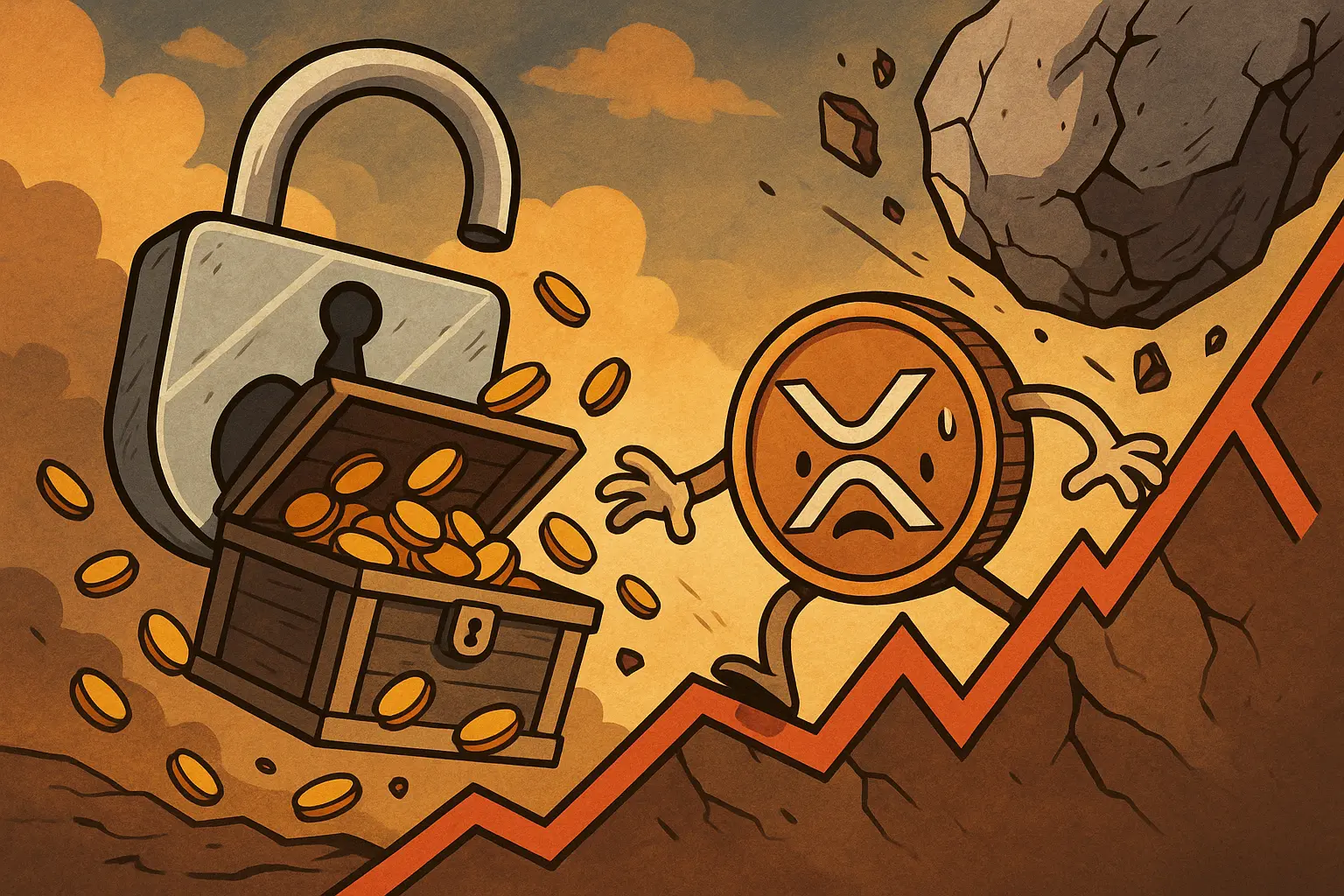
Ripple partners with Figment and Securosys to expand custody services. The staking feature supports ETH and SOL, with added HSM security options for on-premises or cloud deployment. However, XRP has fallen 32% month-over-month to $1.44, with total locked value dropping from $80 million to $49.6 million, and stablecoins totaling only $416 million, indicating that institutional infrastructure upgrades have not boosted the price.
Institutional Expansion of Figment Staking and Securosys HSM
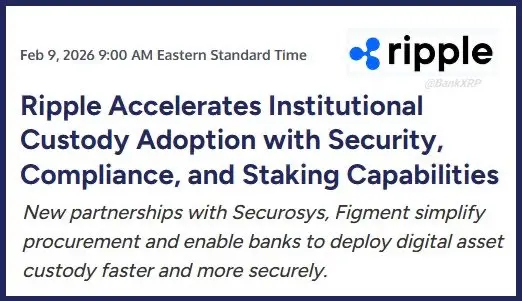
(Source: BankXRP)
Ripple states that these collaborations aim to streamline procurement processes and enable regulated entities to deploy custody services more quickly. Recently, Ripple expanded its custody product suite through acquisitions of Palisade and integration of Chainalysis compliance tools. As part of the partnership with Figment, Ripple will launch a staking feature, allowing institutional clients to offer staking services without operating their own validator infrastructure.
This integration aims to help banks, custodians, and regulated entities gain exposure to proof-of-stake networks while maintaining security and governance standards. Through Figment’s infrastructure, Ripple Custody clients will be able to support staking on major networks like Ethereum (ETH) and Solana (SOL). Figment is a leading global staking service provider managing billions of dollars in staked assets.
Ben Spiegelman, Vice President and Head of Partnerships and Enterprise Development at Figment, said: “By combining Ripple’s enterprise-grade custody technology with Figment’s secure, non-custodial staking platform, we provide regulated institutions a way to offer staking rewards to their clients across multiple blockchain networks.” The advantage of this “one-stop” solution is that clients don’t need to contract separately with custodians and staking providers, reducing operational complexity and compliance costs.
Additionally, Ripple has partnered with Securosys to enhance the security of Ripple Custody. This collaboration adds support for CyberVault HSM and CloudHSM. HSMs (Hardware Security Modules) are dedicated hardware devices used to protect cryptographic keys and are core security components for enterprise custody. This allows institutions to choose on-premises or cloud-based HSM deployment options.
Three Key Features of Ripple’s Institutional Custody Upgrade
Staking Service: Supports ETH/SOL staking without running validators, via Figment partnership
HSM Security: On-premises or cloud deployment options with Securosys
Compliance Tools: Integration with Chainalysis to meet regulatory requirements
Ripple states that the integration with Securosys aims to address longstanding challenges in HSM applications, including high costs, complexity, and slow procurement processes. Ripple also notes that Securosys broadens the range of HSM providers supported on its custody platform, offering greater flexibility for institutions operating under various regulatory environments.
Robert Rogenmoser, CEO of Securosys, said: “By integrating our CyberVault HSM with Ripple Custody, institutions can access an out-of-the-box enterprise solution that can be deployed quickly, without added complexity, while maintaining full control over their cryptographic keys.”
XRPL Total Locked Value Halves from $80 Million to $50 Million
Despite Ripple’s ongoing efforts to strengthen its institutional infrastructure, on-chain metrics for the XRP Ledger show a moderate adoption rate. According to DeFiLlama data, XRPL’s total value locked (TVL) has declined from approximately $80 million in early January to about $49.6 million at the time of writing, indicating a slowdown in DeFi activity on the network. This nearly 40% drop in TVL far exceeds the declines seen in Bitcoin or Ethereum during the same period, suggesting a more severe capital outflow from the XRPL ecosystem.
TVL is a key indicator of blockchain ecosystem health, representing the total value of assets locked in DeFi protocols such as lending platforms, DEXs, and liquidity pools. Growth in TVL indicates increasing user and capital inflows; decline suggests capital leaving. The halving of XRPL’s TVL from $80 million to $50 million signals a shrinking rather than expanding DeFi ecosystem.
Stablecoin data also shows slow growth. According to DeFiLlama, the total market cap of stablecoins on XRPL is about $416 million, reflecting steady but limited growth. In comparison, stablecoins on Ethereum exceed $100 billion, Solana around $10 billion, and Tron approximately $60 billion. XRPL’s $416 million is very low among mainstream blockchains, indicating its adoption as a settlement layer for stablecoins is far behind competitors.
In other words, Ripple’s institutional strategy largely focuses on custody, settlement, and permissioned financial use cases, which may not always be reflected in traditional DeFi metrics like TVL. This argument has some validity, as Ripple’s target clients are banks and financial institutions whose transactions often occur via private channels, not visible on public blockchain data. But if these institutional use cases are truly large-scale, why haven’t XRP’s price and network activity shown corresponding growth?
Institutional Infrastructure Has Not Translated into Market Demand
It’s notable that so far, expansion of institutional use cases has had limited impact on XRP’s market performance. Over the past month, XRP’s price has fallen nearly 32%, tracking the overall market decline. At the time of writing, XRP trades at $1.44, down 0.66% from the previous day. This “institutional bullishness, price bearishness” disconnect has been a recurring pattern in Ripple’s history.
Ripple has long promoted its institutional partnerships and technological upgrades—from RippleNet’s bank collaborations, to On-Demand Liquidity for cross-border payments, to the launch of RLUSD stablecoin—all framed as major positives. Yet, XRP’s price performance has lagged the market for years, with a long-term downtrend since its 2018 high. This persistent disconnect raises a fundamental question: Is Ripple’s institutional strategy truly effective?
Possible explanations include: institutional use cases are smaller than advertised, institutions use Ripple’s tech but do not hold XRP (settling in fiat), or the market simply does not believe Ripple’s narrative. Regardless, the result is that XRP investors cannot benefit from Ripple’s commercial success. This “company profits, token stagnates” phenomenon is common among enterprise blockchain projects.
Clearly, Ripple is in a race to build out its infrastructure for institutional payments, custody, and staking services. But its actual adoption and price breakthroughs remain elusive. This “all talk, no walk” situation is eroding investor patience and confidence.
Related Articles
The escalation of Middle East conflicts has triggered capital transfers, with XRP inflows to trading platforms exceeding $650 million in one week. Short-term selling pressure may intensify.
Wall Street Crash Incoming? Analyst Predicts XRP and Crypto Selloff If War Erupts
The US-Iran conflict drags down the crypto market, XRP faces $650 million potential sell-off
Ripple CEO Projects 80-90% Chance of Clarity Act Passage by April; Analysts Debate Potential XRP Price Impact