


Vitalik laments that the prediction market has gone astray, turning into a short-term gambling tool, and calls for rebuilding long-term societal value

Vitalik criticizes prediction markets for being addicted to short-term gambling, warns that high-frequency contracts erode informational value, and calls for a shift toward long-term risk mitigation infrastructure.
Warning of Over-Convergence in Prediction Markets, Vitalik Condemns “Corporate Trash” Trend
Ethereum co-founder Vitalik Buterin recently published a lengthy post on social platform X, expressing deep concern about the current trajectory of prediction markets. He points out that while the industry has achieved significant success in scale and influence, it is now overly converged on an unhealthy product-market fit.
Vitalik describes this phenomenon as “Corposlop,” implying that platforms, in order to sustain revenue during bear markets, choose to compromise on short-term dopamine-driven gambling activities. These products typically include short-term cryptocurrency price predictions and sports betting, lacking long-term social value or information aggregation functions.
This stance contrasts subtly with his attitude in December 2025, when he publicly defended prediction markets, believing these platforms to be healthier than traditional markets because their operation is limited within 0 to 1, effectively reducing the risk of pump-and-dump schemes, and positioning them as tools for seeking truth and assessing uncertainty.
However, with market data evolving in early 2026, he believes platform teams, under user acquisition pressures, tend to develop highly addictive high-frequency features, risking that prediction markets become dominated by ignorant speculation rather than genuine information aggregation.

Image source: X/@VitalikButerin Ethereum co-founder Vitalik Buterin recently published a lengthy post on social platform X, expressing deep concern about the current trajectory of prediction markets.
High-Frequency Short-Term Contracts Dominate, Algorithmic Trading Dilutes Information Value
Vitalik’s concerns stem from data showing deterioration in market structure. After the launch of 15-minute crypto prediction contracts by the well-known prediction platform Polymarket in January 2026, market focus shifted dramatically. Trading volume for these ultra-short-term “bullish or bearish” contracts, initially only 5% of total crypto volume, surged to about 60% by early 2026. When including hourly contracts, the proportion reaches as high as 80%.
According to analysis by Blockworks researcher Kunal Doshi, participants in these short-term markets are not genuine directional investors but mainly systematic traders, aiming to capture tiny arbitrage opportunities rather than providing socially valuable information. These traders even contribute to 70% of the 15-minute market volume.
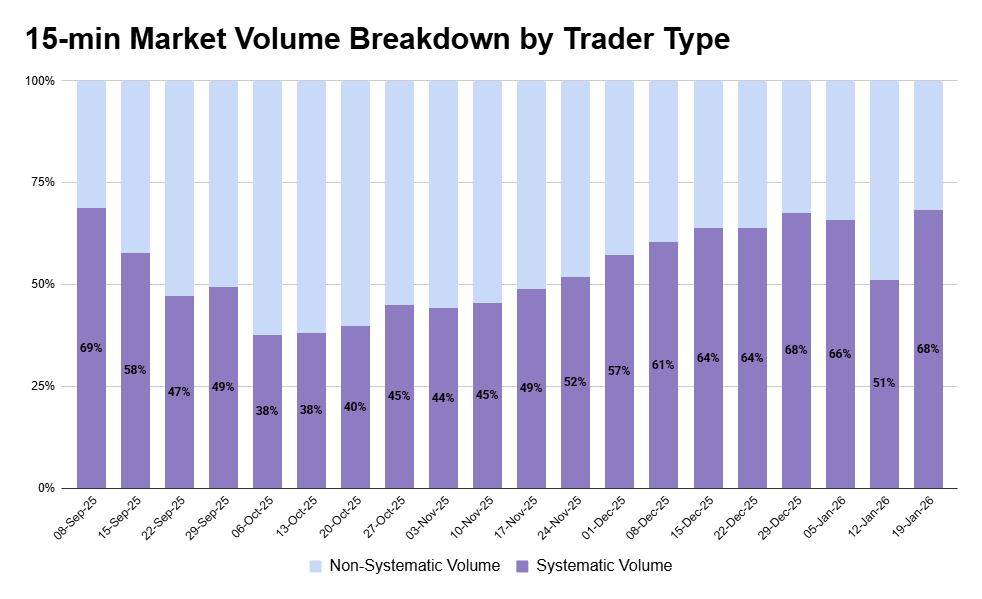
Image source: Kunal Doshi Systematic traders contributed 70% of 15-minute market volume
Vitalik points out that over-reliance on these products creates a negative incentive mechanism, encouraging platforms to seek out naive traders holding incorrect views and fostering a community culture that promotes low-quality insights to increase user engagement.
This model divides prediction market participants into informed traders who provide value and groups deliberately attracted by platforms to incur losses. Long-term, this dependence on naive traders for profit severely damages the credibility of prediction markets as information tools.
From Currency to Hedging Tools, Exploring Personalized Hedging New Financial Paradigms
Regarding the current state of prediction markets, Vitalik proposes a more forward-looking solution: reposition prediction markets as broad-based hedging tools rather than mere entertainment or gambling products. He believes prediction markets should serve hedgers, allowing investors to establish inverse positions to reduce real-world risks—for example, using political risk prediction markets to offset impacts of industry policy changes on assets.
Vitalik further challenges the current concept of stablecoins, arguing that users’ core demand is to ensure they can pay for specific living expenses in the future, rather than holding digital currencies pegged to fiat. He suggests that users’ local large language models (LLMs) analyze their expenditure patterns to automatically assemble a basket of prediction market shares based on price indices, creating personalized hedging portfolios. This would transform prediction markets into core financial infrastructure.
To realize this vision, prediction markets must settle in assets with long-term holding value (such as ETH or interest-bearing tokenized assets) to reduce opportunity costs for hedgers. While industry insiders are divided—some see speculative activity as a necessary phase to guide liquidity—Vitalik emphasizes that developers should look beyond short-term revenue metrics and focus on building the next-generation financial system rather than producing meaningless corporate trash.
This content is summarized by Crypto Agent, reviewed and edited by Crypto City. It is still in training, and may contain logical biases or inaccuracies. The information is for reference only and should not be considered investment advice.
Related Articles
【Morning Market Brief】 Cryptocurrency market fluctuates... Bitcoin $68,929, Ethereum $2,041
Data: If ETH falls below $1,931, the total long liquidation strength on mainstream CEXs will reach $1.135 billion.
ETH 15-minute sharp decline of 1.23%: leveraged long liquidations and on-chain capital outflows resonate, intensifying volatility
ETH short-term increase of 1.01%: ETF capital net inflow and ecological upgrade expectations resonate to drive a rebound