


Financial giant SBI issues 10 billion yen on-chain bonds, with Ripple XRP as a bonus for purchases
Japan’s SBI Holdings Launches 10 Billion Yen (Approximately $64.5 Million USD) Blockchain Bonds, Investors Receive XRP as Rewards Besides Fixed Interest
(Background: Japan’s Crypto Policy Shift — Finance Minister Kato Shigeki Permits Diversified Virtual Asset Investments to Foster a Friendly Environment)
(Additional Context: Japan’s Largest Osaka Exchange Plans to Launch Cryptocurrency Derivatives; JPX Considers Listing Crypto ETFs)
Table of Contents
Toggle
- SBI and Ripple’s Decade-Long Partnership
- Japan’s Securities Token Market: 16.8 Billion Yen Foundation
- The Turning Point in Japan’s Crypto Regulation
This week, Japan’s financial giant SBI Holdings announced the issuance of a blockchain bond called SBI START Bonds, totaling 10 billion yen (about $64.5 million USD).
The bond structure itself is straightforward: a 3-year term, A- credit rating, estimated annual interest rate of 1.85% to 2.45%, paid semiannually, with Mizuho Bank serving as bond administrator. These terms are standard in Japan’s corporate bond market and unlikely to excite fixed-income investors.
However, it includes an unusual additional clause: Buy the bond and receive XRP.
Specifically, after completing the subscription and opening an account on SBI VC Trade (SBI’s crypto exchange), investors will immediately receive XRP equivalent to their subscription amount. Furthermore, on the interest payment dates in 2027, 2028, and 2029, they will receive additional XRP distributions. (For every 100,000 yen invested, investors get XRP worth 200 yen.)
In other words, this is a hybrid bond offering both fiat interest and crypto asset rewards.
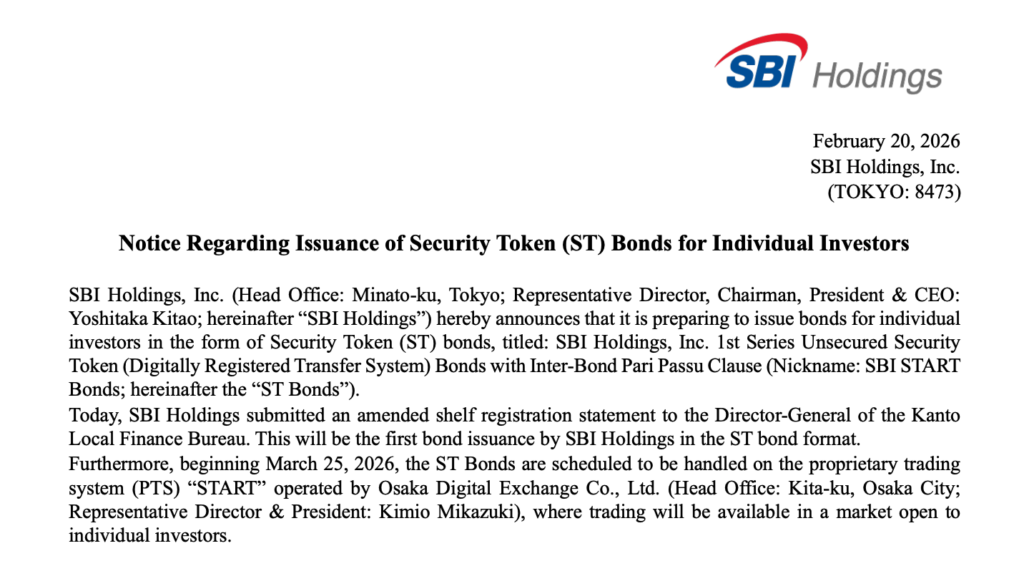
The bonds will be issued and managed on the BOOSTRY ibet for Fin platform, completely bypassing Japan’s traditional JASDEC securities settlement system, and will be traded on the Osaka Digital Exchange (ODX) START trading platform in the secondary market. The subscription period runs from March 11 to 23, with a minimum denomination of 10,000 yen (about NT$2,100), targeting retail investors within Japan.
SBI and Ripple’s Decade-Long Partnership
Why XRP? Let’s go back to 2016.
That year, SBI Holdings invested in Ripple Labs, acquiring about 9% of the company and becoming Ripple’s largest external shareholder. In the same year, the two established a joint venture, SBI Ripple Asia, to promote blockchain cross-border payments across Asia. In 2019, SBI Remit began using XRP as a bridge currency for cross-border remittances, one of XRP’s earliest real-world applications.
By November 2025, Ripple had completed a $500 million funding round at a $40 billion valuation, with SBI’s 9% stake valued at approximately $3.6 billion. In February 2026, SBI VC Trade became Japan’s first licensed “Electronic Payment Instrument Trading Service Provider,” capable of handling offshore stablecoins like USDC.
From equity investments, to cross-border payments, to stablecoin licensing, and now bond issuance, SBI has spent nearly a decade gradually embedding XRP into its financial product lineup.
Japan’s Securities Token Market: 16.8 Billion Yen Foundation
SBI’s on-chain bonds are not an isolated case. Japan’s securities token market has moved beyond proof of concept into early-scale deployment.
Other major issuance examples include: Mitsubishi UFJ Financial Group (MUFG) issuing Japan’s first digital bank bond in November 2025, also worth 10 billion yen; Nomura Securities completing multiple digital bond settlement tests, reducing settlement cycles to T+1; and the Tokyo Metropolitan Government offering subsidies up to 5 million yen to encourage companies to issue digital bonds.
The Turning Point in Japan’s Crypto Regulation
2026 marks a critical year for Japan’s crypto asset regulation.
The Financial Services Agency (FSA) is pushing a major reform: moving crypto assets from the “Fund Settlement Act” to the “Financial Instruments and Exchange Act,” officially classifying them as financial products rather than payment tools. This means crypto assets will be regulated similarly to stocks and bonds.
Accompanying this reform are tax changes: capital gains tax on crypto assets will be reduced from a progressive rate (up to 55%) to a flat 20%, aligning with traditional capital gains tax rates. Additionally, banks will be permitted to trade and hold crypto assets; digital yen (DCJPY) is planned to be jointly launched in April by Japan Post Bank and the Bank of Japan; Mitsubishi, Sumitomo Mitsui, and Mizuho are testing yen-pegged stablecoins for cross-border payments.
Putting these pieces together: a legal framework that treats crypto assets as financial products, a 20% fixed tax rate, mature securities token infrastructure, and the upcoming rollout of central bank digital currency. Japan is building one of the world’s most comprehensive digital asset ecosystems with a conservative regulatory approach.

Related Articles
XRP Holds $1.32 Support as Weekly Volatility Expands
Buy bonds and receive Ripple airdrops! SBI issues 10 billion yen digital corporate bonds with an estimated annual interest rate of up to 2.45%.