


Anthropic Hackathon Champion Free Sharing of Claude Code Universal Configuration: 13 Agents, 40+ Skills, 31 Commands Fully Revealed
Developer Affaan Mustafa, after winning first place at Anthropic’s hackathon, compiled all the Claude Code settings accumulated during 10 months of actual product development into an open-source package. This includes 13 intelligent agents, over 40 skill modules, 31 commands, AgentShield security auditor, and more. This article shares that with you.
(Background recap: Clawdbot, a legendary 24/7 AI butler that sold out Mac minis)
(Additional context: Beware! Improper Clawdbot configuration may hide serious security vulnerabilities: some users’ encrypted wallets have been looted)
Table of Contents
Toggle
- Five module layers covering the entire workflow from security review to automatic learning
- The existence of AgentShield security auditor
- The configuration cost of AI-assisted development is higher than expected
- This package is a starting point, not the end
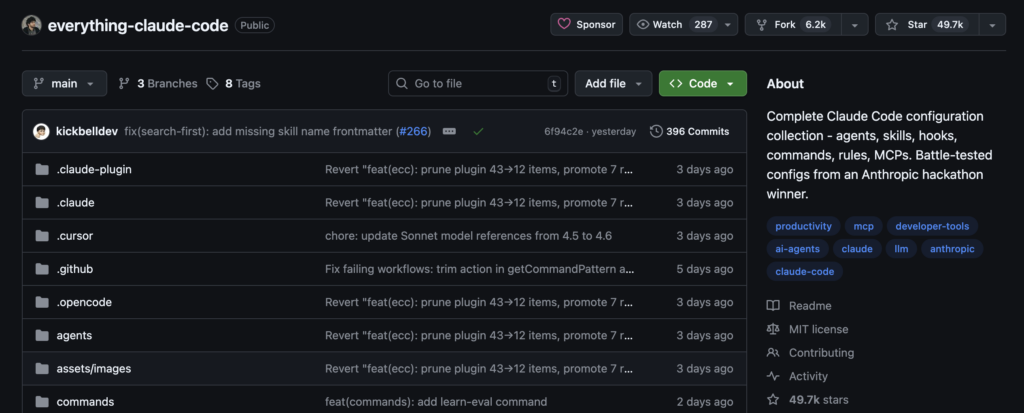
The latest Anthropic hackathon just concluded. After each competition, community discussions usually focus on the technical highlights of the winners’ projects or what new challenges Anthropic introduced. But this article aims to share something with longer-term value: the champion Affaan Mustafa, who organized all the Claude Code settings he accumulated over 10 months of building actual products into a directly installable open-source package called “everything-claude-code,” freely published on GitHub.
As of writing, the repository has over 49,000 stars and 6,200 forks. These numbers reflect not only community interest in the tools but also highlight a real pain point in AI-assisted development: configuring Claude Code properly in real-world scenarios is not as simple as many imagine. Below, we’ll quickly explore the key features of this configuration.
Five module layers covering the entire workflow from security review to automatic learning
The entire package is organized into five core layers, with clear division of responsibilities:
Agents: 13 specialized sub-agents, each with their own role. Covering planners, architects, TDD guides, code reviewers, security auditors, build error resolvers, end-to-end test executors, refactoring cleaners, documentation updaters, and language-specific reviewers for Go, Python, and databases.
Each agent is designed as a task delegation node rather than a single agent handling all tasks. This design aligns with the performance limits of large language models in “broad but shallow” problem spaces.
Skills: Over 40 workflow definitions, categorized by language and use case. Patterns for TypeScript, Python, Go, Java, C++, Django, Spring Boot, with clear guidelines for testing, security, deployment, API design, database migration, Docker, and more.
Notably, some advanced skill modules include “Cost-aware LLM pipeline” and “Content hashing cache mode,” indicating that this setup extends beyond pure development assistance into AI product engineering itself.
Commands: 31 slash commands to trigger common workflows step-by-step. /plan, /tdd, /code-review, /build-fix, /e2e are basic commands. The newer versions also include multi-agent coordination commands like /multi-plan, /multi-execute, as well as learning-related commands like /instinct-status and /evolve.
Hooks: Trigger-based automation mechanisms for cross-conversation memory persistence, context compression strategies, and pattern extraction. These are foundational for maintaining context coherence over long-term use and are often overlooked by configuration beginners.
Rules: Always-follow coding standards, divided into general rules, TypeScript rules, Python rules, and Go rules. Covering code style, Git workflows, testing standards, and security requirements. The package supports Windows, macOS, Linux, and automatically detects package managers like npm, pnpm, yarn, and bun.
The significance of AgentShield security auditor
Among the modules, three stand out for deeper analysis, as they represent not just feature options but clear stances on AI-assisted development.
AgentShield (Security Auditor) performs static analysis of Claude Code configurations, including 102 vulnerability scan rules, 912 test cases, and 98% test coverage. The practical reason behind this is that when an AI agent is given the ability to execute code, access the filesystem, or call external APIs, the configuration file itself becomes an attack surface.
AgentShield’s existence indicates this issue has become serious enough to require dedicated tools, serving as a reminder for any team deploying AI coding assistants in production.
Continuous Learning v2 describes an “intuition” concept where AI extracts behavioral patterns from past interactions, with confidence scoring. In other words, it allows Claude to “remember” specific codebases over time, rather than rebuilding context from scratch each time. This mechanism automates what was previously manual knowledge accumulation.
Skill Creator analyzes Git commit history to automatically generate tailored skill modules for specific codebases. This shortens the gap between “knowing what Claude Code can do” and “making Claude Code act on my codebase.” It enables domain-specific developers to extract the most suitable configurations from their own development history without designing workflows from scratch.
The configuration cost of AI-assisted development is higher than expected
Mustafa’s decision to publish this configuration set is essentially a community infrastructure effort: transforming the repeated trial-and-error costs that everyone faces into a shared public resource.
This logic is familiar in open-source communities—think ESLint rule sets or Docker Compose templates—where organizing such work is a vital part of the ecosystem.
The difference is, AI-assisted development configuration is an order of magnitude more complex than traditional tools. Claude Code’s behavior involves not just toggles but also intelligent architecture, prompt engineering, workflow design, cross-conversation memory management, and more.
This package is a starting point, not the end
It’s important to note that this configuration reflects the optimized results for a specific developer in a specific context. It may not directly apply to all scenarios.
But that doesn’t diminish its value. Instead, consider it a starting point rather than a final solution. For beginners, a well-founded preset configuration is far more useful than a blank slate; for experienced users, it provides a reference for comparison and modification.
Mustafa organized his 10 months of decision-making into an installable package. Its value isn’t in being perfect but in making explicit and accessible a knowledge system that was previously implicit—publicly available, referenceable, and modifiable.