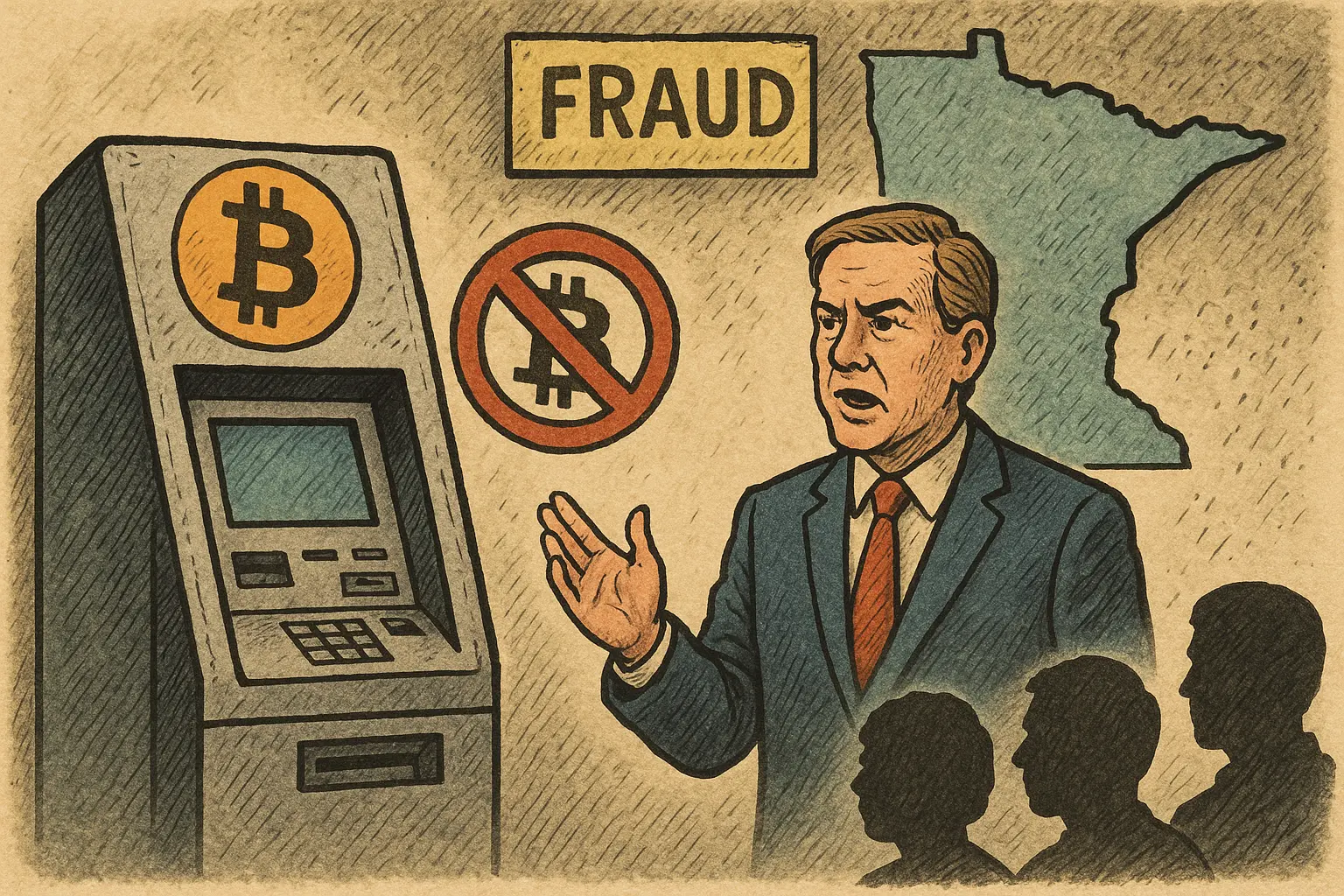
U.S. Rep. Erin Koegel of Minnesota introduced HF 3642 bill this week, which proposes a complete ban on all physical machines in the state that allow users to buy cryptocurrencies with cash. If passed, Minnesota will become the first state in the nation to implement a state-level blanket ban on Bitcoin ATMs, following the nationwide ban introduced by New Zealand last year. There are currently about 430 such machines in Minnesota.
HF 3642 Act: Legislative logic from elder victimization to full-scale legislation
This is not the first time Minnesota has regulated Bitcoin ATMs. In 2024, the state has passed a regulatory framework that stipulates a daily transaction cap of $2,000 for new customers, a refund mechanism, and a business licensing system. However, the continued increase in fraud cases has prompted lawmakers to turn to more aggressive blanket ban options.
During Thursday’s legislative hearing, law enforcement officials provided several typical cases describing elderly victims being lured into by scammers posing as government officials or technical support workers to continuously transfer money through Bitcoin ATMs. A detective testified that a resident sent Bitcoin to scammers ten times in six months, losing 50% of his monthly income as a result, and was eventually found in a trance at a gas station and had to rely on government assistance. A city police chief pointed out in a written statement: “The ability of law enforcement to recover funds after they have been transferred is extremely limited.”
The core point of contention in the HF 3642 bill
Legislative purpose: Responding to the rising public safety needs of seniors affected by Bitcoin ATM scams
Scope of the ban: All physical machines that allow users to purchase cryptocurrencies with cash are prohibited, regardless of whether the operator is compliant
The first case in the United States: If passed, it will be the first state-level blanket ban in the United States, following New Zealand’s national ban model
Scale of loss: Bitcoin ATM fraud losses across the United States reached $3.33 billion last year, with about 430 machines in Minnesota
Rural community impact: Lawmakers note that millions of dollars may have flowed out of rural communities
Bitcoin Depot’s lawsuit and industry compliance pressure are heating up across the board
The proposed legislation in Minnesota is a microcosm of the regulatory tightening the Bitcoin ATM industry in the United States as a whole. Bitcoin Depot, North America’s largest Bitcoin ATM operator, announced this week that it will proactively strengthen its compliance process by requiring customers to provide personally identifiable information starting with every transaction.
However, just before that, Massachusetts Attorney General Andrea Campbell filed a lawsuit this month, accusing Bitcoin Depot of knowingly facilitating cryptocurrency scams and “removing fraud prevention safeguards to enrich its own pockets.” Bitcoin Depot denies the allegations, emphasizing compliance and consumer protection as its core business principles.
Additionally, the Arizona Attorney General has issued an urgent warning, stating that Arizona residents lost more than $1.77 million in 2024 due to cryptocurrency ATM scams. This series of events shows that the Bitcoin ATM industry is facing unprecedented regulatory and legal pressure, and how to effectively prevent fraud while maintaining business has become a key issue for the industry’s survival.
Frequently Asked Questions
What is the content of the Minnesota HF 3642 bill?
The HF 3642 bill proposes a blanket ban on all physical machines within Minnesota that allow users to purchase cryptocurrencies with cash. Previously, Minnesota had established relevant regulatory frameworks in 2024, including a daily transaction limit of $2,000 for new customers, a refund mechanism, and a business licensing system, but fraud cases continue to rise, prompting lawmakers to seek tougher solutions.
Why is Minnesota considering a blanket ban instead of further regulation?
Testimony from law enforcement officials at legislative hearings reveals that existing regulatory frameworks are ineffective in deterring seniors from continued scams. Scammers impersonate government or technical support personnel to trick victims into continuous transfers, and once the funds are transferred through Bitcoin ATMs, the chances of law enforcement recovering them are extremely low.
How is Bitcoin Depot Responding to Regulatory Pressure?
Bitcoin Depot has announced that it will make it mandatory for customers to provide personally identifiable information starting with every transaction. However, the Massachusetts Attorney General has filed a lawsuit against him, accusing him of knowingly facilitating cryptocurrency scams. The company denies the allegations, emphasizing that compliance and consumer protection are core business principles.
Disclaimer: The information on this page may come from third parties and does not represent the views or opinions of Gate. The content displayed on this page is for reference only and does not constitute any financial, investment, or legal advice. Gate does not guarantee the accuracy or completeness of the information and shall not be liable for any losses arising from the use of this information. Virtual asset investments carry high risks and are subject to significant price volatility. You may lose all of your invested principal. Please fully understand the relevant risks and make prudent decisions based on your own financial situation and risk tolerance. For details, please refer to
Disclaimer.
Related Articles
U.S. Treasury Report Proposes AML rules for DeFi Sector
U.S. Department of the Treasury recommended AML and counter-terror financing rules for DeFi platforms.
The report proposes a digital asset “hold law” allowing institutions to freeze suspicious crypto funds during
CryptoFrontNews49m ago
U.S. financial regulators bypass Basel Accords to promote the development of tokenized securities, with several major financial institutions launching pilot programs
The U.S. financial regulatory agencies led by Trump are bypassing the Basel Accords to promote the development of tokenized securities, believing that technology-neutral regulatory strategies should be provided. Several financial institutions have taken this opportunity to initiate related pilot projects.
GateNews1h ago
South African Economist Flags Authoritarian Risks in CBDCs
Economist Dawie Roodt has issued a warning that central bank digital currencies could become tools for authoritarian control due to their “programmable” nature.
The Authoritarian Risk
South African economist Dawie Roodt warned that central bank digital currencies, or CBDCs, could become
Coinpedia3h ago
People's Bank of China Governor Pan Gongsheng: Maintain high-pressure efforts to crack down on illegal financial activities such as virtual currency speculation
People's Bank of China Governor Pan Gongsheng stated at the National People's Congress that over the past year, China's financial risks have been effectively controlled, and the financial market has operated stably. In the future, efforts will continue to crack down on illegal financial activities, maintain financial stability, assess the impact of external shocks, and implement policy measures to manage risks.
GateNews5h ago
Hong Kong Legislative Council Chairman Calls for Cautious Development of Stablecoins and Virtual Assets, Emphasizing the Need to Regulate AI Oversight
Hong Kong Legislative Council Chairman Regina Ip stated that she will support the development of the first five-year plan and proposed recommendations for financial and technological development. Hong Kong's National People's Congress delegate Chan Zhenying emphasized the need for cautious development of emerging financial products and regulation of AI usage to ensure financial security. Wu Jiezhuang mentioned that Hong Kong should leverage its advantages, consolidate its status as an international financial center, and promote technological innovation.
GateNews7h ago
A certain CEX criticizes the new U.S. digital asset tax reporting regulations as too complicated, potentially increasing the burden on retail investors.
A Vice President of Tax at a certain CEX pointed out that the IRS's new regulation 1099-DA is overly complicated, requiring the reporting of small transactions such as stablecoin trades and Gas fees, which may lead to over-reporting and increase administrative burdens for cryptocurrency holders.
GateNews8h ago


