


PeckShield: February crypto losses decreased by 69%, mainly due to the absence of major hackers

Blockchain security company PeckShield released its monthly security report on Sunday via the X platform. Data shows that the total losses from cryptocurrency hacking and scams in February 2026 dropped to $26.5 million, the lowest monthly level since March 2025. PeckShield pointed out that the absence of mega-scale hacker attacks, market volatility leading to strategic shifts, and continuous improvements in security measures are the main reasons for this decline.
February Crypto Loss Analysis: Two Major Incidents Account for Most of the Damage
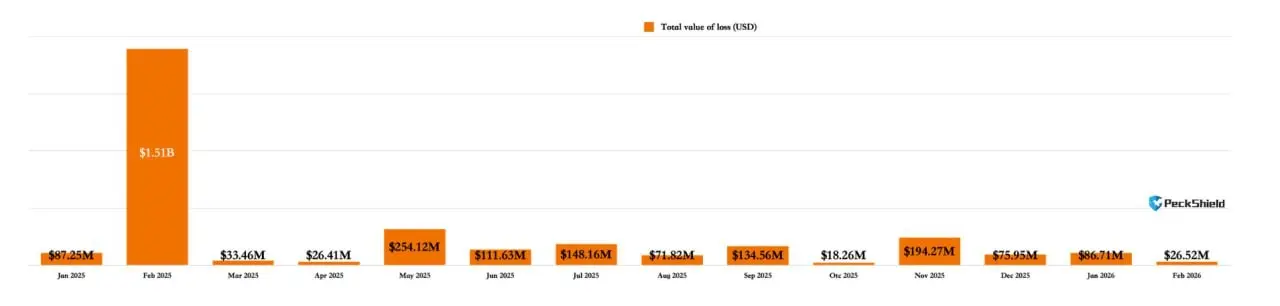
(Source: PeckShield)
In February, there were 15 security incidents, but only two caused the majority of losses, indicating that attacks are becoming more concentrated rather than dispersed.
Largest Crypto Security Incidents in February
YieldBlox (February 21): A price manipulation attack stole $10 million from a DAO-managed lending pool, making it the biggest single incident of the month.
IoTeX (February 21): A decentralized identity protocol lost about $8.9 million due to private key leakage, ranking as the second-largest loss in February.
Total Share: These two incidents combined account for $18.9 million, over 70% of February’s total losses.
Notably, the massive incident in February 2025 when Bybit was hacked for $1.5 billion is not reflected in this report. PeckShield spokesperson noted that this structural factor significantly contributed to the sharp decline in February’s data.
Three Main Reasons for the Decline in Losses and Future Outlook
PeckShield spokesperson told Cointelegraph that early February saw a sharp market correction, with Bitcoin falling below $70,000, shifting industry focus from protocol exploits to institutional deleveraging and algorithmic sell-offs. “During high volatility periods, strategic focus often shifts from protocol vulnerabilities to managing market liquidity,” the spokesperson explained.
Kronos Research analyst Dominick John added that the decline in losses also reflects enhanced risk controls at major trading venues, higher standards for counterparties, and improved real-time monitoring: “Capital is becoming more selective, favoring protocols with mature security frameworks.” He predicts that as audits, monitoring, and institutional risk frameworks mature, losses may continue to decrease throughout the year, with AI-driven code reviews and automated vulnerability scans further accelerating this trend.
However, phishing remains a persistent threat. Despite a significant drop in wallet theft losses in 2025 (from $494 million to $83.85 million), PeckShield warned: “Malicious actors are no longer primarily trying to hack contracts but are increasingly focusing on attacking individuals. For institutions and whale users, multi-signature cold storage solutions are crucial.”
Frequently Asked Questions
Why did crypto losses in February 2026 drop to recent lows?
PeckShield cites three main reasons: the absence of mega-scale attacks like the $1.5 billion Bybit hack in 2025; market volatility shifting hacker strategies from protocol exploits to liquidity manipulation; and continuous security enhancements and risk controls at major trading venues.
What was the biggest crypto security incident in February?
The largest incident was YieldBlox’s price manipulation attack, resulting in a $10 million loss. The second was IoTeX’s private key leak, with about $8.9 million lost. Both occurred on February 21, accounting for over 70% of the month’s total losses.
Will crypto security continue to improve in the future?
Kronos Research analyst Dominick John expects losses to keep decreasing as audits, monitoring, and institutional risk frameworks mature. AI-driven automated vulnerability scans will help detect issues earlier, but the rapidly evolving ecosystem remains a challenge. The shift toward attacking individuals through phishing requires ongoing vigilance.
Related Articles
Sanae Takashi issues a statement regarding "SANAE TOKEN": Not related and unauthorized
Curve Finance: Investigation into sDOLA LlamaLend attack initiated; attacker profits are limited
The US authorities confiscated over 61 million USDT from the "fattening then slaughtering" scam network
South Korea Urgently Reviews Management of Seized Crypto Assets: 22 BTC Lost and 620,000 BTC System Misrecorded Trigger Regulatory Upgrades
National Tax Agency Virtual Asset Leak Incident, Investigation Officially Launched... Security Concerns Once Again Draw Attention