


Beyond Islamic teachings, Iran needs Bitcoin
Author: Zen, PANews
The world’s spotlight is on Iran and the Persian Gulf. External discussions about Iran often revolve around military and regime risks, energy, and shipping disruptions. Mainstream media’s immediate reports focus on military actions, oil and gas facilities, the Strait of Hormuz, and sharp fluctuations in financial markets.
But beneath these grand narratives, if you zoom in on cities like Tehran, Mashhad, and Ahvaz, and focus on ordinary people, you’ll find that during times of heightened tension, the most important things are safeguarding lives and assets.
After the US and Israel launched attacks, the outflow of assets from Iran’s largest cryptocurrency exchange, Nobitex, surged—spiking about 700% within minutes. A Chainalysis report also confirmed that within hours of the attack, the hourly trading volume of crypto assets inside Iran rapidly increased.
In just four days up to March 2, over ten million dollars worth of crypto assets accelerated out of Iran. Iranian citizens are moving their funds through cryptocurrencies to a safer channel.
Iran’s Economy Under the “Dollar Domination”
For Iran, any escalation in Middle East tensions quickly impacts its fragile exchange rates and financial system, and cryptocurrencies have unexpectedly become an important medium.
Over the past few years, Iran’s economy has been sinking deeper into a cycle of external sanctions, internal imbalance, and currency devaluation. The persistent weakening of the rial is no longer just a price change but has become a nationwide social panic.
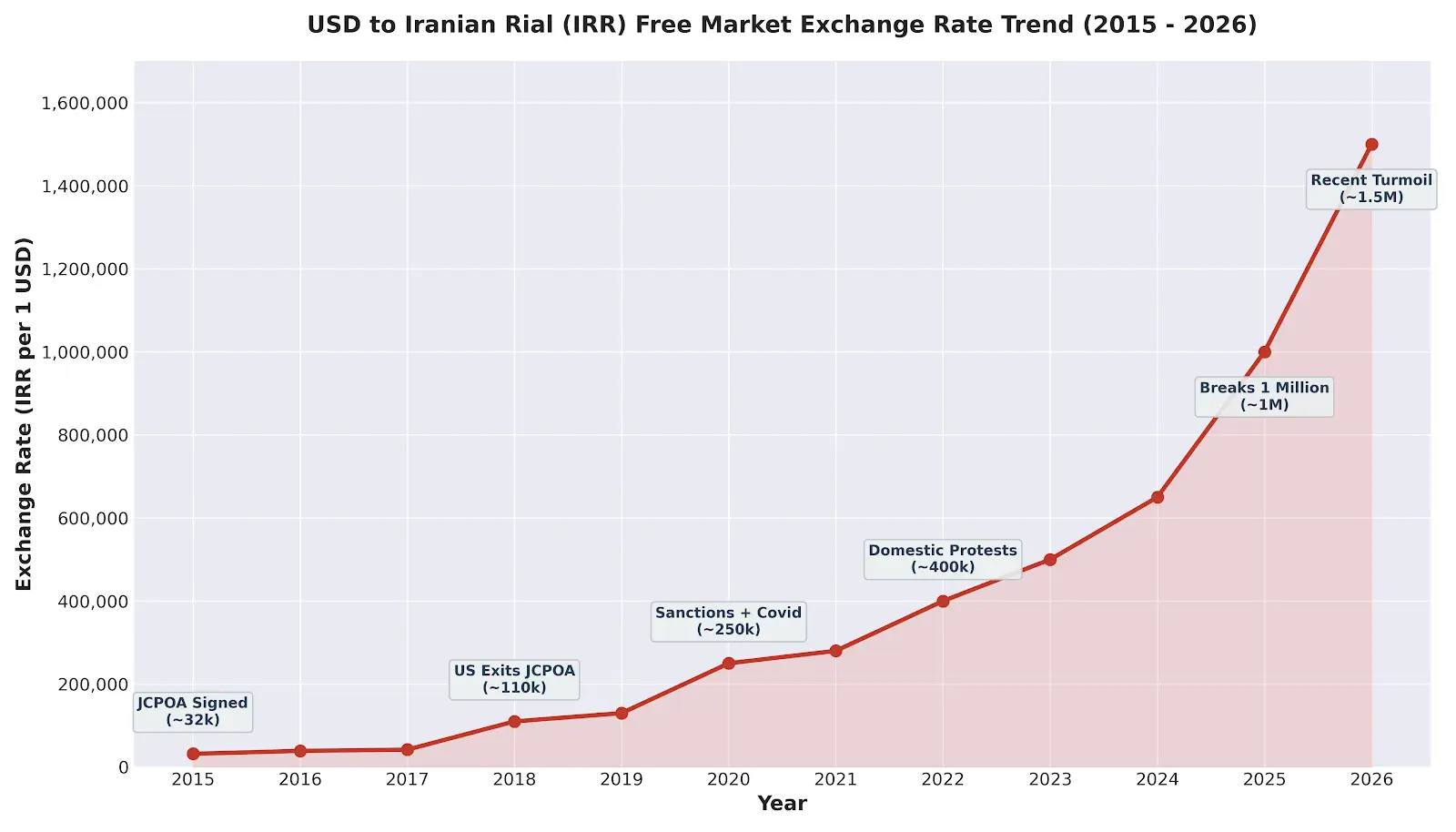
In 2015, after the Iran nuclear deal (JCPOA), markets initially expected sanctions relief: the free market rate was roughly 1 USD to 32,000 rials. But after the US withdrew from JCPOA in 2018 and announced phased sanctions reinstatement, the rial-to-dollar exchange rate quickly moved from several tens of thousands to the “hundred-thousand rial era.” Long-term sanctions, combined with inflation, foreign exchange shortages, and geopolitical conflicts, caused the rial to fall below one million in the first half of last year. During protests earlier this year, it even dropped to a historic low of 1.5 million rials.
In a global financial system centered on the US dollar, Iran—being under sanctions—must face a dollar-dominated, continuously devaluing rial scenario.
The US dollar, as the “hub currency” of global foreign exchange trading, can facilitate stable, low-friction cross-border transactions for imports, debt payments, insurance, shipping, and key component procurement. Even if Iran’s printing presses run wildly and more rials are issued domestically, they cannot replace this critical capability.
In many commodity and supply chain pricing systems, the dollar remains the natural anchor. Under sanctions, Iran finds it harder to access dollar clearing services through normal banking channels, making hard currency access scarce and expensive.
Therefore, many Iranians expect to quickly convert their rial holdings into more reliable assets—cash USD, gold, or cryptocurrencies like Bitcoin and stablecoins such as USDT.
As an Islamic country, Iran’s financial activities must also comply with Sharia law. Islamic teachings prohibit all forms of usury (Riba) and gambling (Gharar), and crypto trading, with its volatility and speculative nature, is viewed with caution.
However, Iran’s former Supreme Leader Khamenei has shown a relatively open attitude toward cryptocurrencies, calling for the adaptation of Sharia law to modern realities. His statements are essentially pragmatic compromises in the face of economic desperation.
From Government to Citizens, Iran’s Cryptocurrency Needs
Due to long-term sanctions and high inflation, both the government and the people are seeking hard currency substitutes in their own ways. This is why crypto assets, represented by Bitcoin and stablecoins, are gradually shifting from speculative tools to essential value-preservation instruments in Iran. They serve as a financial safety valve for citizens and a “cyber bank” for the state to evade sanctions.
Iran’s official stance on cryptocurrencies is a mix of “love and hate, utilization and repression.”
At the national level, when crypto activities help provide alternative channels for import settlements, foreign exchange access, or fund transfers, the government tolerates or even embraces them within certain limits—such as early domestic Bitcoin mining. Crypto also functions as an important part of Iran’s “shadow financial network,” used for moving funds and evading regulation.
According to TRM Labs, over 5,000 addresses linked to the Iranian Islamic Revolutionary Guard Corps (IRGC) have been identified, with an estimated transfer of $3 billion worth of crypto since 2023. British blockchain research firm Elliptic reports that Iran’s central bank has at least $507 million worth of USDT stablecoins as of 2025.
But when cryptocurrencies are seen as accelerating rial devaluation, fueling capital flight, or creating unregulated civilian financial networks, the government quickly tightens controls.
In early 2025, Iran’s central bank (CBI) suddenly “cut off all rial payment channels for crypto exchanges,” leaving over 10 million crypto users unable to buy Bitcoin and other assets with rials. Reports suggest one main goal was to prevent further rial devaluation and stop the currency from being rapidly exchanged into foreign currencies or stablecoins via exchanges.
This move to block fiat currency entry essentially uses administrative measures to cut off the most convenient channels for civilians to convert rials into value. But it doesn’t mean society no longer needs crypto; instead, demand shifts to more gray, dispersed avenues—such as OTC trades, alternative payment accounts, or covert on-chain transfers.
Repeated government crackdowns during currency crises tend to reinforce ordinary people’s preference for “off-system assets.” Every sudden restriction reminds them that financial rules can change at any time, and assets are not fully under personal control.
On the citizen level, crypto demand is driven by three main factors: preservation of value, transferability, and speculation. TRM Labs estimates that 95% of Iran-related fund flows come from retail investors. Iran’s largest exchange, Nobitex, reports 11 million customers, mostly retail and small investors. The exchange states: “For many users, cryptocurrencies mainly serve as a store of value to cope with the ongoing devaluation of the national currency.”
More surprisingly, in mid-2024, Iran saw a nationwide craze over Telegram-based “Tap-to-Earn” crypto games like Hamster Kombat and Notcoin. On Tehran’s subway and streets, countless Iranians frantically tapped their screens, trying to fight soaring prices through free “airdrops.” Reports indicate nearly a quarter of Iran’s population participated in these games. When the national currency loses credibility, even clicking on screens for tiny virtual coins becomes a faint glimmer of hope in darkness.
Thus, a paradox emerges in Iran: on one hand, authorities worry that crypto accelerates rial devaluation and weakens capital controls, so they cut off rial payment channels at critical moments; on the other hand, in a long-term sanctions and foreign exchange shortage environment, cryptocurrencies repeatedly prove their usability. For ordinary Iranians, this usability is crucial—becoming an emergency escape in times of crisis.
Power Struggles and the Growing “Black Miners”
Unlike front-line conflicts involving weapons, Iran has long been engaged in a silent shadow war over electricity resources.
In a country with “scarce social resources,” electricity is no longer just a necessity but has been redefined as a strategic resource ripe for arbitrage. The cost of this arbitrage, however, is borne by ordinary residents, causing severe power shortages.
Despite being a major energy resource country, Iran has long suffered from cycles of power shortages and rolling blackouts. The main reasons are underinvestment in infrastructure, aging generation and transmission systems, and demand surges driven by price subsidies.
In summer 2025, Iran’s Tavanir electricity company publicly stated that crypto mining consumed nearly 2,000 MW—about the output of two Busher nuclear plants. Crucially, mining accounted for about 5% of total electricity use but possibly 15–20% of the current power shortfall.
Tavanir reported that during an internet outage related to conflict with Israel, national electricity demand dropped by about 2,400 MW; they partly attributed this to the offline status of large numbers of illegal miners, with around 900,000 illegal devices shut down—indirect evidence of a large underground mining industry.
The CEO of Tehran Province’s power distribution also said Iran has become the world’s fourth-largest crypto mining hub, with over 95% of active miners operating illegally, making it a “paradise for illegal miners.” This shifts responsibility from the government to ordinary Iranians.
Authorities have been cracking down on illegal mining in recent years, but the problem has only grown. Illegal mining has shifted from a marginal activity to a structural industry, driven by electricity arbitrage, gray protection, enforcement rent-seeking, and complex local interest networks—deeply entrenching privilege.
Religious and military-controlled industrial zones even enjoy free mining power.
“Ordinary citizens and private enterprises cannot access the electricity needed to run and cool such large-scale mining operations,” say industry insiders. Only industrial-scale operations can cause such massive power consumption.
Multiple media and research reports reveal that Iran’s privileged classes dominate this power feast. Religious sites like mosques, legally enjoying extremely cheap or free electricity, have become underground “mining farms.” Meanwhile, military-controlled heavy industrial zones and secret facilities often hide massive mining operations. When elites exploit free “state electricity” to mine Bitcoin, ordinary residents suffering from high inflation can barely keep their fans running on hot summer nights.
Ultimately, Iran’s power crisis and illegal mining are not just security issues but a struggle over subsidy resources, currency devaluation, and survival pressures. Power outages will continue to haunt ordinary households during summer nights.
In the current context of endless geopolitical conflicts and political uncertainty, Iran’s economic future remains shrouded in shadow.
Related Articles
BTC 15-minute sharp decline of 1.60%: Bullish liquidation and risk aversion sentiment intensify short-term selling pressure
Bitcoin Miner MARA Says It May Sell BTC Holdings in Strategy Shift