


XRP Today's News: Cardano Founder Reiterates "Securities" Regulation Sparks Community Controversy
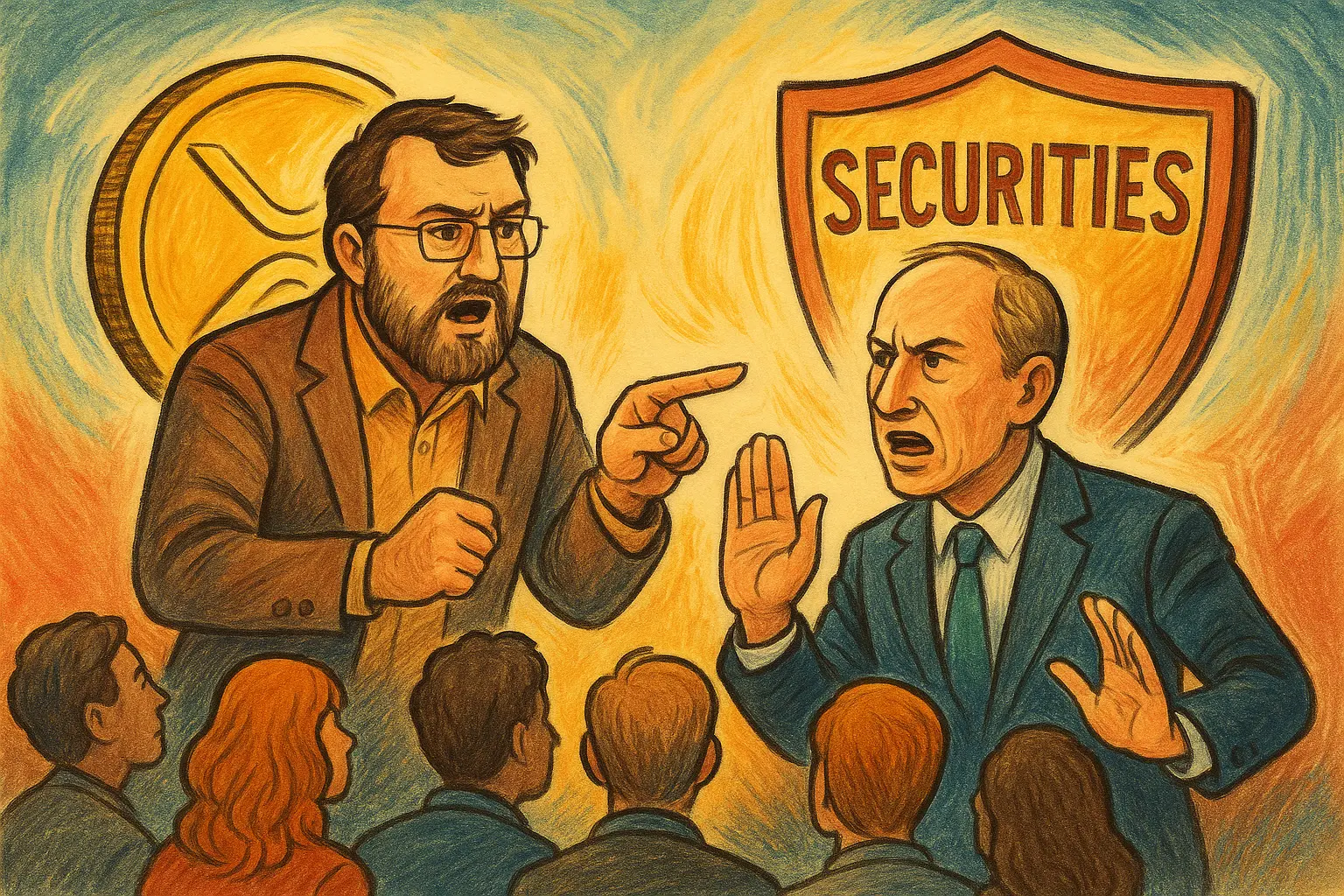
Cardano founder Charles Hoskinson recently publicly criticized Ripple’s stance on the “Clarity Act,” believing that under the current wording of the bill, XRP is very likely to be classified as a “security” at launch. This statement has once again sparked controversy within the XRP community. Meanwhile, technical analysis shows XRP remains trapped in a downtrend channel, with the key support level at $1.30 facing bullish and bearish tests.
Hoskinson’s Core Allegation: Regulatory Classification Triggered by XRP’s Early Structure
Hoskinson’s main argument focuses on XRP’s origin architecture. He points out that early XRP in 2012 was highly centralized around a few founders in terms of network operation and token distribution. The current framework of the “Clarity Act” stipulates that high centralization at the start of a blockchain project could trigger the criteria for classification as a security.
He also issues a broader industry warning: most new tokens will automatically be considered securities upon launch, and only after reaching a certain level of decentralization might they transition into commodities. This sets a potential dangerous precedent for the entire blockchain industry.
In response, Ripple CEO Brad Garlinghouse holds a different view—he has long advocated that even if the regulatory framework is imperfect, clear rules are far better than ongoing uncertainty. Clear regulatory boundaries can reduce enforcement risks caused by ambiguity and provide a clearer path for innovation.
Three Key Perspectives on the XRP Securities Controversy
Hoskinson’s stance: The current wording of the “Clarity Act” could retrospectively classify XRP as a security at issuance, setting a dangerous precedent for the industry.
Garlinghouse’s stance: Clear regulatory rules are more beneficial than uncertainty; Ripple supports legislation for clarity.
Investors’ actual risk: Hoskinson’s comments point to a “hypothetical classification” under the legislative framework, not a direct enforcement threat to XRP’s current market position.
Important background: XRP has undergone years of legal review in the U.S. and has received some favorable rulings. There are no immediate enforcement signals to change the status in the short term.
Technical Analysis: $1.30 as a Key Support/Resistance Level, How Policy Turmoil Affects the Trend
 (Source: Trading View)
Hoskinson’s comments are currently more aligned with regulatory policy debate rather than a direct threat to XRP’s current market position. The actual movement of XRP is still primarily driven by technical bullish and bearish patterns.
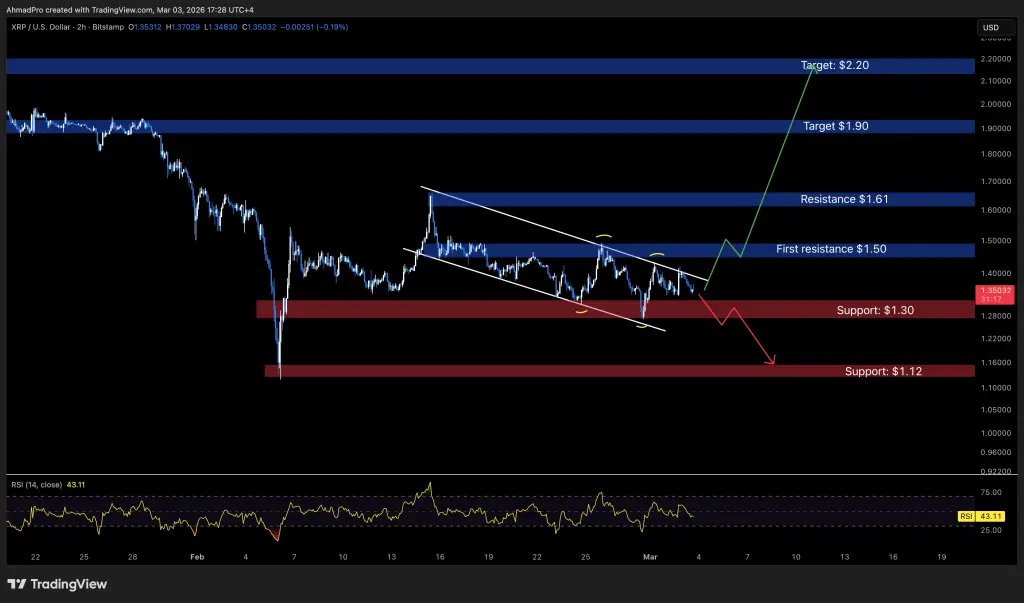
XRP Currently stuck in a downtrend channel, with $1.30 as the recent critical support level. This price has been repeatedly defended, but repeated tests may erode the strength of the support. If $1.30 breaks, the next major demand zone is around $1.12, and a breakdown could accelerate selling pressure.
Bullish traders need to first recover the short-term supply ceiling at $1.50; if they can break and hold above $1.50, then $1.61 becomes the next breakout trigger; a confirmed break above $1.61 would break the downtrend structure, with upside targets at $1.90 and $2.20. Under the combined pressure of policy narratives and technical signals, maintaining caution until a clear breakout or support confirmation appears may be the more prudent approach.
Frequently Asked Questions
Does Hoskinson’s comment pose an immediate threat to XRP investors?
Hoskinson’s comments concern the potential “hypothetical classification” of XRP at issuance under the “Clarity Act” framework, not an enforcement action on its current market status. XRP has completed years of legal review in the U.S. and received some favorable rulings. In the short term, this commentary is more about policy narrative debate rather than an immediate risk investors need to address.
Why is the $1.30 support level so critical for XRP?
$1.30 is a key demand zone that XRP has tested multiple times recently. Each test has seen a rebound, indicating active buying defense. However, repeated testing can weaken support strength—if this level is broken under strong momentum, the next support is around $1.12.
If XRP breaks above $1.61, what are the next targets?
If XRP successfully breaks and holds above $1.61, it will break the current downtrend structure, turning the technical outlook bullish. The next targets are $1.90 and $2.20. However, XRP first needs to recover the short-term supply ceiling at $1.50, which is a prerequisite for any meaningful upward move.
Related Articles
XRP News Today: Ripple Expands Payments Platform as XRP Consolidates Near $1.33 Support
U.S. XRP spot ETF had a total net inflow of $7,525,500 in a single day
ETF Launch Fails to Stem Tide As XRP Sinks to $1.81, Lowest Since April