


Strive's strategist believes that AI-driven deflation could push Bitcoin's price to $11 million by 2036
AI-driven technology inflation could be the catalyst pushing Bitcoin’s value beyond $10 million within the next decade by exerting pressure on central banks to continuously expand the money supply. This is the conclusion from a report by Joe Burnett, a strategist at Strive.
Burnett, currently serving as Vice President of Bitcoin Strategy at Strive, states that significant productivity advances due to AI will lead to lower prices for goods and services, narrowing profit margins, which will force policymakers to maintain an expansionary monetary policy. He predicts that the baseline scenario for Bitcoin is to reach $11 million by the first quarter of 2036.
“My baseline scenario for Q1 2036 is $11 million per Bitcoin,” Burnett writes.
Bold Forecast Based on Ambitious Assumptions
This forecast is built on a series of bold assumptions, including that Bitcoin will account for about 12% of the total global financial assets, while total global assets will grow at an average rate of 7% annually from now until 2036. Currently, Bitcoin makes up only about 0.2% of the total global financial assets. This means Bitcoin’s market capitalization would need to increase over 176 times in the next decade, reaching $230 trillion.
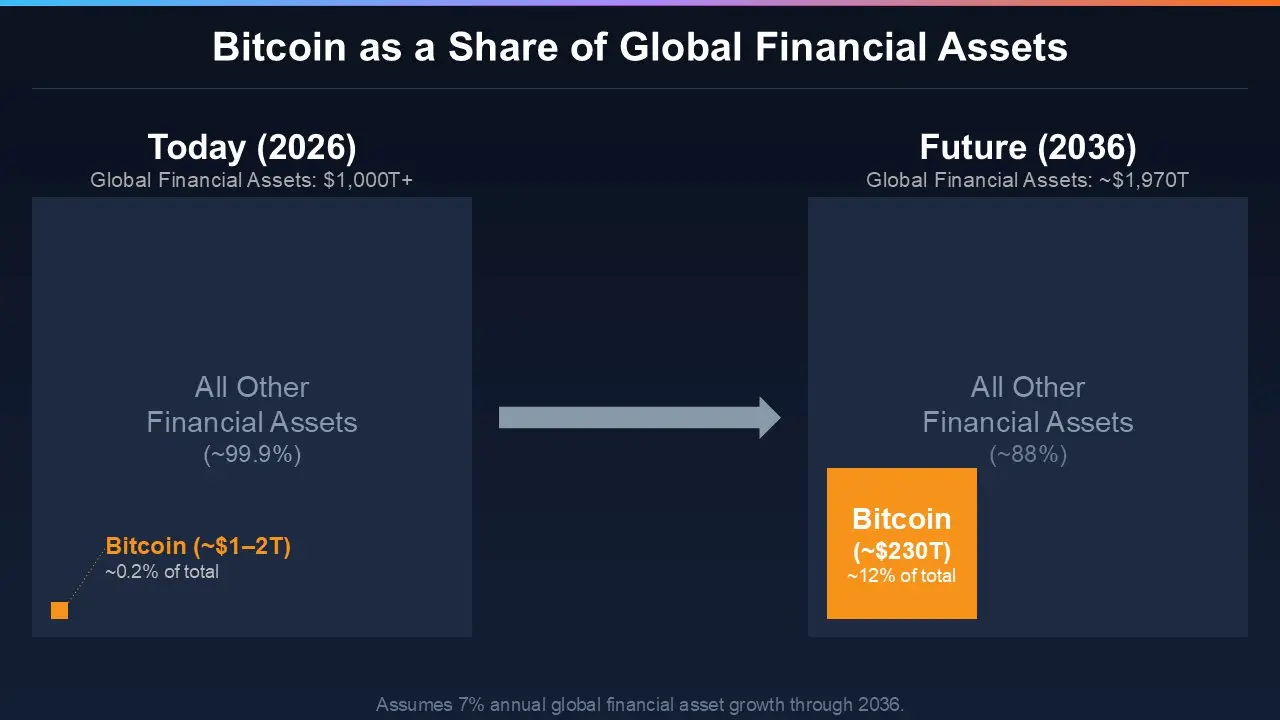 Source: Joe Burnett According to Nic Puckrin, co-founder and chief market analyst at the Coin Bureau educational platform, this forecast implies that Bitcoin will become the dominant global reserve asset, as loose monetary policies continue to influence the economy over the next decade.
“This forecast suggests that Bitcoin will be roughly 10 times larger than the current US M2 money supply, nearly four times the size of the US stock market, and almost double the current global GDP,” Puckrin explains.
The forecast also indicates a compound annual growth rate (CAGR) of about 53% per year. While not unprecedented—Bitcoin achieved an average CAGR of 60% between 2015 and 2024—the growth rate may slow down due to the increasing market capitalization, Puckrin adds.
AI Deflation Tool: A Structural Driver for Monetary Expansion
Burnett’s argument revolves around the concept of an “AI deflation tool,” suggesting that automation and cost reductions driven by AI will create prolonged deflationary pressures.
In a debt-based fiat system, prolonged deflation can strain credit markets, as asset prices and wages fall while debts remain at their nominal value. This could force central banks and governments to inject more liquidity to prevent a deflationary spiral.
“In a debt-based fiat system, prolonged deflation destabilizes credit markets because wages and asset prices decline while mortgage, corporate, and government debts stay at their nominal values,” Burnett explains.
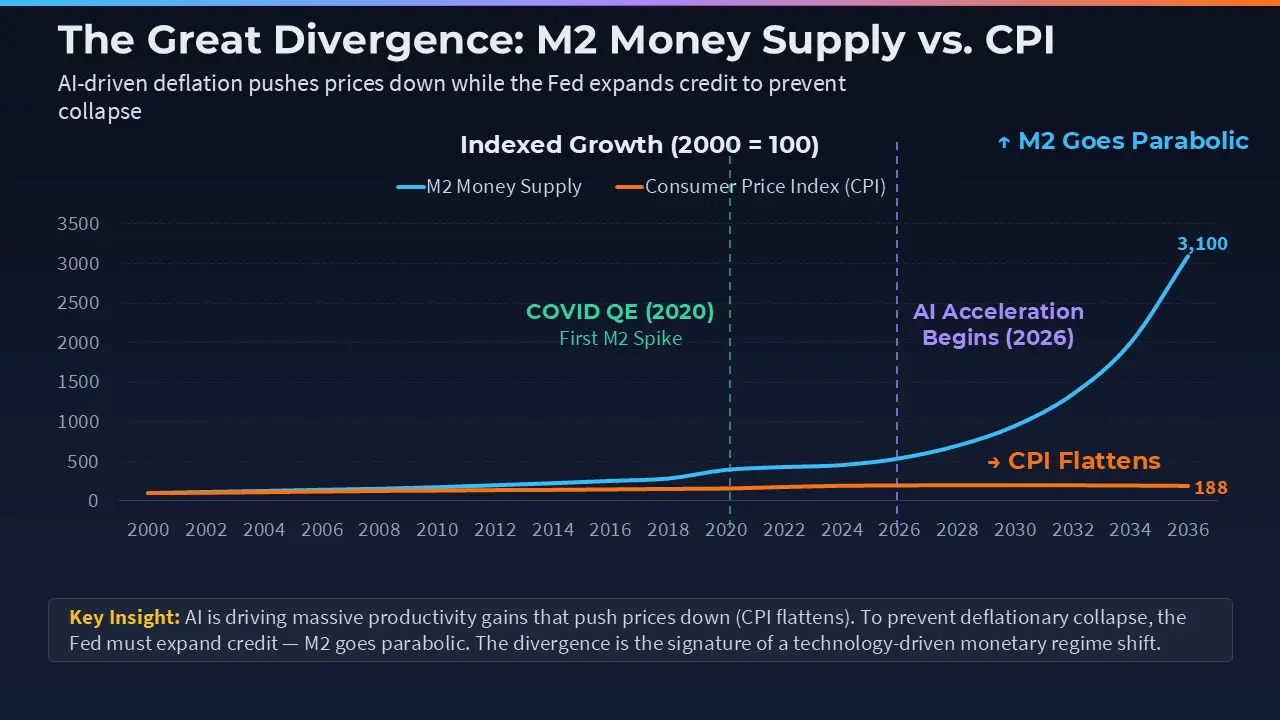 Chart comparing M2 money supply with CPI | Source: Joe Burnett “When AI drives deflation in the real economy, central banks and fiscal authorities will be compelled to expand liquidity to prevent a deflationary cycle.”
Burnett predicts this will lead to a continuous increase in the money supply, especially relative to scarce assets like Bitcoin.
The Rise of Digital Credit: A New Driver for Bitcoin Demand
Additionally, Burnett’s report highlights the emergence of “digital credit” models promoted by companies like Strategy—holder of the largest Bitcoin reserves.
Digital credit provides USD income to investors through publicly traded securities backed by large balance sheets containing Bitcoin. Financial firms use this method to raise capital, thereby accumulating more Bitcoin.
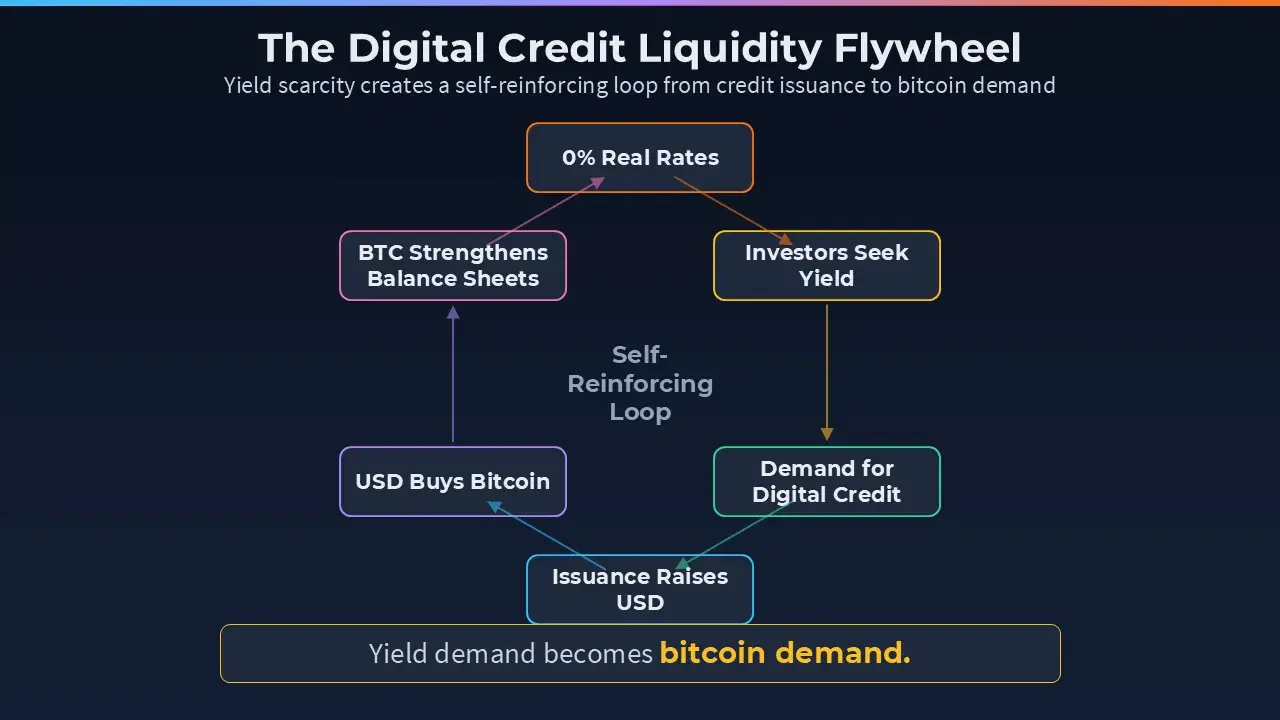 Digital credit liquidity transfer mechanism | Source: Joe Burnett Burnett forecasts that digital credit products will create a “feedback loop” between global yield demand and Bitcoin accumulation, marking the early stages of a credit system built on a verifiable scarce currency.
A Forecast Far Beyond Other Optimistic Scenarios
Although Burnett’s $11 million prediction is highly ambitious, it far exceeds most other optimistic scenarios with shorter timeframes. For example, ARK Invest previously projected Bitcoin reaching $1.5 million by 2030 in an optimistic scenario, and $300,000 in a pessimistic one, according to Coinphoton in November 2025.
Overall, Burnett’s forecast not only presents a bold vision for Bitcoin’s future value but also emphasizes the roles of artificial intelligence and new financial models in shaping the future of the global financial market.
Related Articles
Yesterday, US Bitcoin spot ETF saw a net inflow of $225 million, while Ethereum ETF experienced a net outflow of $10.8 million.
Ray Dalio: Bitcoin is not suitable as a long-term store of value or a hedge asset
Ray Dalio warns of four major weaknesses of Bitcoin: BTC is unlikely to become a hedge asset, and there is only one gold in the world
American Bitcoin Acquires 11,298 ASIC Miners, Expanding Owned Hashrate to 28.1 EH/s