Anthropic released an upgraded version of its flagship model, Claude Opus 4.7, on April 16 (local time). Compared to the previous Opus 4.6 model, Opus 4.7 demonstrates “significant improvements” in advanced software engineering capabilities, particularly on difficult tasks, with enhanced rigor and consistency in complex, long-running operations and improved vision abilities. However, Anthropic deliberately weakened the model’s cybersecurity attack-defense capabilities during training and introduced safety mechanisms to automatically detect and block prohibited or high-risk requests.
Performance and Benchmarks
In benchmark testing, Opus 4.7 achieved scores generally higher than the previous Opus 4.6 and competitor GPT-5.4. However, Anthropic emphasized that Opus 4.7’s overall capabilities do not match the company’s most powerful model, Claude Mythos Preview. According to Anthropic: “By deploying and operating these protective mechanisms in the real world, we will accumulate experience to ultimately enable broader release of Mythos-level models.”
Deployment and Pricing
Opus 4.7 is now live across all Claude products and API interfaces, integrated with Amazon Bedrock, Google Cloud Vertex AI, and Microsoft Foundry services. Pricing remains consistent with Opus 4.6: $5 per million input tokens and $25 per million output tokens.
Token Consumption Changes
Two changes in Opus 4.7 compared to Opus 4.6 will affect token usage. First, Opus 4.7 uses an updated tokenizer, improving how the model processes text. However, this means identical inputs may consume more tokens—approximately 1 to 1.35 times the previous generation’s consumption.
Second, Opus 4.7 performs more reasoning at higher “thinking intensity,” particularly in subsequent rounds of agentic scenarios. This improves reliability on complex problems but generates additional output tokens.
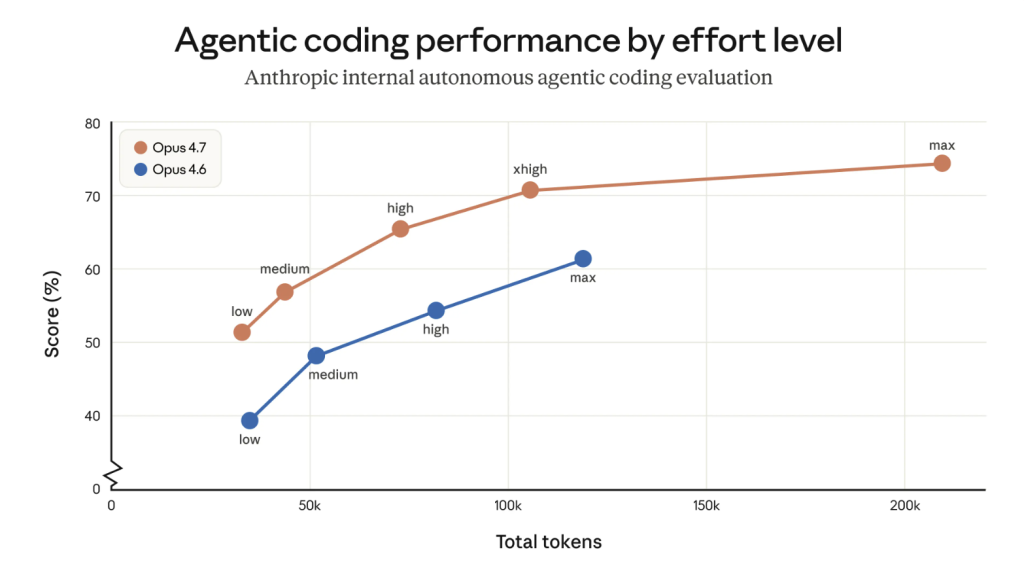 Opus 4.7 token consumption increase. Source: Anthropic
Market Analysis and Context
Analysts characterize Opus 4.7 as a “transitional” model. Investment analyst Adam Button noted that the Opus 4.7 release reinforces Anthropic’s narrative around “godlike models” like Mythos and confirms market skepticism: publicly available paid models are essentially “lite” versions constrained by safety mechanisms.
Company Background and Financial Milestone
Anthropic, founded in 2021 by former OpenAI employees, develops the Claude series of large language models. On April 6, Anthropic announced its annualized revenue (ARR) exceeded $300 billion, a significant increase from $9 billion at the end of 2025. The company is actively pursuing an initial public offering.
Cybersecurity Risk Concerns
Anthropic executives have repeatedly warned about AI’s impact on cybersecurity. According to reports dated April 10 (local time), U.S. Treasury Secretary Yellen and Federal Reserve Chair Powell held an emergency meeting with Wall Street leaders on April 7 to discuss how Anthropic’s latest Mythos AI model could heighten cybersecurity risks. Anthropic has stated that Mythos is not suitable for public release because the model could be misused by cybercriminals and spies. The company is selectively providing access to Mythos to leading global cybersecurity and software enterprises.
Disclaimer: The information on this page may come from third parties and does not represent the views or opinions of Gate. The content displayed on this page is for reference only and does not constitute any financial, investment, or legal advice. Gate does not guarantee the accuracy or completeness of the information and shall not be liable for any losses arising from the use of this information. Virtual asset investments carry high risks and are subject to significant price volatility. You may lose all of your invested principal. Please fully understand the relevant risks and make prudent decisions based on your own financial situation and risk tolerance. For details, please refer to
Disclaimer.
Related Articles
V4-Pro Achieves 67% Coding Pass Rate in Internal Dogfooding Test, Approaching Opus 4.5 Performance
Gate News message, April 24 — V4 has publicly disclosed internal dogfooding data for its V4-Pro model. The company collected approximately 200 real-world engineering tasks from over 50 engineers, covering feature development, bug fixes, refactoring, and diagnostics across tech stacks including
GateNews15m ago
UK Eyes Anthropic AI to Strengthen Banking Cybersecurity
The United Kingdom is exploring a major step in financial cybersecurity by working with AI firm Anthropic. Early discussions suggest the government may deploy Anthropic’s advanced Claude Mythos model across banks and financial institutions. This move aims to improve defenses as cyber threats
CryptometerIo20m ago
China's IP Office Adds AI, Semiconductors, and Brain-Computer Interfaces to Fast-Track Protection Program
Gate News message, April 24 — China's National Intellectual Property Administration announced on April 24 that it will establish comprehensive intellectual property protection for emerging technologies through institutional reforms, enhanced services, and expanded applications. The administration wi
GateNews26m ago
US Government Operating Bitcoin Node Without Mining, Admiral Indicates
A senior admiral has indicated that the US Government is actively operating a node on the Bitcoin network while deliberately avoiding participation in mining activities. The disclosure suggests that authorities are taking a more involved role in blockchain infrastructure for oversight and
CryptoFrontier43m ago
Tesla Q1 Revenue Rises 16% to $22.4B; Humanoid Robot Debut Planned for Mid-2026
Gate News message, April 24 — Tesla reported first-quarter revenue of US$22.4 billion on April 23, representing a 16% year-over-year increase. The company's global vehicle deliveries exceeded 358,000 units, while production topped 408,000 units.
Tesla's Shanghai Gigafactory delivered 213,000 vehicl
GateNews43m ago


