
The Trump administration made a rare intervention on April 2 in a regulatory dispute involving prediction markets—U.S. Commodity Futures Trading Commission (CFTC) and the U.S. Department of Justice (DOJ) filed federal lawsuits against the states of Illinois, Connecticut, and Arizona, directly challenging the gambling regulators in those three states. The CFTC’s core legal argument is that under the Commodity Exchange Act (CEA), the federal government has exclusive jurisdiction over “designated contract markets (DCMs),” and state governments may not interfere.
The lawsuit’s trigger: the 2025 stop-letter blowup ignited the federal counterattack
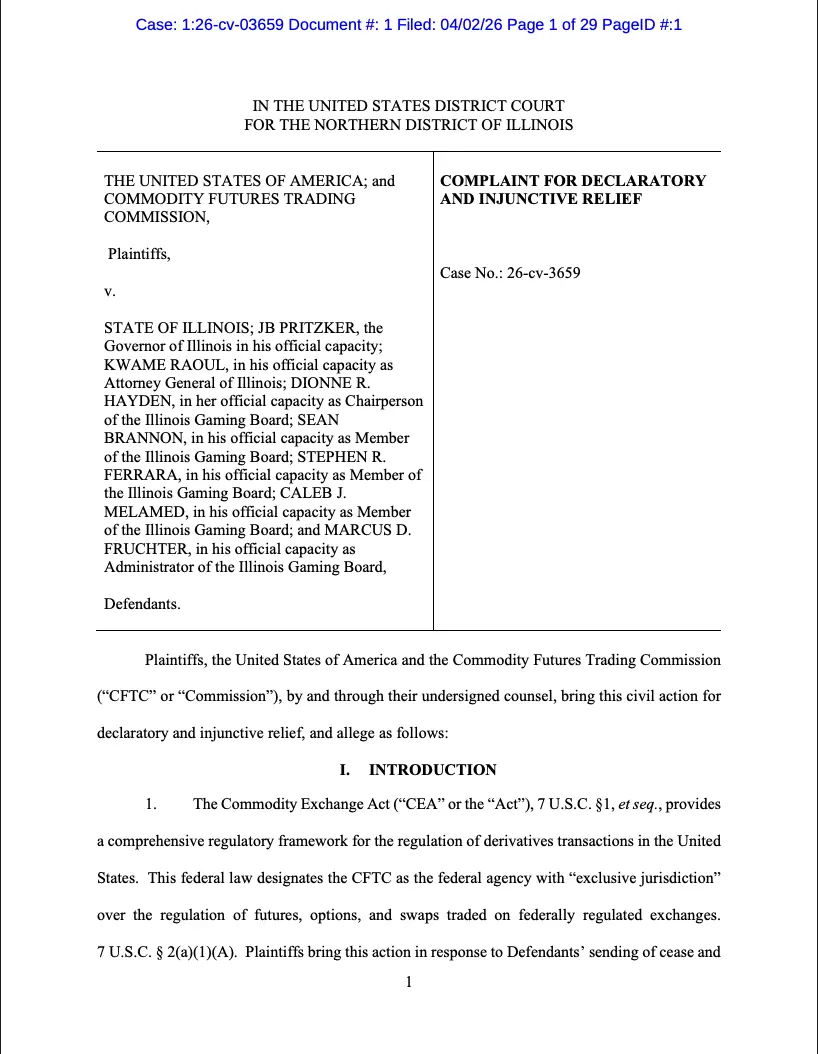 (Source: CourtListener)
The spark for this lawsuit began in 2025. Gambling regulators in multiple states, including Illinois, Connecticut, and Arizona, sent stop letters one after another to prediction market platforms such as Kalshi and Polymarket, claiming that the event contracts offered by these platforms violate state gambling laws and licensing requirements.
The Illinois lawsuit targets Governor JB Pritzker, Attorney General Kwame Raoul, and the Illinois Gaming Board. In its court filings, the CFTC accuses the Illinois Gaming Board of “overreaching,” attempting to reclassify event contracts that are subject to federal regulation as “bets” or “sports wagering,” rather than as the asset swaps required by law. The court filings state plainly: “Unless the court restrains and prohibits the defendants, they are very likely to continue trying to undermine federal law and the exclusive jurisdiction that Congress granted the CFTC over event contract swaps.”
The CFTC’s legal argument: why it is federal jurisdiction, not states’ jurisdiction
In all three lawsuits, the CFTC has consistently argued that it has “exclusive jurisdiction” over DCMs. The core pillars of the legal framework are as follows:
Legal basis: The Commodity Exchange Act (CEA) clearly authorizes the CFTC to conduct unified regulation of nationwide derivatives markets, and event contracts and prediction market platforms fall within its regulatory scope
Historical precedent: The CFTC argues that in 1992 it was “first formally recognized” for event contracts, and decades of regulatory practice have established the existing federal jurisdictional framework
National uniformity: Inconsistent state regulatory requirements would create contradictory obligations and systemic uncertainty for market participants operating across jurisdictions, harming the normal operation of the nationwide market
Congressional authorization: The CFTC argues that Congress designed a nationwide swap market regulatory mechanism that gives the CFTC the only regulatory authority over such markets
CFTC Chairman Mike Selig said, “These states’ aggressive interventions create market uncertainty and may have destabilizing effects on market participants and our registrants. The CFTC will continue to defend its exclusive regulatory authority over these markets.”
11 states have taken action: a broader regulatory front is forming
The states that have taken legal action against prediction market platforms so far include: Arizona, Nevada, Illinois, Maryland, New Jersey, Montana, Ohio, Connecticut, Tennessee, New York, and Massachusetts—11 states in total—showing that this three-state lawsuit is only a snapshot of a broader conflict landscape.
Legislative pressure at the congressional level is also forming—some lawmakers are pushing proposals attempting to ban sports event contracts and prevent political insiders from participating in war-related prediction markets—showing that regulatory tightening signals from multiple directions are being reinforced in tandem. The CFTC has issued a “Proposed Rulemaking Pre-Notification,” and it is expected to further strengthen the federal jurisdictional framework through a more standardized path.
Frequently Asked Questions
Why does the CFTC claim it has “exclusive jurisdiction” over prediction markets?
The CFTC cites the Commodity Exchange Act (CEA), arguing that Congress has established a unified nationwide derivatives regulatory framework and granted the CFTC the sole regulatory authority over designated contract markets (DCMs). States trying to regulate these federally authorized markets through gambling regulations, as a matter of law, violates the Supremacy Clause and the overarching principle of federal law—this is the core argument advanced by the CFTC.
What does this lawsuit mean for platforms like Kalshi and Polymarket?
If a federal court rules that the CFTC has exclusive jurisdiction, it would effectively prevent states from sending stop letters to these platforms or imposing operating restrictions, providing clearer legal protection for the lawful operation of prediction markets across the United States. Conversely, if the states’ position is upheld, prediction market platforms could face systemic cross-state compliance challenges, with operating costs and uncertainty rising significantly.
Could the regulatory actions by 11 states cause prediction markets to stop operating in parts of the United States?
That risk is real before a final ruling is issued by the federal courts. States’ stop letters and regulatory pressure could still interfere with prediction market platforms. The urgency of the CFTC’s lawsuit is partly because it aims to use judicial confirmation of federal jurisdiction before more states take action, preventing the regulatory landscape for prediction markets from further fragmenting.
Disclaimer: The information on this page may come from third parties and does not represent the views or opinions of Gate. The content displayed on this page is for reference only and does not constitute any financial, investment, or legal advice. Gate does not guarantee the accuracy or completeness of the information and shall not be liable for any losses arising from the use of this information. Virtual asset investments carry high risks and are subject to significant price volatility. You may lose all of your invested principal. Please fully understand the relevant risks and make prudent decisions based on your own financial situation and risk tolerance. For details, please refer to
Disclaimer.


