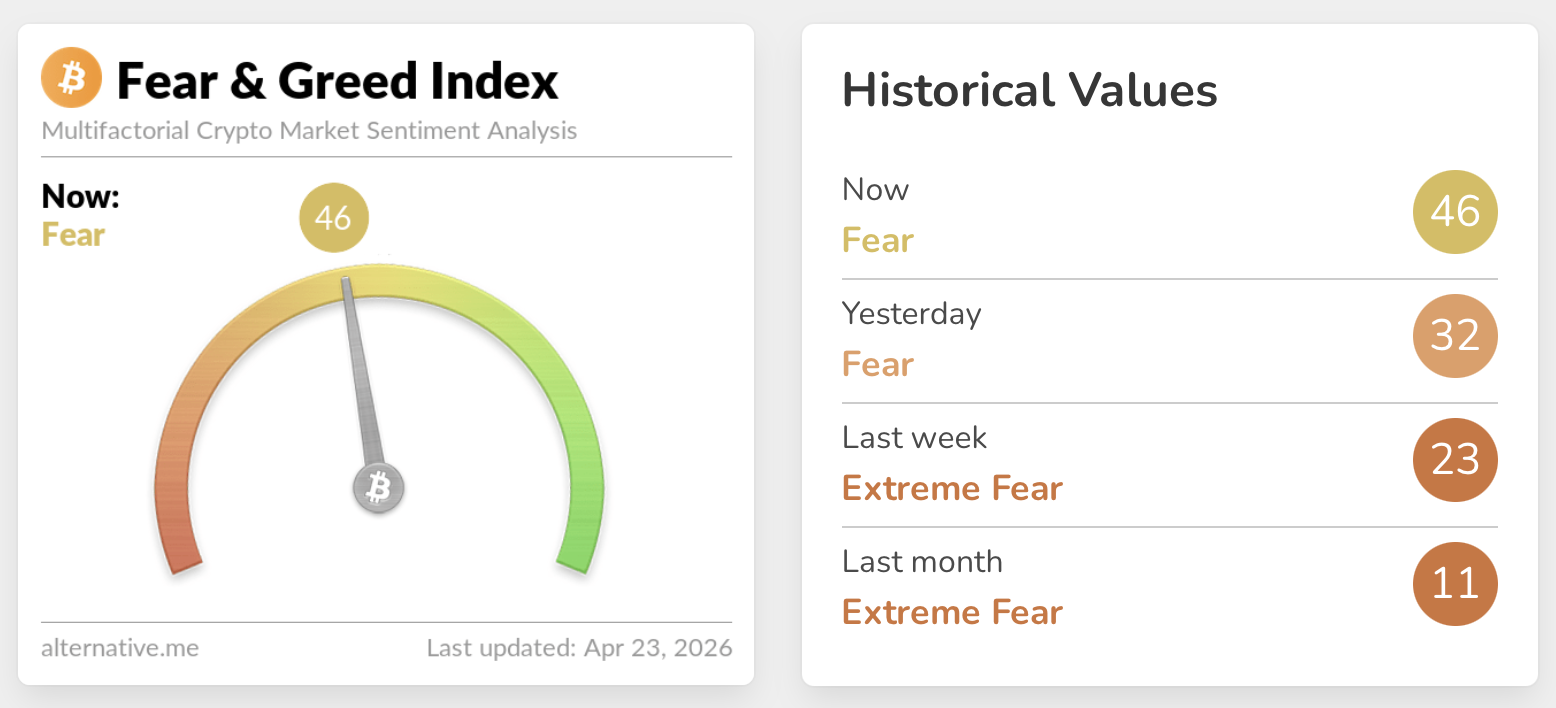
The Crypto Market Fear and Greed Index has climbed to its highest level since January 18, reaching 46 over the past 24 hours, according to data from Alternative.me. This represents a 14-point jump from the previous day and marks the largest single-day increase recorded so far this year, signaling a notable shift in market sentiment despite the index remaining in the “fear” zone.
Sentiment Recovery and Capital Inflows
The current recovery reflects a gradual build rather than a sudden shift. The uptrend began around April 13, when the index dropped to 12, one of its weakest levels this year, before steadily improving in the weeks that followed. Sharp increases of this nature typically point to rising social engagement and renewed attention toward crypto assets, though sentiment has struggled to break out of the fear range since mid-January.
 Source: Alternative.me
This shift in sentiment has coincided with a quiet but steady return of capital into the market. Since April 13, total crypto market capitalization has expanded by $193.13 billion, rising 8.13% to $2.58 trillion, a level that has previously acted as a resistance zone. Flows into crypto investment products further support this trend. Recent data shows that total crypto exchange-traded products attracted $1.4 billion in inflows, the highest weekly figure since January, extending a three-week streak of positive flows largely driven by U.S.-based investors.
Macro Drivers of Recovery
Macro conditions have played a key role in this improvement. Easing geopolitical tension between the United States and Iran, following a ceasefire with no immediate escalation, has helped stabilize broader risk sentiment. This has encouraged renewed capital allocation from institutional investors, particularly in the U.S., alongside corporate and retail participation.
Speculative Positioning and Downside Risks
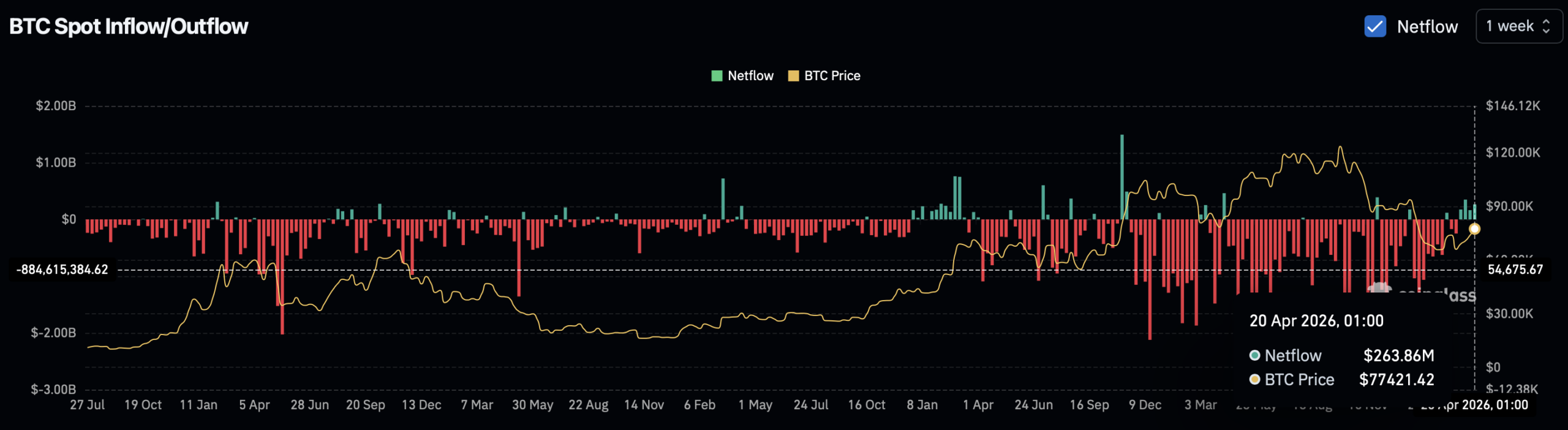
Underlying risks remain evident, particularly as on-chain data points to a market increasingly driven by speculative activity, most notably in Bitcoin trading around $77,000. Demand across derivatives markets has surged relative to spot activity, with perpetual futures leading the current move. This divergence mirrors conditions seen in early January, when Bitcoin approached $98,000 before facing a sharp pullback.
Such a setup raises the likelihood of a repeat pattern, where profit-taking in leveraged markets spills over into broader selling pressure. Early signs of this dynamic are already visible, with spot netflow data showing $263 million in realized selling over the past day.
 Source: CoinGlass
Market Analyst Perspectives
Caution from market analysts reinforces this view. João Wedson of Alphractal maintains that the broader market structure has yet to confirm a transition into a sustained bull phase. “This bear market may last a bit longer. At least another five to six months is what I believe,” he said. His outlook draws on the relationship between long-term and short-term holder realized prices. Historically, a confirmed bull cycle has followed a crossover between these metrics, a condition that has yet to materialize in the current market.
Still, not all market participants share this cautious stance. Tom Lee, chairman of Bitmine, argues that the crypto market may be approaching the end of what he describes as a “mini crypto winter.” The firm recently increased its exposure to Ethereum to 4.12% following its latest purchase, reflecting growing confidence in a near-term recovery. According to Bitmine’s outlook, the market could be entering a relief phase, with the firm positioning early through continued accumulation.
Disclaimer: The information on this page may come from third parties and does not represent the views or opinions of Gate. The content displayed on this page is for reference only and does not constitute any financial, investment, or legal advice. Gate does not guarantee the accuracy or completeness of the information and shall not be liable for any losses arising from the use of this information. Virtual asset investments carry high risks and are subject to significant price volatility. You may lose all of your invested principal. Please fully understand the relevant risks and make prudent decisions based on your own financial situation and risk tolerance. For details, please refer to
Disclaimer.
Related Articles
Bitcoin Futures Open Interest Declines 5.74% in 24 Hours, Total Positions at $60.08B
Gate News message, April 23 — According to Coinglass data, Bitcoin futures open interest across all exchanges fell 5.74% over the past 24 hours, with total positions now standing at $60.08 billion.
Among major platforms, a leading CEX
GateNews1h ago
Bitcoin and Ethereum Options Worth $98.7B Set to Expire
Gate News message, April 23 — Bitcoin and Ethereum options with a combined notional value of $98.7 billion are set to expire this month. According to on-chain data, 109,000 BTC options will expire with a put-call ratio of 0.93 and a maximum pain point of $72,000, representing a notional value of $85
GateNews2h ago
Morgan Stanley Purchases 143.34 BTC Worth $11.17 Million
Gate News message, Morgan Stanley bought 143.34 BTC worth $11.17M around an hour ago. Now they hold 1.964K BTC worth $153.41M.
GateNews2h ago
Bitcoin Falls to $78,326 After Trump Issues Military Warning Over Iran Strait
Gate News message, April 24 — Bitcoin retreated to approximately $78,326 on Thursday after U.S. President Donald Trump issued a military warning to Iran, stating he had ordered the U.S. Navy to "shoot and kill" any Iranian vessels placing mines in the Strait of Hormuz. The pullback followed a rally
GateNews3h ago
Grayscale Transfers 3,817 ETH and 210 BTC Worth $25.02M to Institutional Custody Platform
Gate News message, April 23 — Grayscale transferred a total of 3,817 ETH and 210.006 BTC to an institutional custody platform approximately 40 minutes ago, according to market sources.
The combined transfer was valued at approximately $25.02
GateNews4h ago


