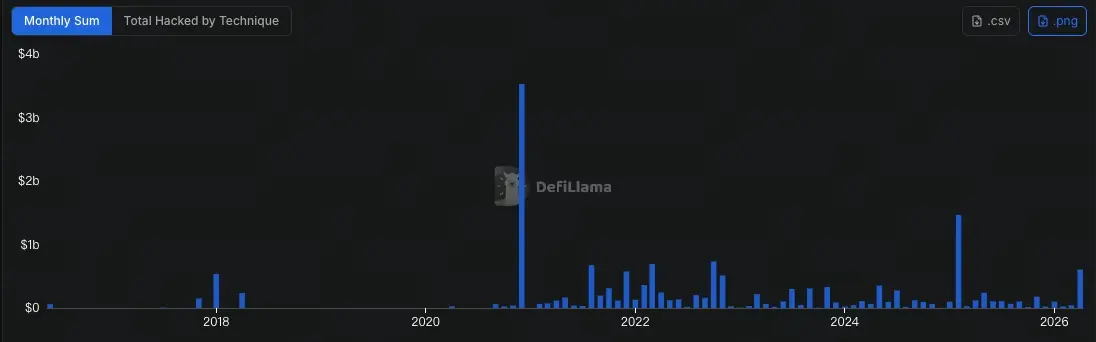
In April 2026, within just 20 days, crypto protocols lost more than $606 million due to hacker attacks, setting the harshest single-month loss record since the February 2025 $1.4 billion data breach at exchanges. KelpDAO and Drift Protocol accounted for 95% of the April losses combined, and for 75% of the $771.8 million total losses through 2026 to date.
Monthly data: April losses far exceed the combined total of the first three months
(Source: DefiLlama)
Based on DefiLlama’s tracked data, hacker-attack losses in 2026 by month are as follows:
January: 12 incidents, losses of $100.1 million
February: 8 incidents, losses of $24.2 million
March: 15 incidents, losses of $41.3 million
April (through April 18): 12 incidents, losses of $606.2 million
Since February 2025, the loss scale in each month has remained below $240 million. April’s loss pattern clearly points to attackers systematically shifting their targets to DeFi infrastructure—unlike the single, major CEX attack in 2025, this time both major attacks targeted DeFi’s cross-chain bridges and lending protocols.
Attack pattern shifts: from CEX to full-scale penetration of DeFi infrastructure
KelpDAO’s LayerZero cross-chain bridge was attacked, resulting in losses of more than $290 million, making it the largest DeFi incident so far in 2026; Drift Protocol suffered losses of $285 million, following closely behind. In addition, in recent April there were a series of incidents, including Vercel, Hyperbridge, Grinex Exchange, and Rhea Finance, indicating that the attack surface is being systematically expanded to multiple infrastructure layers across the DeFi ecosystem.
In terms of frequency, in the first 4.5 months of 2026 there were 47 hacker attacks in the crypto space, compared with 28 attacks in the same period in 2025—an approximately 68% year-over-year increase.
DeFi TVL under pressure, market confidence worsens
After the Kelp incident, DeFi’s total value locked (TVL) fell by more than 7% within 24 hours. Aave’s TVL dropped from $26.4 billion to nearly $17.9 billion. One analyst issued a warning: “Until risk can be priced in reasonably, DeFi is still a niche market; and right now, we’re still far from that goal.”
Frequently Asked Questions
Why are the crypto hacker losses in April 2026 so unusual?
The main reason for the severity of the April losses is that the two attacks—KelpDAO ($290 million) and Drift Protocol ($285 million)—combined to about $575 million, accounting for 95% of April’s total losses. Both attacks targeted DeFi’s core infrastructure—cross-chain bridges and lending protocols—exploiting vulnerabilities in smart contracts and cross-chain message verification, making them highly technical, targeted attacks.
How exactly did the attacks on KelpDAO and Drift Protocol occur?
KelpDAO’s LayerZero cross-chain bridge was attacked, and the attacker forged cross-chain messages to extract rsETH tokens. Drift Protocol also suffered a security vulnerability; in both cases, multiple DeFi protocols have already triggered emergency security response measures, including freezing related assets and temporarily pausing LayerZero bridge functions, among others.
What impact does a 68% year-over-year increase in DeFi attack frequency have on the broader crypto market?
Analysts view the systematic rise in attack frequency as an important signal that DeFi’s risk pricing has not yet kept pace with the rate at which vulnerabilities in underlying infrastructure are being exposed. The continuously accumulating security incidents not only directly erode TVL, but also create an ongoing barrier to institutional adoption of DeFi, which may have far-reaching effects on the long-term development trajectory of the entire DeFi ecosystem.
Disclaimer: The information on this page may come from third parties and does not represent the views or opinions of Gate. The content displayed on this page is for reference only and does not constitute any financial, investment, or legal advice. Gate does not guarantee the accuracy or completeness of the information and shall not be liable for any losses arising from the use of this information. Virtual asset investments carry high risks and are subject to significant price volatility. You may lose all of your invested principal. Please fully understand the relevant risks and make prudent decisions based on your own financial situation and risk tolerance. For details, please refer to
Disclaimer.
Related Articles
Pay attention to the signed content! Vercel is hit with ransomware demanding $2 million, and crypto protocol frontend security raises a red flag
The cloud development platform Vercel was breached by hackers on April 19. The attackers gained access through a third-party AI tool used by employees and threatened to extort $2 million. Although sensitive data was not accessed, other data may have been used. The incident has raised security concerns in the crypto community, and Vercel is currently investigating while advising users to rotate their keys.
ChainNewsAbmedia1h ago
KelpDAO Loses $290M in Lazarus Group LayerZero Attack
KelpDAO faced a $290 million loss due to a sophisticated security breach linked to the Lazarus Group. The attack exploited configuration weaknesses in their verification system and highlighted the risks of relying on a single-point verification setup. Industry experts emphasize the need for improved security configurations and multi-layer verification to prevent future incidents.
CryptoFrontier2h ago
LayerZero responds to Kelp DAO’s 292 million incident: it indicates that Kelp set up a custom 1-of-1 DVN configuration, and the attacker was North Korea’s Lazarus.
LayerZero issued a statement regarding the $292 million hack suffered by Kelp DAO, accusing Kelp’s self-selected 1-of-1 DVN configuration of making the incident possible. The attacker was the North Korean Lazarus Group. LayerZero emphasized that this incident stems from configuration choices and that it will no longer support this kind of vulnerable setup. In addition, responsibility is still disputed, and no compensation plan has been provided.
ChainNewsAbmedia2h ago
Vercel Breach Linked to AI Tool Context.ai Compromise Raises Risk for Crypto Frontends
Vercel confirmed a security breach caused by a compromised AI tool, leading to the theft of employee and customer data. The incident poses risks to the Web3 ecosystem, and the attacker is attempting to sell the stolen data for $2 million. Vercel is addressing the situation with law enforcement and incident response experts.
GateNews2h ago
Ripple CTO: Kelp DAO Exploit Reflects Bridge Security Trade-Offs
David Schwartz, CTO Emeritus at Ripple, analyzed bridge security vulnerabilities following the $292 million Kelp DAO exploit. He noted that providers prioritized convenience over robust security, undermining essential protective features. The Kelp DAO breach stemmed from a private key leak, exacerbated by a simplified security configuration in their LayerZero implementation.
CryptoFrontier5h ago
rsETH LayerZero bridge hacked, Aave and other protocols urgently freeze funds
Kelp DAO’s liquidity re-staking token rsETH was attacked on April 19 by a hacker exploiting a cross-chain message verification vulnerability, resulting in 116,500 rsETH being released to an address controlled by the attacker. Multiple DeFi protocols urgently froze related functions to address potential losses. LayerZero stated that it is actively fixing the vulnerability and will release a post-incident analysis report.
MarketWhisper5h ago


