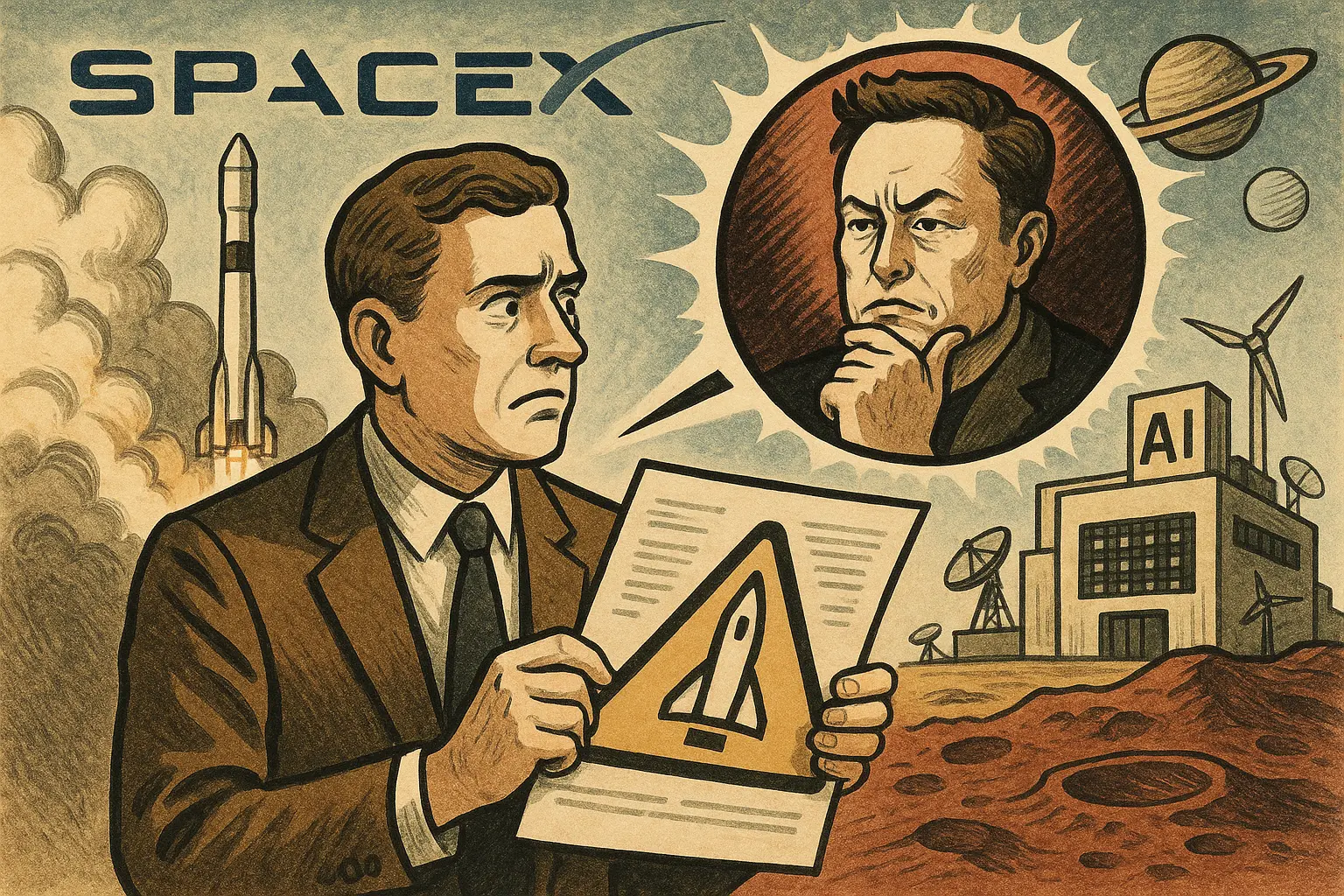
According to a report by Reuters on April 22, SpaceX, in a draft of its soon-to-be-filed S-1 registration statement, issued a warning to potential investors, saying that its plans to develop space AI data centers and to industrialize the Moon and interplanetary space are “still in the early stages,” involving “significant technical complexity and unproven technologies,” which “may not achieve commercial viability.” This stands in sharp contrast to the optimism expressed publicly by its CEO, Musk, this year.
Three Core Key Risks Disclosed in the Prospectus
Inherent Dangers of the Space Environment: The document says that any future AI orbital data centers would operate in “harsh and unpredictable outer space environments,” facing widespread and unique space-related risks that could lead to equipment failure or complete shutdown.
Severe Reliance on Starship: The prospectus clearly states that if there are “any failures or delays” in the scaled development of Starship or in achieving the required launch cadence, reusability, and related capabilities, it “would delay or limit the ability to execute its growth strategy.” Starship has already experienced multiple delays and test failures to date.
Uncertainty About Commercial Viability: The prospectus directly acknowledges that the space AI computing and interplanetary industrialization plans may “fail to achieve commercial viability,” which is a rare case of such public acknowledgment of commercial uncertainty in legal filings by a company in this kind of cutting-edge technology.
The Gap Between Musk’s Public Statements and the S-1 Filing
SpaceX’s cautious internal expectations, as presented in its IPO prospectus, differ significantly from Musk’s recent public remarks. Earlier this January, Musk told the World Economic Forum in Davos that building AI data centers in space is “a no-brainer,” and said that within two to three years, space would become the most economically effective place to deploy AI. After he announced the merger between SpaceX and xAI in February, he went further, saying that “AI in space is clearly the only scalable path.”
As a statutory filing under U.S. securities law, the prospectus’s risk-factor disclosure is both a way to inform investors of potential risks and a tool to protect the company from future legal liability. It is typically more conservative than external public statements made by management.
SpaceX IPO Snapshot: Valuation of $1.75 Trillion, $75 Billion in Funding
SpaceX plans to complete its IPO within the next several months, targeting a valuation of about $1.75 trillion and raising $75 billion. If successful, it would become the largest IPO in history. Starship, at the core of the company’s growth strategy, is designed to significantly reduce launch costs for Starlink satellites, space data centers, and crewed lunar landing missions.
Frequently Asked Questions
Why is SpaceX’s IPO prospectus so cautious, compared with Musk’s optimistic remarks?
Under U.S. securities law, the S-1 registration statement must disclose comprehensive risk factors to inform investors of potential risks and protect the company from future legal claims. Therefore, the prospectus’s risk warnings are usually framed in more conservative language than what management has publicly stated, and should not be taken as directly equivalent to the company’s actual level of strategic confidence.
How do Starship delays affect SpaceX’s space AI plans?
The prospectus makes clear that the scaled development of Starship is the fundamental prerequisite for space AI data centers and the interplanetary program. If there are any failures or delays in Starship’s launch cadence or reusability, it would directly slow down the space AI growth strategy, while also affecting the deployment cadence of Starlink’s satellites.
What are the scale and expected timeline for SpaceX’s IPO?
SpaceX plans to complete its IPO by 2026, targeting a valuation of about $1.75 trillion and raising $75 billion. If successful, it would become the largest IPO in history, surpassing Saudi Aramco. The specific listing date has not been announced. SpaceX has not offered any public comments on the details of the prospectus.
Disclaimer: The information on this page may come from third parties and does not represent the views or opinions of Gate. The content displayed on this page is for reference only and does not constitute any financial, investment, or legal advice. Gate does not guarantee the accuracy or completeness of the information and shall not be liable for any losses arising from the use of this information. Virtual asset investments carry high risks and are subject to significant price volatility. You may lose all of your invested principal. Please fully understand the relevant risks and make prudent decisions based on your own financial situation and risk tolerance. For details, please refer to
Disclaimer.
Related Articles
Tesla Q1 Revenue Reaches $22.4B, Beats EPS Estimates Despite Missing Top-Line Guidance
Gate News message, April 22 — Tesla reported first-quarter 2026 revenue of $22.39 billion, representing 16% year-over-year growth but falling slightly short of Wall Street's $22.64 billion consensus estimate. However, the company exceeded earnings expectations, posting adjusted earnings per share of
GateNews12m ago
IBM Stock Falls 8% in After-Hours Trading
Gate News message, April 22 — IBM shares declined 8% during after-hours trading on Tuesday.
GateNews1h ago
Tokenized T-Bills Reach $14B Record on-Chain, Driven by Multi-Chain Expansion
Tokenized U.S. Treasuries reach $14B TVL across blockchains by April 2026, driven by expanding wallet inflows; Ethereum remains the main hub, led by Franklin Templeton’s Benji and other growing T-bill tokens.
Abstract: Tokenized U.S. Treasuries total value locked rose to a record $14 billion across multiple blockchains as of April 2026, led by active wallet inflows and sustained institutional interest despite DeFi headwinds. Ethereum remains the dominant platform, with Franklin Templeton’s Benji fund driving notable growth, and several other tokenized T-bill products expanding on Ethereum and Sei. About 33.9k wallets hold these assets, mainly used as collateral in DeFi protocols. At current yields around 3.68%, issuers could earn roughly $515 million annually, signaling continued appetite for conservative DeFi instruments.
GateNews2h ago
S&P 500 and Nasdaq Close at Record Highs as Tech Stocks Rally
U.S. stocks closed higher, with the S&P 500 and Nasdaq at new closing highs; Apple, Amazon, and Google rose over 2%, and TSMC jumped 5%, while the Nasdaq China Golden Dragon index fell and iQIYI dropped.
Abstract: On April 21, U.S. major indices rose, led by technology shares. The Dow gained 0.69%, the S&P 500 1.05%, and the Nasdaq 1.64%, as Apple, Amazon, and Google advanced over 2% and TSMC climbed 5%. The Nasdaq China Golden Dragon index declined, with iQIYI down more than 5%.
GateNews2h ago
TradFi Rise Alert: FCEL (FuelCell Energy Inc) Rises Over 24%
Gate News: According to the latest Gate TradFi data, FCEL (FuelCell Energy Inc) has surged by 24% in a short period. Current volatility is significantly higher than recent averages, indicating increased market
GateNews2h ago
ADA Price Outlook as Cardano Lands LSE Tokenized Deal
Key Insights
Cardano tokenized a Hannover Re reinsurance product and listed it on the London Stock Exchange, expanding blockchain use in regulated institutional markets.
ADA price holds within a descending wedge as support at $0.2400 remains intact while resistance near $0.2550 and $0.2824 l
CryptoNewsLand2h ago


