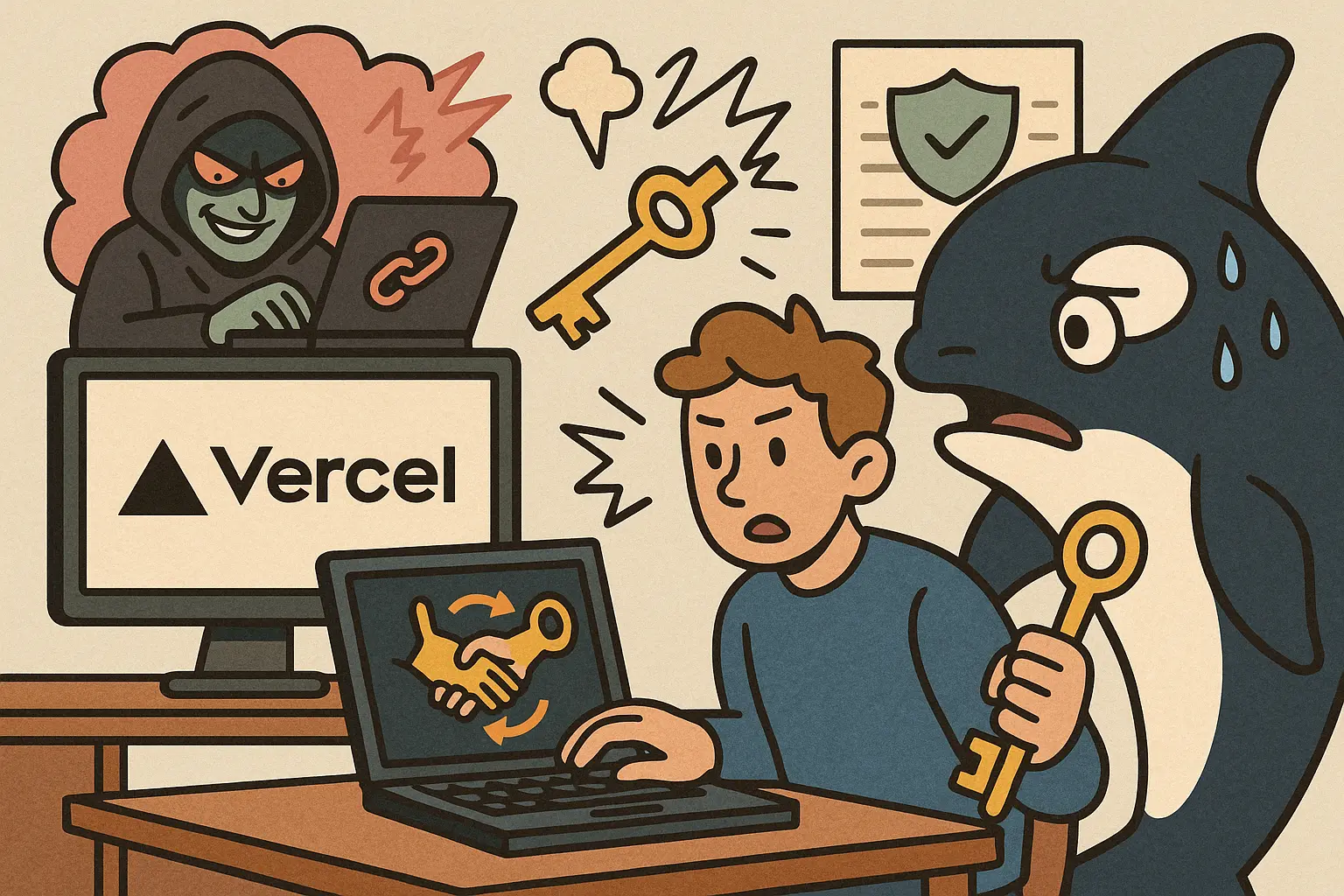
Decentralized exchange Orca announced on April 20 that it has completed a comprehensive rotation of encryption keys and credentials in response to a security incident involving the cloud development platform Vercel, confirming that its on-chain contracts and users’ funds were not affected. Vercel disclosed on Sunday that the attackers accessed parts of the platform’s internal systems through a third-party AI tool that integrates with Google Workspace OAuth.
Attack Path: An AI OAuth Supply Chain Flaw, Not a Direct Attack on Vercel Itself
 (Source: Vercel)
The attack path in this incident was not a direct targeting of Vercel, but instead involved a third-party AI tool that had previously been compromised in an earlier, larger-scale security incident. It used its Google Workspace OAuth integration permissions to access Vercel’s internal systems. Vercel said that the tool previously affected hundreds of users across multiple organizations.
This kind of supply chain vulnerability is difficult for traditional security monitoring to detect because it leverages trusted integration services rather than a direct code vulnerability. Developer Theo Browne noted that the most severely affected was the internal Vercel integration with Linear and GitHub. Information the attacker could potentially access includes: access keys, source code, database records, and deployment credentials (including NPM and GitHub tokens). The incident attribution is currently unclear; there have been reports that the seller demanded a ransom from Vercel, but the details of the negotiations were not disclosed.
Unique Risks for Crypto Frontends: Attacks on the Hosting Layer vs. Traditional DNS Hijacking
This incident highlights a long-overlooked attack surface in crypto frontend security:
Key Differences Between the Two Attack Modes
DNS-Layer Hijacking: Attackers redirect users to a spoofed website, which can typically be detected relatively quickly through monitoring tools
Hosting Layer (Build Pipeline) Compromise: Attackers directly modify the frontend code delivered to users. Users visit the correct domain but may unknowingly run malicious code
In the Vercel environment, if environment variables are not marked as “sensitive,” they may be leaked. For crypto protocols, these variables typically contain critical information such as API keys, private RPC endpoints, and deployment credentials. Once leaked, attackers may tamper with deployed versions, inject malicious code, or access backend services to carry out broader attacks. Vercel has urged customers to immediately review environment variables and enable the platform’s sensitive variable protection features.
Implications for Web3 Security: Supply Chain Dependence Is Becoming a Systemic Risk
This incident affects not only Orca but also reveals a deeper structural problem to the entire Web3 community: the growing dependence of crypto projects on centralized cloud infrastructure and AI integration services is creating a new attack surface that is difficult to defend against. When any trusted third-party service is compromised, attackers can bypass traditional security defenses and directly affect users. Crypto frontend security has moved beyond the scope of DNS protection and smart contract audits; comprehensive security governance for cloud platforms, CI/CD pipelines, and AI integrations is becoming an essential defensive layer that Web3 projects cannot ignore.
Frequently Asked Questions
How did this Vercel security incident affect crypto projects that use Vercel?
Vercel said the number of affected customers was limited and that the platform service was not interrupted. However, because many DeFi frontends, DEX interfaces, and wallet connection pages are hosted on Vercel, project teams are advised to immediately review environment variables, rotate any keys that may have been exposed, and confirm the security status of deployment credentials (including NPM and GitHub tokens).
What specific risks does “environment variable leakage” entail in crypto frontends?
Environment variables typically store sensitive information such as API keys, private RPC endpoints, and deployment credentials. If these values leak, attackers could tamper with frontend deployments, inject malicious code (for example, forged wallet authorization requests), or access backend connection services to carry out broader attacks—while the domain the user visits still appears normal on the surface.
Were Orca users’ funds affected by this Vercel incident?
Orca has explicitly confirmed that its on-chain contracts and users’ funds were not affected. This key rotation was carried out as a precautionary measure out of caution, not based on any confirmed loss of funds. Because Orca uses a non-custodial architecture, even if the frontend is affected, ownership and control of on-chain assets remain with the users themselves.
Disclaimer: The information on this page may come from third parties and does not represent the views or opinions of Gate. The content displayed on this page is for reference only and does not constitute any financial, investment, or legal advice. Gate does not guarantee the accuracy or completeness of the information and shall not be liable for any losses arising from the use of this information. Virtual asset investments carry high risks and are subject to significant price volatility. You may lose all of your invested principal. Please fully understand the relevant risks and make prudent decisions based on your own financial situation and risk tolerance. For details, please refer to
Disclaimer.
Related Articles
Pay attention to the signed content! Vercel is hit with ransomware demanding $2 million, and crypto protocol frontend security raises a red flag
The cloud development platform Vercel was breached by hackers on April 19. The attackers gained access through a third-party AI tool used by employees and threatened to extort $2 million. Although sensitive data was not accessed, other data may have been used. The incident has raised security concerns in the crypto community, and Vercel is currently investigating while advising users to rotate their keys.
ChainNewsAbmedia1h ago
KelpDAO Loses $290M in Lazarus Group LayerZero Attack
KelpDAO faced a $290 million loss due to a sophisticated security breach linked to the Lazarus Group. The attack exploited configuration weaknesses in their verification system and highlighted the risks of relying on a single-point verification setup. Industry experts emphasize the need for improved security configurations and multi-layer verification to prevent future incidents.
CryptoFrontier2h ago
LayerZero responds to Kelp DAO’s 292 million incident: it indicates that Kelp set up a custom 1-of-1 DVN configuration, and the attacker was North Korea’s Lazarus.
LayerZero issued a statement regarding the $292 million hack suffered by Kelp DAO, accusing Kelp’s self-selected 1-of-1 DVN configuration of making the incident possible. The attacker was the North Korean Lazarus Group. LayerZero emphasized that this incident stems from configuration choices and that it will no longer support this kind of vulnerable setup. In addition, responsibility is still disputed, and no compensation plan has been provided.
ChainNewsAbmedia2h ago
DeFi hackers stole $600 million in April; Kelp DAO and Drift accounted for 95% of the monthly losses
In April 2026, within just 20 days, cryptocurrency protocols suffered losses of more than $606 million due to hacker attacks, becoming the worst single-month loss record since the February 2025 exchange incident in which $1.4 billion in data was leaked. The two attacks by KelpDAO and Drift Protocol accounted for 95% of April’s losses, and 75% of the total $771.8 million losses as of now in 2026.
MarketWhisper2h ago
Vercel Breach Linked to AI Tool Context.ai Compromise Raises Risk for Crypto Frontends
Vercel confirmed a security breach caused by a compromised AI tool, leading to the theft of employee and customer data. The incident poses risks to the Web3 ecosystem, and the attacker is attempting to sell the stolen data for $2 million. Vercel is addressing the situation with law enforcement and incident response experts.
GateNews2h ago
Ripple CTO: Kelp DAO Exploit Reflects Bridge Security Trade-Offs
David Schwartz, CTO Emeritus at Ripple, analyzed bridge security vulnerabilities following the $292 million Kelp DAO exploit. He noted that providers prioritized convenience over robust security, undermining essential protective features. The Kelp DAO breach stemmed from a private key leak, exacerbated by a simplified security configuration in their LayerZero implementation.
CryptoFrontier5h ago


