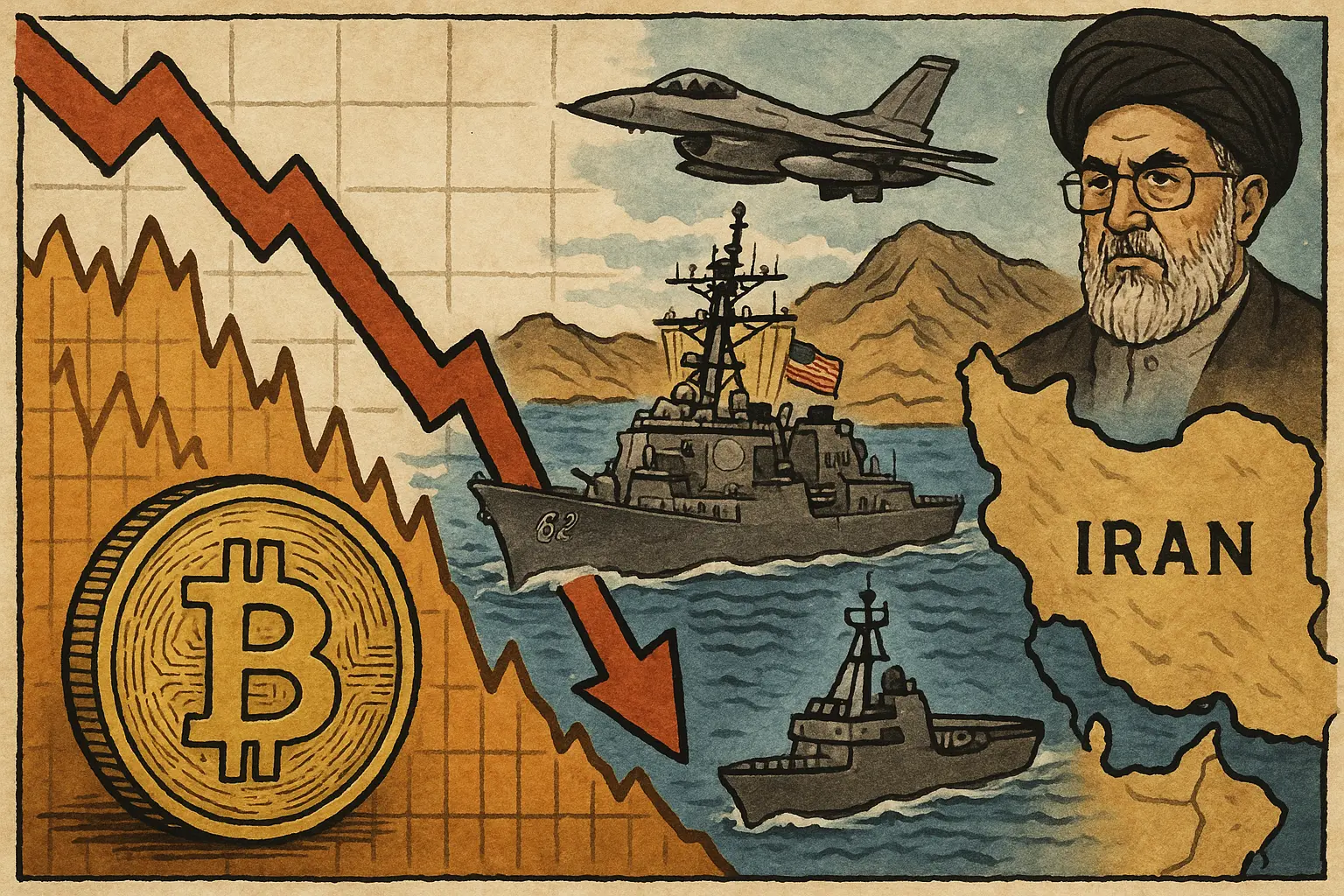
The U.S. Central Command (CENTCOM) began, starting at 10:00 a.m. Eastern Time on April 13, implementing a blockade on all maritime traffic entering and leaving Iranian ports. After more than 20 hours of nuclear talks between the U.S. and Iran ended without result, the situation escalated rapidly. Brent crude oil and WTI crude oil futures surged by more than 8% at the open. U.S. stock index futures slipped by more than 1% at the open. The crypto market faced downward pressure in tandem, and Bitcoin briefly fell below $71,000.
Geopolitical Trigger Point: U.S.-Iran Talks Collapse and Port Blockade Orders
Representatives from both sides of the U.S. and Iran held nuclear issue negotiations in Pakistan, but after more than 20 hours of talks, they still failed to reach any agreement. The delegations left immediately. Trump announced that he would initiate a maritime blockade of Iranian ports, citing Iran’s “refusal to accept the nuclear issue red line,” and said he would not rule out limited military strikes on Iranian infrastructure, with targets including desalination plants and power plants.
CENTCOM clearly stated that the blockade covers all Iranian ports in the Persian Gulf and the Gulf of Oman, and applies to vessels of all nationalities. However, it emphasized that it does not interfere with the freedom of navigation for non-Iranian vessels to pass through the Strait of Hormuz. Iran’s Islamic Revolutionary Guard Corps warned that any foreign warships approaching the Strait of Hormuz would be regarded as violating the ceasefire agreement and would be hit forcefully. Iran’s parliament is also advancing a plan to ban hostile countries’ fleets from passing through the strait.
The United Kingdom ruled out participating in the blockade, but said it is working with France and other partners to form an alliance to protect freedom of navigation. Pakistan urged all parties to strictly honor their ceasefire commitments. Insiders said a second round of U.S.-Iran talks could be held within a few days.
Impact on the Crypto Market: Full Picture of Today’s Bitcoin Decline Data
According to HTX market data, the impact of this geopolitical shockwave on the crypto market is as follows:
Bitcoin (BTC): Falls below $71,000, down 3.1% over the past 24 hours
Ethereum (ETH): Briefly touched $2,200 in the early morning and then retreated; currently at $2,192, down 3.97% over the past 24 hours
Solana (SOL): Currently at $81.5
BNB: Currently at $592
Total crypto market cap: Down 2.8% over the past 24 hours; currently $2.49 trillion
In traditional markets, spot gold and silver opened down by more than 2%. The U.S. dollar index rose by more than 0.4%, indicating that funds rotated from risk assets to energy and currency safe-haven instruments.
Technical Analysis: Can the $70,000 Support Hold?
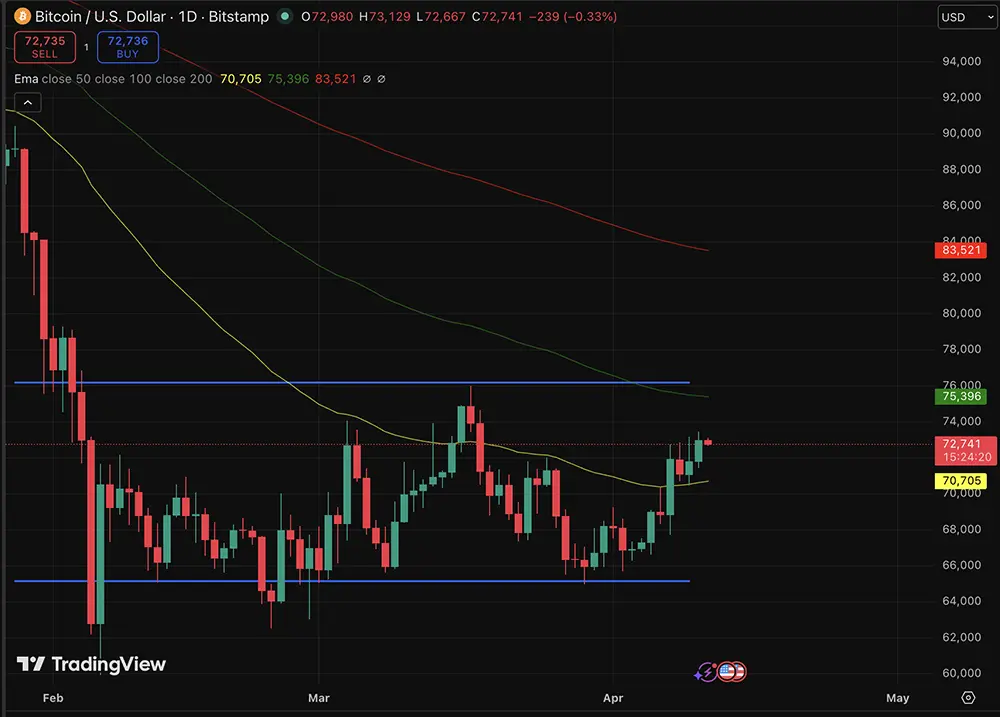 (Source: Trading View)
Although Bitcoin is down today, technical indicators still show several support signals. BTC is still holding above the 50-day moving average. The MACD indicator shows a bullish divergence. RSI is 60, and there is still room to move upward away from the oversold/overbought zone.
Analysts have formed two camps on the outlook. The bullish camp believes that if IBIT inflows effectively push a breakout above $77,500, it will open the door to a move toward $80,000. The cautious camp warns that if the market closes below $70,000, it will reopen the $67,000 support zone, putting the near-term rebound thesis under severe testing. Until the geopolitical situation becomes clearer, range consolidation between $70,000 and $72,000 is the most likely scenario.
FAQ
Why is Bitcoin down today? What is the underlying cause?
On April 13, the U.S. implemented a maritime blockade on Iranian ports, and on the same day the U.S.-Iran nuclear talks broke down. Trump threatened to escalate military action. The geopolitical shock led to a surge of 8% in crude oil, with global risk assets being dumped in a concentrated manner. As a high-risk asset category, the crypto market was hit first, and Bitcoin’s decline over the past 24 hours reached 3.1%.
Will a blockade of the Strait of Hormuz continue to suppress Bitcoin?
CENTCOM has not announced how long the blockade will last, saying it will issue updates depending on developments in the situation. If U.S.-Iran tensions continue to escalate, uncertainty in the energy market will continue to weigh on global risk assets. If progress is made in the second round of talks, risk-hedging sentiment is expected to fade quickly, providing Bitcoin with room for a technical rebound.
Where are Bitcoin’s key technical levels right now?
The short-term key support is at $70,000. If it holds, the market could consolidate in the $70,000 to $72,000 range. If it breaks below $70,000, support below points to $67,000. For resistance, watch $77,500; after a breakout, the next target would be $80,000.
Disclaimer: The information on this page may come from third parties and does not represent the views or opinions of Gate. The content displayed on this page is for reference only and does not constitute any financial, investment, or legal advice. Gate does not guarantee the accuracy or completeness of the information and shall not be liable for any losses arising from the use of this information. Virtual asset investments carry high risks and are subject to significant price volatility. You may lose all of your invested principal. Please fully understand the relevant risks and make prudent decisions based on your own financial situation and risk tolerance. For details, please refer to
Disclaimer.


